




Finding qualified prospects from public signals is not about collecting more company names.
It requires a repeatable sales prospecting workflow: define the prospecting job, translate ICP into signal criteria, qualify prospects, confirm contact paths, shape message angles, and learn from outcomes.
The goal is not to build a larger list. The goal is to help your team know which prospects are worth contacting now, why they matter, who to reach, and what to say next.
Public signals are input. Reasoning is the differentiator. Qualified prospecting motion is the output.
Quick Summary
You do not need a bigger prospect list. You need a clearer way to decide which prospects are worth working now.
This guide shows how to turn ICP ideas, public signals, and signal intelligence into a qualified prospect list, contact paths, message angles, and a repeatable sales motion.
The simple model is:
Fit + Timing + Actionability = Better prospecting decisions.
Who This Guide Is For
This guide is for hands-on B2B GTM teams that already know who they want to sell to, but still struggle to turn market movement into qualified sales action.
It is especially useful for founders, SDR managers, growth teams, RevOps teams, and high-ACV sales teams that need a clearer way to turn public market movement into qualified sales action.
Although we use a B2B SaaS company as the running example, the same workflow can apply to B2B trade, logistics, PLG-led product companies, insurance agencies, legal and tax services, professional services, and other B2B sales motions where timing and context matter.
In this guide, a "qualified prospect" does not mean a product account record. It may refer to a target company, a founder-led team, a specific person, or a contact path involving several roles.
Quick Start
Use this workflow when you are not simply trying to find more contacts, but trying to answer a sharper GTM question:
Which prospects are relevant right now, why do they matter, who should we contact, and what should we say?
Table 01: Quick Start Workflow
| Step | Action | Output |
|---|---|---|
| 1 | Define the prospecting job | GTM task |
| 2 | Translate ICP into public signals | Signal criteria |
| 3 | Build the prospecting brief | Usable prompt |
| 4 | Generate qualified prospects | Prospect list |
| 5 | Prioritize by fit and timing | Work Now / Research More / Nurture / Skip |
| 6 | Create contact paths and message angles | Rep-ready outreach |
| 7 | Review what worked | Sharper signal logic |
| 8 | Repeat with better criteria | Sharper next list |
Throughout this guide, we will use one example: a B2B SaaS company wants to find US mid-market businesses that are expanding outbound sales teams and may need a better way to prioritize prospects, identify contact paths, and create relevant outreach.
01 Start With the Prospecting Job
A common mistake in sales prospecting is starting with the tool instead of the job.
Teams open a database, apply filters, export companies, enrich contacts, and ask reps to work the list.
But the better question comes earlier:
What kind of sales opportunity are we trying to find?
A prospecting job gives workflow direction. It tells your team what kind of market movement, company change, or buying context should matter.
For example:
- Enter a new market: find companies expanding into that region or segment.
- Build outbound pipeline: find prospects showing GTM growth or sales hiring signals.
- Sell to new sales leaders: find companies with recent VP Sales, CRO, or GTM leadership changes.
- Find RevOps pain: find teams adding tools, roles, routing, or reporting complexity.
- Support high-ACV sales: find prospects with stronger timing and clearer contact paths.
This shift matters because a database filter produces names. A prospecting job produces criteria. And criteria are what allow public signals to become useful.
For example, "find SaaS companies" may produce a broad list. But "find US B2B SaaS companies expanding outbound sales teams" gives the workflow a clearer job: identify prospects where sales growth, team expansion, or workflow pressure may create a relevant reason to reach out.
Categories create lists. Business changes create timing. The list is not the finish line. It is the starting point for a sales motion.
02 Translate ICP Into Signal Criteria
Public signals are only useful when you know what they are supposed to prove.
An ICP tells you who might fit. Signal criteria help you decide who may be worth working now.
For example, "US mid-market B2B SaaS companies" tells you the market. It does not tell you which companies are currently showing signs of growth, change, complexity, or timing.
A signal-based prospecting workflow filters public signals through ICP fit, timing, and actionability before turning them into prospecting criteria.
A stronger workflow translates ICP assumptions into observable signals.
Table 02: From ICP Ideas to Signal Criteria
| ICP Assumption | Observable Public Signal | What It Suggests |
|---|---|---|
| The company is growing outbound | SDR, BDR, AE, or sales manager hiring | Pipeline or coverage pressure |
| The GTM team is becoming more complex | RevOps, Sales Ops, or tools movement | Workflow or routing pain |
| The company is entering a new market | Expansion announcements or new regional roles | New GTM motion |
| A new sales leader joined | VP Sales, CRO, or GTM leadership change | Strategy reset or process review |
| The team is under growth pressure | Funding, hiring, or growth announcements | Higher pipeline expectations |
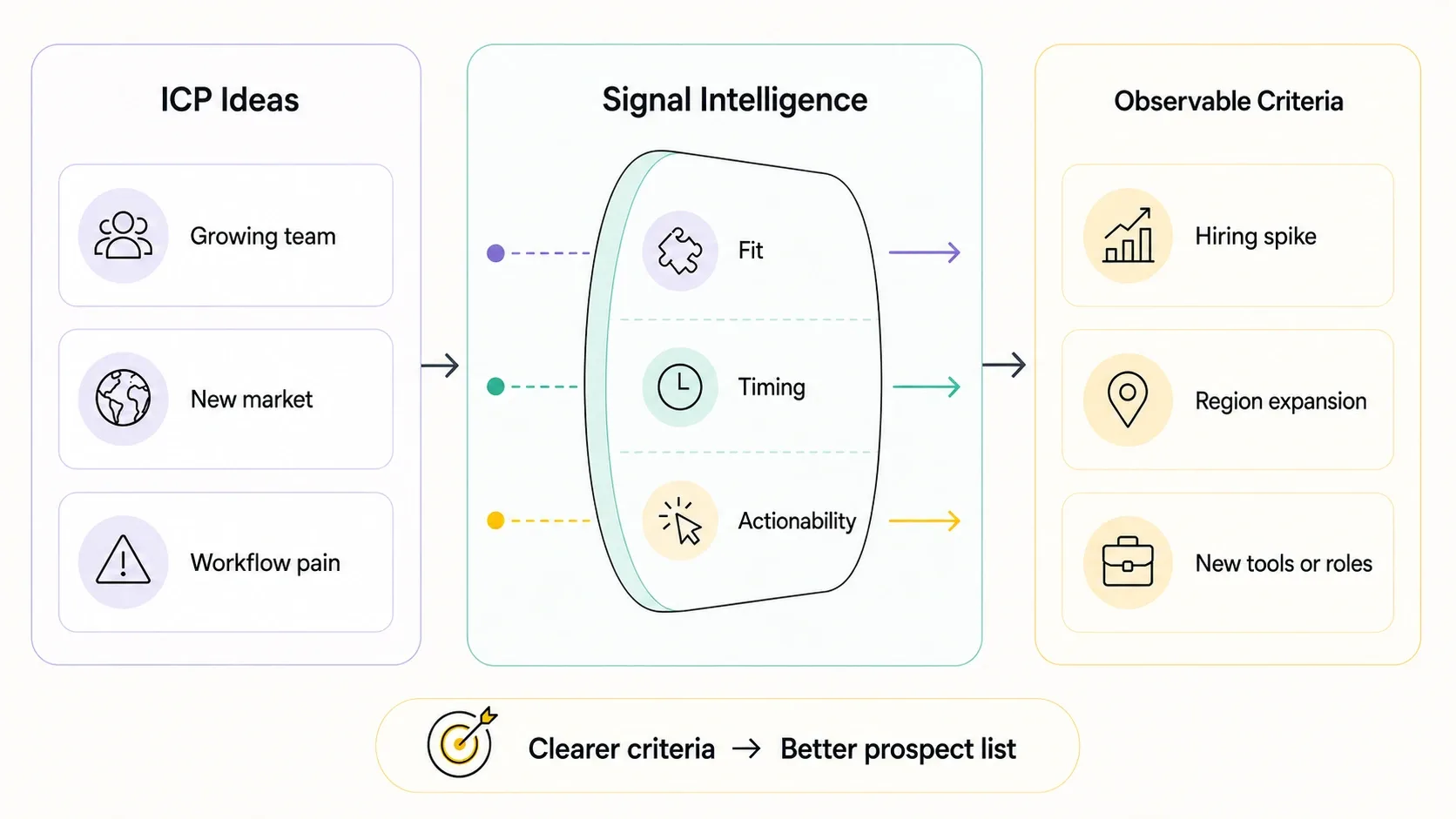
This is also why many teams are moving beyond static interest data and thinking about intent data as real-time signals that can support actual prospecting decisions.
The point is not to treat every public signal as intent.
The point is to ask what the signal helps you infer.
Use four simple questions to keep the signal useful:
- Fit: Does this prospect match the ICP?
- Timing: Is there a current reason to reach out?
- Persona: Who likely owns the problem?
- Motion: What sales action should happen next?
This logic can apply beyond SaaS. A logistics company may look for cross-border expansion. A tax advisory firm may look for entity changes or new-market complexity. A PLG-led company may look for signals that suggest sales-assisted motion. The signal changes by industry, but the reasoning pattern stays the same.
03 Build the Prospecting Brief
Once the prospecting job and signal criteria are clear, turn them into a prospecting brief.
A prospecting brief gives the workflow enough context to reason about fit, timing, persona, and action. It should include market, region, ICP, trigger conditions, relevant personas, exclusions, and the output you want.
A weak prompt might look like this:
Find SaaS companies.
That is too broad.
A stronger prompt looks like this:
Find US B2B SaaS companies with 50-500 employees that are hiring outbound sales roles, expanding GTM teams, or showing signs of pipeline growth. Prioritize prospects with a VP Sales, RevOps, SDR leadership, or Founder contact path. Exclude companies outside the US or companies with fewer than 50 employees.
This prompt is better because it defines the sales task, not just the category.
A simple prospecting brief should define:
- Target market: US B2B SaaS companies.
- Fit criteria: 50-500 employees, outbound-led GTM motion.
- Signals to look for: SDR hiring, GTM expansion, pipeline growth.
- Likely pain: prospect prioritization, outreach workflow, or rep productivity.
- Contact paths: VP Sales, SDR Manager, RevOps, or Founder.
- Desired output: qualified prospects, match reasons, contact paths, and message angles.
- Exclusions: very small companies, irrelevant regions, or non-B2B companies.
A good brief does not describe more targets. It makes the next search easier to judge.
A complete brief could look like this:
Find US B2B SaaS companies with 50-500 employees that appear to be expanding outbound sales. Look for public signals such as SDR hiring, sales leadership changes, new market expansion, or RevOps hiring. Prioritize companies where the likely pain is prospecting workflow, prospect prioritization, or outbound productivity. Return qualified prospects with match reasons, relevant public context, likely contact paths, message angles, and recommended next action.
The prompt is not just a search query. It is the operating brief for the workflow.
A strong brief does not only describe who you want to sell to. It connects ICP assumptions with buying signals that suggest real sales opportunities.
04 Generate a Qualified Prospect List
Once the brief is clear, public data and public signals can be used to generate a qualified prospect list.
This is where the product boundary matters.
The output is not a visual signal dashboard. The output is not a pile of raw alerts. The output should be a list of prospects worth reviewing, prioritizing, and moving into sales action.
Public signals may include hiring activity, funding, leadership changes, market expansion, technology movement, company updates, or other observable public activity.
But public signals are not the final answer. They are qualification inputs.
A qualified list should tell sales more than "here are some companies." It should explain why each prospect matches, what public context supports the timing, which contact path may be relevant, and what the next action should be.
A useful qualified prospect list should include:
- Who the prospect is: the target company, person, or contact path.
- Why it matches: the ICP and signal logic behind the recommendation.
- What public context supports timing: hiring, expansion, leadership change, or market movement.
- Who to contact: the likely owner of the problem.
- What to do next: work now, research more, nurture, or skip.
For example, a SaaS company hiring SDRs may be worth reviewing if the team also shows signs of outbound expansion, sales leadership change, or RevOps complexity.
In some cases, the qualified prospect may be a company. In other cases, especially for smaller teams or service businesses, the useful target may be a person, a founder-led team, or a small group of stakeholders inside one company.
The value of a qualified list is not that it contains more prospects. It is that each prospect comes with a reason to act, a likely contact path, and a possible message angle.
Example: When One Signal Is Not Enough
A company hiring one SDR may not be enough to justify outreach.
But a company hiring three SDRs, adding a RevOps role, and expanding into a new market may be a stronger prospecting opportunity.
Signal strength becomes clearer when you compare isolated signals with connected signals:
- Hiring one SDR: possible growth, but weak context.
- Hiring several SDRs: stronger outbound expansion signal.
- Hiring SDRs plus RevOps: workflow and routing pain may be increasing.
- New VP Sales plus SDR hiring: a GTM leader may be rebuilding process.
- Funding plus sales hiring plus market expansion: stronger timing and GTM pressure.
This is the difference between raw signal detection and prospect qualification.
The signal is not valuable in itself. The value comes from how the signal fits the prospect, timing, persona, and possible sales motion.
This shift also reflects a broader sales trend: prospecting teams are focusing less on activity volume and more on lead quality. HubSpot's 2025 Sales Trends Report found that many sales teams are seeing improvements in lead quality, which makes relevance and timing more important than simply expanding list size.
05 Fit + Timing + Actionability
Prioritization matters because not every public signal points to a real buying window. The stronger question is whether the signal helps your team detect a real buying window, not just whether the company matches your ICP.
Not every relevant prospect should be worked now.
A stronger prospecting workflow asks whether the prospect has enough fit, timing, and actionability to justify sales attention.
Fit + Timing + Actionability = Better prospecting decisions.
A good prospecting workflow separates prospects into clear action tiers.
Use three lenses before sending a prospect to sales:
- Fit: Does the prospect match the ICP?
- Timing: Is there recent public context that makes outreach more relevant?
- Actionability: Can the rep take a clear next step?
This is especially important in B2B, where buying decisions often involve multiple people and a longer decision horizon. Research on B2B account and user scoring also points to the challenge of deciding which people to reach and when during a complex buying process.
Then evaluate the prospect with a simple qualification rubric. This helps your team compare weak and strong signals before deciding what to do next.
Table 03: Qualification Rubric
| Factor | Weak | Strong |
|---|---|---|
| ICP Fit | Broad industry match | Clear match on segment, size, region, and sales motion |
| Signal Strength | One isolated public event | Multiple signals pointing to the same business change |
| Timing | Old or unclear signal | Recent signal tied to a current initiative |
| Persona Clarity | No obvious owner | Clear Founder, VP Sales, RevOps, Operations, Finance, or Growth path |
| Message Potential | Generic "thought this was relevant" | Specific angle tied to public context |
| Next Step | Needs more manual research | Ready for outreach or enrichment |
Once the prospect is reviewed across these factors, place it into a simple action tier:
- Work Now: strong fit, recent signal, clear contact path, and strong message angle. Start outreach.
- Research More: good fit, but timing or persona needs verification. Enrich or review.
- Nurture: relevant prospect, but weak current timing. Save for future signal changes.
- Skip: poor fit or no clear action. Remove from the active workflow.
This prevents reps from working prospects just because they appeared in a list.
The goal is not to make scoring complicated. The goal is to make prioritization explainable.
A rep should be able to look at a prospect and understand why it is in the list, why it matters now, and what to do next.
06 Turn Qualified Prospects Into Sales Motion
A qualified prospect list is only the beginning. Once a prospect is qualified, the next step is not another export list. The next step is a motion that helps your team turn intent signals into sales meetings: choose the right contact path, shape the message angle, and follow up before the timing goes cold.
To create conversations, each qualified prospect has to move into a sales motion.
That does not always mean one company equals one contact. In B2B sales, especially for small teams, founder-led companies, professional services, or high-ACV deals, the useful prospecting object may include several possible contact paths.
That is why contact path matters. In many B2B deals, the visible buyer is only part of the buying group, while finance, IT, procurement, or operations may also influence the decision.
That means three things:
Confirm the contact path -> create the message angle -> launch the follow-up motion.
First, confirm who is most likely to care.
The right contact path depends on the sales context:
- For founder-led companies, start with the founder or owner.
- For larger SaaS teams, consider VP Sales, SDR leadership, RevOps, or demand generation.
- For professional services, look for operators tied to growth, compliance, or client delivery.
- For high-ACV deals, expect multiple stakeholders rather than one obvious buyer.
The right prospect still fails if the message goes to the wrong person.
Next, create the message angle.
Prospect Fit + Public Context + Persona Pain + Timely Reason
Weak message:
Saw your company is growing. I would love to connect.
Stronger message:
Noticed your team is hiring outbound roles while expanding into a new segment. Teams at that stage often need a faster way to turn company research into qualified outreach without adding more manual work for reps.
This gives the rep a reason to reach out, a business context, and a more relevant opening message.
Example: Same Prospect, Different Contact Path
Using the same example, the workflow may identify a SaaS company that is hiring SDRs and expanding into a new customer segment.
Table 04: Same Prospect, Different Contact Path
| Contact Path | Why It Matters | Message Angle |
|---|---|---|
| VP Sales | Owns pipeline and outbound productivity | Scaling outbound without lowering rep quality |
| SDR Manager | Owns daily prospecting execution | Helping reps know which prospects to work first |
| RevOps | Owns workflow quality, scoring, and routing | Turning signals into cleaner prioritization logic |
| Founder | Owns growth efficiency in lean teams | Building more pipeline without adding manual research burden |
Same prospect. Same public signal. Different contact path. Different message angle.
Then build a follow-up motion, not a one-off email.
A simple follow-up motion can start with three touches:
- First touch: connect the public signal to the prospect's current business context.
- Second touch: clarify the likely pain or operational gap.
- Third touch: offer a concrete next step, resource, or use case.
A qualified prospect list should trigger a motion, not sit unused in a spreadsheet.
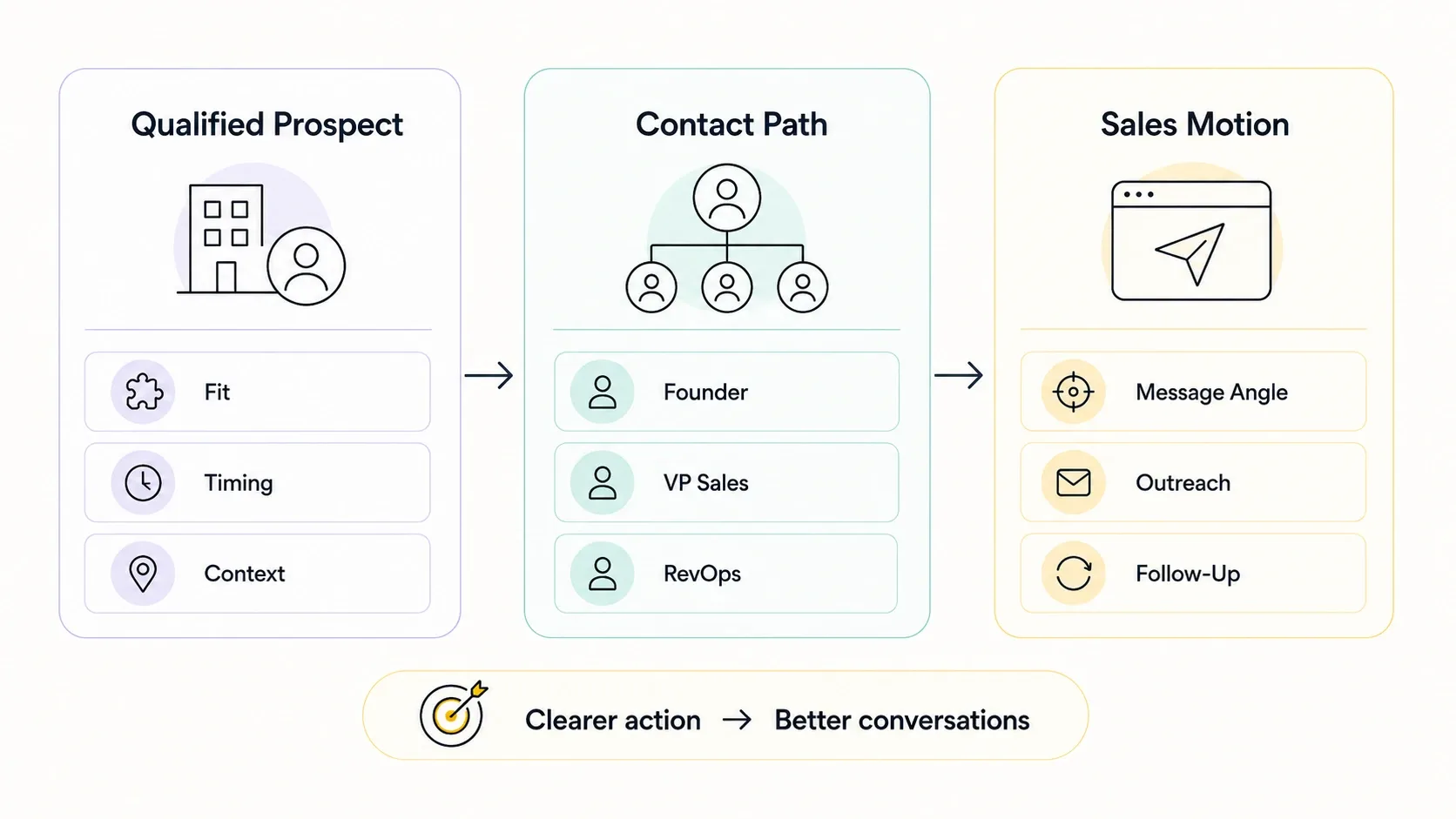
Before you run the next prospecting motion, review what worked. Which prospects replied? Which public signals created useful conversations? Which contact paths worked best? Which message angles felt relevant? You do not need a complex feedback system to start. Even a simple review can help your next prospect list become sharper.
The goal is not to chase every signal. The goal is to make each new prospect list more precise than the last one.
07 Where Lev8 Fits
This is where Lev8 fits. The hard part of modern prospecting is not finding more company names. It is turning a sales idea into a qualified prospecting motion.
Lev8 helps users move from:
I want to find this kind of customer.
to:
Here are the prospects worth reviewing, why they match, who to contact, what angle to use, and what to do next.
This is where AI sales agents can reduce tool-switching across research, enrichment, messaging, and follow-up.
Instead of treating public signals as a dashboard, Lev8 uses them as qualification inputs.
That distinction matters.
Compared with traditional tools, the goal is to move beyond raw company lists, signal alerts, contact enrichment, generic AI emails, manual prioritization, and static exports.
A Lev8-style output should help the team see the qualified prospect list, match reasons, public context, contact path, message angle, explainable prioritization, and follow-up motion.
Lev8 is not just helping teams find more prospects.
It is helping teams make better prospecting decisions from live public context.
A prompt-based workflow should understand more than the search request. It should understand the user's role, sales task, target market, ICP, preferred personas, and expected outcome.
That context changes the output.
Different roles use that context differently.
- For a founder, the value may be speed: getting from target idea to qualified prospects without building a manual research process.
- For an SDR manager, the value may be consistency: helping reps work from a clearer list instead of improvising research.
- For RevOps, the value may be explainability: understanding why prospects are prioritized and which signals are actually useful.
- For a growth lead, the value may be campaign relevance: turning public context into better segments and sharper messaging.
The same workflow can support different B2B roles because each role needs context before taking action.
Lev8 helps turn a broad targeting idea into qualified prospects your team can review, understand, and act on.
What's Next
This guide gives you the general workflow for turning public signals into qualified prospects.
But every B2B sales motion has its own context. A logistics company may look for expansion or supplier-change signals. A PLG-led product team may look for sales-assisted opportunities. A legal, tax, or insurance team may care more about compliance events, entity changes, renewals, or operational risk.
That is why we will continue publishing industry-specific guidebooks and customer use cases to help different teams adapt this workflow faster.
Future guides may cover:
- B2B trade and logistics prospecting
- PLG-led sales-assisted prospecting
- Insurance agency prospecting
- Legal and tax services prospecting
- Professional services prospecting
- High-ACV B2B sales prospecting
The goal is not just to explain the framework. The goal is to help teams get to visible success faster: a clearer target list, better contact paths, more relevant message angles, and a prospecting motion they can repeat.
Build Qualified Prospect Lists From Live Public Signals
Public signals are only useful when your team can turn them into action.
Lev8 helps GTM teams move from target criteria to qualified prospect lists, contact paths, outreach angles, and follow-up motion without stitching together separate tools for research, enrichment, and messaging.
Start for Free and get 300 credits per monthly cycle to see how Lev8 helps turn public signals into qualified sales action.