



Buying signals can reveal market movement, company interest, and potential demand.
But not every signal deserves action.
A company raises funding. A RevOps role opens. A procurement notice appears. A partnership is announced. A buyer persona keeps posting about the same operational pain point.
Each signal may be real.
But real does not mean relevant.
Recent does not mean urgent.
Activity does not mean intent.
That is the problem with buying signals today: GTM teams do not lack signals. They lack a clear way to decide what each signal is worth.
Before acting on a buying signal, teams need a clearer way to judge what each signal deserves.

Preface: What This Article Will Help You Decide
This article helps GTM teams answer one practical question:
When a buying signal appears, what should we do next?
The answer is not always outreach. Sometimes the right move is to ignore, validate, route, activate, or monitor the signal.
This article gives GTM teams a practical way to decide which path a signal deserves.
Key Takeaways
- Buying signals are observable behaviors, public events, or business changes that may indicate company interest, market movement, or potential demand.
- A buying signal is a clue, not a conclusion.
- Signal noise happens when teams treat raw activity as proof of sales readiness.
- GTM teams should triage signals before acting on them.
- The simplest triage process is: filter the signal, interpret the context, decide the next move.
01 What Are Buying Signals in B2B Sales?
Buying signals are observable behaviors, public events, or business changes that suggest a company, market, or buying group may be moving toward a relevant business need, evaluation process, or GTM-relevant change.
They can come from many sources:
- Website behavior
- Product research
- Content engagement
- Job postings
- Funding announcements
- Executive changes
- Procurement requests
- Partnership news
- Competitor research
- Social activity
- Technology adoption
- Market expansion
- Intent data
Common examples of B2B buying signals include pricing page visits, demo requests, review-site activity, category research, RevOps hiring, new executive appointments, CRM migration research, competitor comparison activity, tender postings, and partnership announcements.
But the important point is simple:
Buying signals are clues, not conclusions.
A pricing page visit may suggest evaluation, but it does not prove budget.
A funding announcement may suggest growth pressure, but it does not prove your category will receive investment.
A new CRO may suggest GTM change, but it does not prove the company is ready to replace tools.
The same is true for public signals.
A partnership announcement may signal ecosystem expansion, or it may just be brand PR. A procurement notice may signal active demand, or it may be a poor fit for your region, eligibility, product category, or sales motion. A social post may signal interest, or it may be casual commentary from someone outside the buying group.
Buying signals are useful because they show movement.
They become valuable only when they help a GTM team decide what to do next.
02 Why Buying Signals Become Signal Noise
Many GTM teams make the same mistake:
They treat signal detection as signal understanding.
They see a funding announcement and assume budget.
They see hiring and assume growth.
They see competitor research and assume vendor evaluation.
They see a procurement notice and assume an immediate opportunity.
They see social activity and assume buyer intent.
Sometimes those assumptions are right.
Often, they are not.
This is not just a theoretical problem. Public G2 feedback on sales intelligence tools points to the same operational friction: users mention inconsistent signal interpretation, occasional false positives, outdated contact information, and the need for manual validation. The category may be useful, but teams still need a way to check whether a specific signal is reliable enough to use.
| Buying Signal | Common Assumption | Why It May Become Noise |
|---|---|---|
| Funding announcement | The company has budget | Capital may go to product, hiring, expansion, or operations |
| SDR or AE hiring | The company is scaling outbound | It may be replacement hiring or early experimentation |
| New CRO or VP Sales | The company is ready to change tools | The leader may first focus on team structure or strategy |
| Competitor comparison | The company is ready to switch | It may be casual research or low-level market scanning |
| Procurement notice | The company has an active buying need | The requirement may not match your offer, eligibility, region, or timeline |
| Social activity | A buyer is showing interest | The activity may be casual, non-commercial, or unrelated to a buying process |
This does not mean buying signals are useless.
It means they need triage.
A signal becomes noise when it creates activity without improving a decision. The signal may be real, but the interpretation may be weak, outdated, irrelevant, or unsupported.
This is also why intent data often fails to book meetings when teams treat raw activity as sales readiness without enough context.
A useful signal should help answer at least one GTM question:
- Is this company relevant to our market?
- Is this signal fresh enough to matter?
- Does the signal point to a specific business need?
- Is there enough evidence to trust the interpretation?
- Which team should use this signal?
- What decision should this signal improve?
If a signal cannot improve a decision, it may be interesting.
But it is not useful yet.
Signal noise is not just too many signals. It is too many signals without enough interpretation.
03 The Signal Triage Framework for GTM Teams
When a buying signal appears, do not act on it immediately.
Triage it first.
That frustration also shows up in sales and B2B marketing communities. Practitioners discuss whether intent signals are useful or just noisy, whether third-party intent is too broad or delayed, and whether signals need stronger recency, relevance, and alignment before teams act on them. Community discussions are not statistical proof, but they reveal a practical GTM anxiety: teams do not just want more signals; they want to know which signals deserve action.
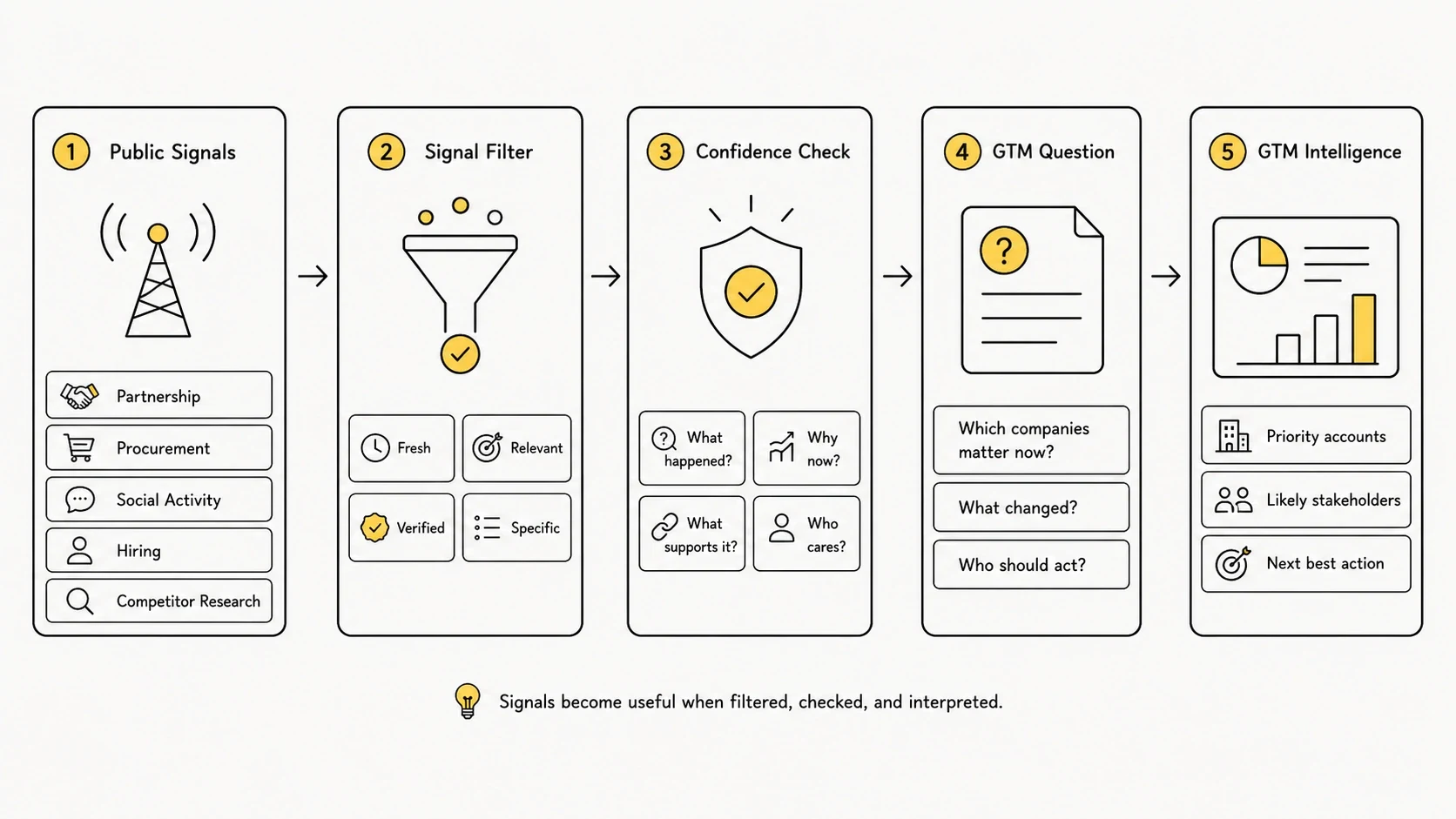
Filter
Is this signal fresh, relevant, verifiable, and specific?
Should we pay attention?
Interpret
What does this signal mean, and what supports it?
Can we trust the interpretation?
Decide
What should happen next?
Ignore, validate, route, activate, or monitor
This is the core job of GTM intelligence.
Not to create more alerts.
But to help teams understand what each signal is worth.
Step 1: Filter
Ask whether the signal is:
- Fresh
- Did it happen recently enough to matter?
- Relevant
- Does it connect to your ICP, category, market, or GTM question?
- Verifiable
- Can it be traced to a concrete public source?
- Specific
- Does it point to a clear need, function, workflow, or change?
- Useful
- Would it change any GTM decision?
If the answer is mostly no, the signal is noise.
Step 2: Interpret
If the signal passes the first filter, ask:
- What happened?
- You need observable evidence, not vague assumptions
- Why does it matter?
- The signal must connect to your GTM question
- What else supports it?
- Supporting signals reduce false positives
- Who would care?
- A signal is more useful when it points to a likely team or stakeholder
- What should change?
- If nothing changes, the signal is not actionable yet
One signal can mislead.
Funding alone may not mean anything for your category. Funding plus RevOps hiring, sales tooling research, and leadership change is more meaningful because the signals point in the same direction.
Step 3: Decide
Once the signal is filtered and interpreted, choose the next path.
Ignore
The signal is weak, stale, irrelevant, or unsupported
Treat it as noise
Validate
The signal may matter, but the interpretation is uncertain
Look for more evidence
Route
The signal points to a likely team, function, or use case
Send context to the right GTM owner
Activate
The signal is specific, supported, and decision-useful
Start a campaign, sales exploration, investigation, or guided workflow
Monitor
The signal is promising but incomplete
Watch for confirming or weakening evidence
The next step is not always sales outreach.
That is the point.
Good GTM teams do not chase every buying signal. They decide what each signal deserves.
04 How to Triage Common Buying Signals
The same signal can lead to different next steps depending on strength, context, and decision use.
| Signal | First Check | Weak Signal | Stronger Signal | Next Move |
|---|---|---|---|---|
| Partnership announcement | Is the partner relevant to your market, region, or ICP? | PR-only announcement | Relevant partner, region, and customer segment | Explore similar companies or partner-led segments |
| Procurement notice | Is it active, specific, and eligible? | Deadline passed or poor fit | Clear requirement, deadline, region, and eligibility | Route to Sales, Partnerships, or Market Intelligence |
| Repeated social activity | Is it repeated and persona-relevant? | One-off casual engagement | Multiple relevant personas discuss the same pain point | Use for audience research or campaign messaging |
| Hiring signal | Does the role mention GTM systems or workflows? | Generic hiring | RevOps, CRM, reporting, routing, or GTM systems mentioned | Validate with funding, tooling research, or leadership changes |
| Competitor comparison | Is it recent and category-specific? | Light research | Repeated comparison around relevant vendors | Route to Sales Enablement or Competitive Intelligence |
This is how signal triage changes the workflow.
A partnership announcement may be market noise, or it may reveal a new segment worth exploring.
A procurement notice may be irrelevant, or it may reveal an active buying requirement.
Repeated social activity may be casual engagement, or it may reveal an emerging audience pain point.
A hiring signal may be generic growth, or it may point to revenue operations change.
A competitor comparison signal may be light research, or it may indicate active category evaluation.
The signal is only the starting point.
The decision path comes from interpretation.
05 From Signal Triage to GTM Intelligence
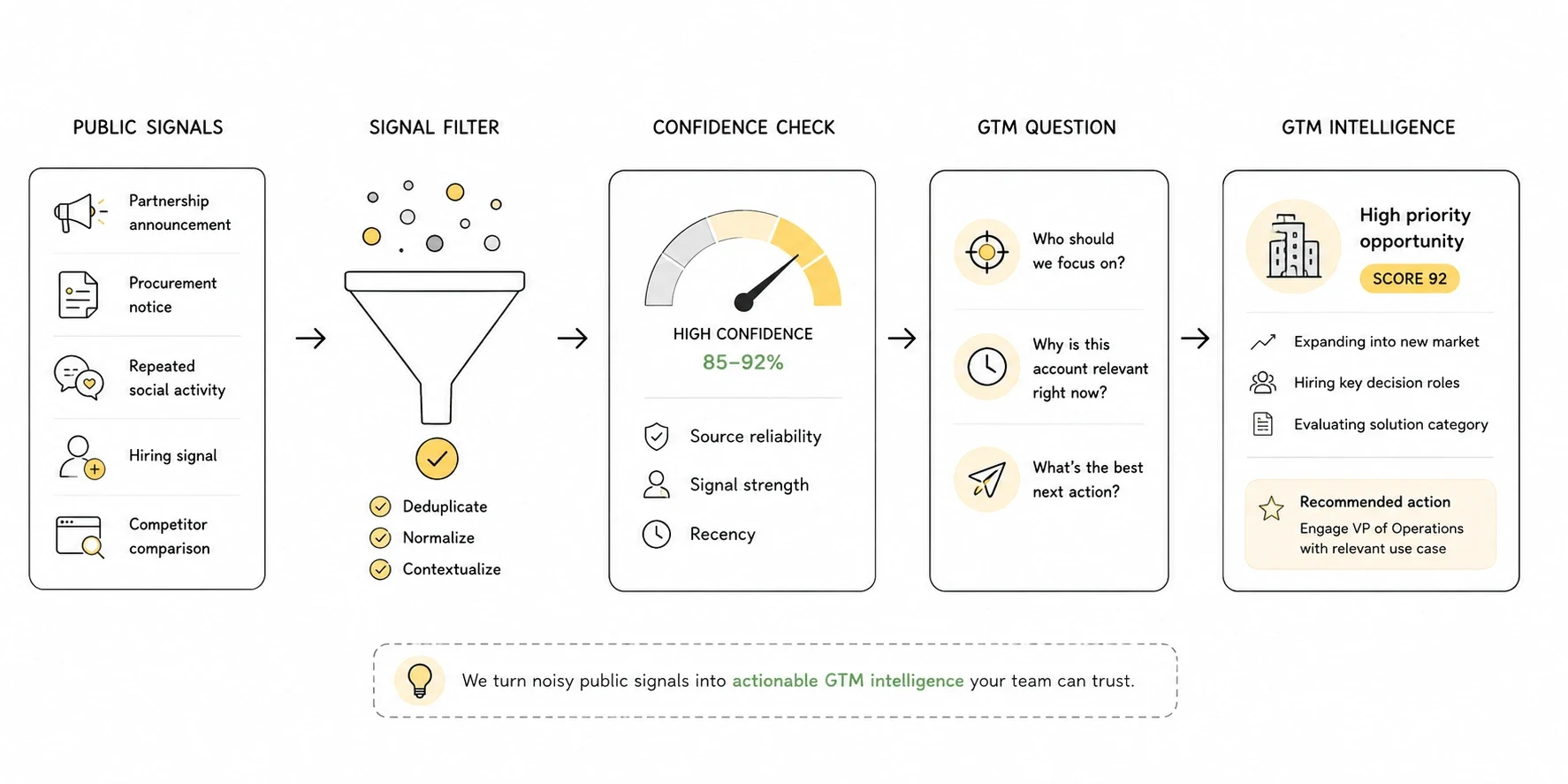
Signal triage helps teams avoid two common mistakes.
The first mistake is acting too fast.
A signal appears, and the team immediately pushes it into outreach, scoring, or account prioritization without enough context.
The second mistake is ignoring too much.
A useful signal appears, but no one knows who should own it, what it means, or what should happen next.
GTM intelligence sits between those two extremes.
This matters because signal data rarely lives in one clean system. Common Room describes a common GTM data problem: CRM, enrichment vendors, product databases, and intent data tools often hold different snapshots of the buyer. When these systems do not connect, isolated signals can look more certain than they really are.
It helps teams turn raw public signals into decision-ready context.
| Raw Signal | Triage Question | GTM Intelligence Output |
|---|---|---|
| A company announces a new partnership | Does this reveal market expansion or a relevant ecosystem move? | Segment or partner-led opportunity to explore |
| A procurement notice appears | Is the requirement active, specific, and eligible? | Sales, Partnerships, or Market Intelligence routing |
| Several buyer personas discuss the same pain point | Is the topic repeated, specific, and persona-relevant? | Campaign angle, audience insight, or messaging theme |
| A company opens RevOps and CRM-related roles | Does this point to GTM systems change? | Sales or RevOps context for further exploration |
| A company compares vendors in your category | Is the behavior recent and supported by other signals? | Competitive Intelligence or Sales Enablement context |
This is also where AI-native GTM workflows become useful.
Instead of forcing teams to move between fragmented tools, AI-native systems can help interpret signals, guide exploration, and support the next decision. See how AI sales agents are replacing the 5-tool GTM stack.
For Lev8, this means starting with a GTM question, exploring real-time public signals, and helping teams move toward clearer GTM intelligence.
Not just more data.
A clearer next move.
Turn Signal Noise Into GTM Intelligence
Revenue teams do not need more disconnected alerts.
They need a faster way to understand which public signals matter, what those signals mean, and what decision should come next.
Lev8 helps teams start with a GTM question, explore real-time public signals, and move through guided steps toward clearer GTM intelligence.
Ready to turn buying signals into GTM intelligence? Explore Lev8.