



TL;DR: Intent data usually fails because teams treat weak account-level research signals as sales-ready triggers. The fix starts with intent data accuracy, but it cannot end there. Teams also need signal thresholds, contact mapping, enrichment, and routing rules that turn noisy account alerts into verified sales actions.
You bought intent data because the promise was simple: less guessing, better timing, and more meetings from accounts already researching your category.
Then the dashboard lit up.
A few accounts were "surging." Another company was researching your solution area. A batch of buying signals looked warmer than a cold outbound list.
So sales followed up. Prospects were confused. Some were the wrong people. Some accounts had only consumed content. Some were already deep into a competitor process. Most never replied.
The dashboard said intent. The calendar said nothing.
That does not mean B2B intent data is useless. The failure is usually narrower: the signal is too broad, too stale, too account-level, or never converted into a sales action a rep can actually use.
| Failure Pattern | What It Looks Like | Likely Root Cause |
|---|---|---|
| SDRs send 80 emails and get silence | "Intent data is inaccurate" | No contact-level mapping |
| Accounts show intent but book no meetings | "The account is interested" | Research activity was mistaken for a sales trigger |
| Prospects sound confused | "The messaging is weak" | Outreach was not tied to credible evidence |
| Sales ignores alerts | "Reps do not trust data" | Too many low-confidence signals |
| Marketing cannot prove ROI | "The tool did not work" | No closed-loop measurement from signal to pipeline |
Why B2B Intent Data Fails Before It Reaches Sales
Many teams think they bought intent data. What they really bought was a set of signals that still need interpretation.
Big difference.
An account researching a topic only tells you something may be worth investigating. It does not answer the questions sales cares about:
- Who researched it?
- Why now?
- Is that person involved in the buying process?
- Does the company match your ICP?
- Is the signal fresh, or already too late?
- What should the rep say?
Without those answers, intent data becomes a more expensive cold list.
I like to split intent signals into three levels: clue, research input, and sales trigger. Most failed programs collapse those levels into one. A weak clue gets treated like a high-confidence trigger.
That is where the $20k starts to disappear.
The team did not need another dashboard. It needed context that made the next sales action more accurate. A sales-ready signal needs at least four things: account fit, signal strength, likely buyer, and recommended action.
Miss one, and the rep is still guessing.
Intent Data Accuracy Is Not the Same as Sales Readiness
A record can be accurate and still fail sales.
That is the trap.
Intent data accuracy and sales readiness are different problems. When teams mix them together, they fix the database and wonder why meetings still do not show up.
Data accuracy asks whether the record is correct
Accuracy checks whether the data itself is right.
For example:
- Is the domain mapped to the right company?
- Is the contact still employed there?
- Is the email valid?
- Is the company size, industry, or region correct?
- Was the signal matched to the right account?
- Did the company actually show relevant research behavior?
These checks matter. A bad domain, stale title, invalid email, or mismatched account can break the workflow before a rep writes a single sentence.
But accuracy only tells you whether the data is correct. It does not tell you whether sales should act now.
Data noise asks whether the signal deserves action
Noise is a different question.
A signal can be real and still be noise. Picture a 5,000-person company where one analyst reads a report about CRM. The account may show intent, but sales still does not know who read it, what team they sit on, whether they own budget, or whether a project exists.
Accurate, but not actionable.
Real, but too weak.
| Dimension | Data Accuracy | Data Noise |
|---|---|---|
| Core question | Is the data correct? | Is the signal worth acting on? |
| Common failure | Wrong company, stale contact, invalid email | Broad topic, weak timing, no context |
| Impact area | CRM, enrichment, database quality | Sales priority, routing, messaging |
| Fix | Verification, cleansing, enrichment | Signal scoring, ICP filter, freshness threshold |
| Sales impact | Avoid contacting the wrong person | Avoid contacting the right person at the wrong time |
Intent data accuracy is the floor. It is not the finish line. Meetings depend on what happens after the data is accurate: whether the team can judge if the signal has crossed a sales-ready threshold.
Why Account-Level Intent Does Not Book Meetings
Account-level intent creates confidence faster than it creates action.
"Acme is researching data enrichment" sounds useful. Then the rep opens CRM and sees 5,000 employees, 312 contacts, 11 possible departments, and titles scattered across RevOps, Sales, Marketing, IT, Procurement, and Finance.
Who gets the email?
Sales books meetings with people, not accounts.
An account can be in-market while the sales team still has no idea who owns the problem. The rep needs a likely problem owner, budget owner, evaluator, champion, or blocker. Without that, account-level intent only says, "Something might be happening over here."
That is a clue. Not a lead.
Before: weak account-level alert
- Account: Acme Corp
- Signal: researching sales intelligence
- Action: SDR emails five random Sales and Marketing contacts
- Result: generic message, low relevance, no reply
After: contact-level sales action
- Account: Acme Corp
- Signal: repeated research around data accuracy and enrichment
- ICP fit: mid-market SaaS, outbound-heavy team
- Likely buyer: RevOps lead and SDR manager
- Contact data: verified email and current title
- Outreach angle: reducing false-positive intent alerts before routing them to SDRs
- Action: personalized message tied to a workflow pain
That is where FIND fits naturally. The job is not to find more people. It is to find the people most likely connected to the buying problem.
Qualified company and people search moves a vague account signal closer to buying committee logic. Without that layer, intent data can help prioritize accounts, but it rarely improves meeting quality on its own. If your team needs a clearer handoff from account signal to buyer map, this guide on decision-maker research is the cleaner upstream step.
The Three Ways Intent Data Turns Into Expensive Noise
Intent data usually turns into expensive noise for three reasons.
Not one magic reason. Three boring ones.
The signal is too vague
Topic-level intent can be painfully broad.
"Researching sales intelligence" might mean a student is writing a paper, a junior employee is reading best practices, a competitor is checking the market, or a buying committee is actually forming.
All of those behaviors can be real. Only some deserve SDR action.
Stronger signals tend to be more specific:
- Repeated visits to competitor comparison content
- Pricing or demo page activity
- Downloads tied to a current operational pain
- Hiring for SDR operations or RevOps roles
- A new VP Sales researching pipeline tooling
- Visits to data accuracy content followed by enrichment workflow pages
Weak signals belong in nurture. Strong signals earn research.
The signal is too stale
Intent is partly a timing product.
If the signal arrives late, sales may be chasing an opportunity that already moved. The account can still show intent after a vendor is chosen, a budget cycle closes, or the buying committee goes quiet.
A 30-day-old account surge and a repeated high-fit signal from the last 48 hours should not trigger the same action.
Freshness changes the route.
The signal goes to the wrong channel
The same signal should not trigger the same motion every time.
Low-confidence signals can feed ads, retargeting, or nurture. Medium-confidence signals can enter a research queue. High-confidence signals, with ICP fit and verified contacts, can move to SDR action.
When every alert goes straight to sales, reps lose trust fast. They are not rejecting data. They are rejecting alerts with no next step.
| Signal Type | Confidence | Best Action |
|---|---|---|
| Broad topic research | Low | Ads or nurture |
| Account-level surge | Low-medium | Research queue |
| Repeated keyword-level activity | Medium | Enrich and map contacts |
| First-party pricing/page visit | Medium-high | SDR research plus tailored outreach |
| Multiple signals plus ICP fit plus verified buyer | High | Sales handoff |
| Competitor comparison plus known stakeholder | Very high | Immediate personalized outreach |
Not Every Intent Signal Deserves a Sales Call
Routing every intent signal to sales is the fastest way to turn useful data into noise.
The better move is to define thresholds before the alerts arrive. We are not only asking whether intent exists. We are asking what the intent should trigger.
A simple routing model works well:
- Low confidence: ads, newsletter, retargeting, or nurture.
- Medium confidence: research queue with company, role, and recent event checks.
- High confidence: contact mapping, email verification, and personalized outreach.
- Very high confidence: immediate SDR or AE follow-up.
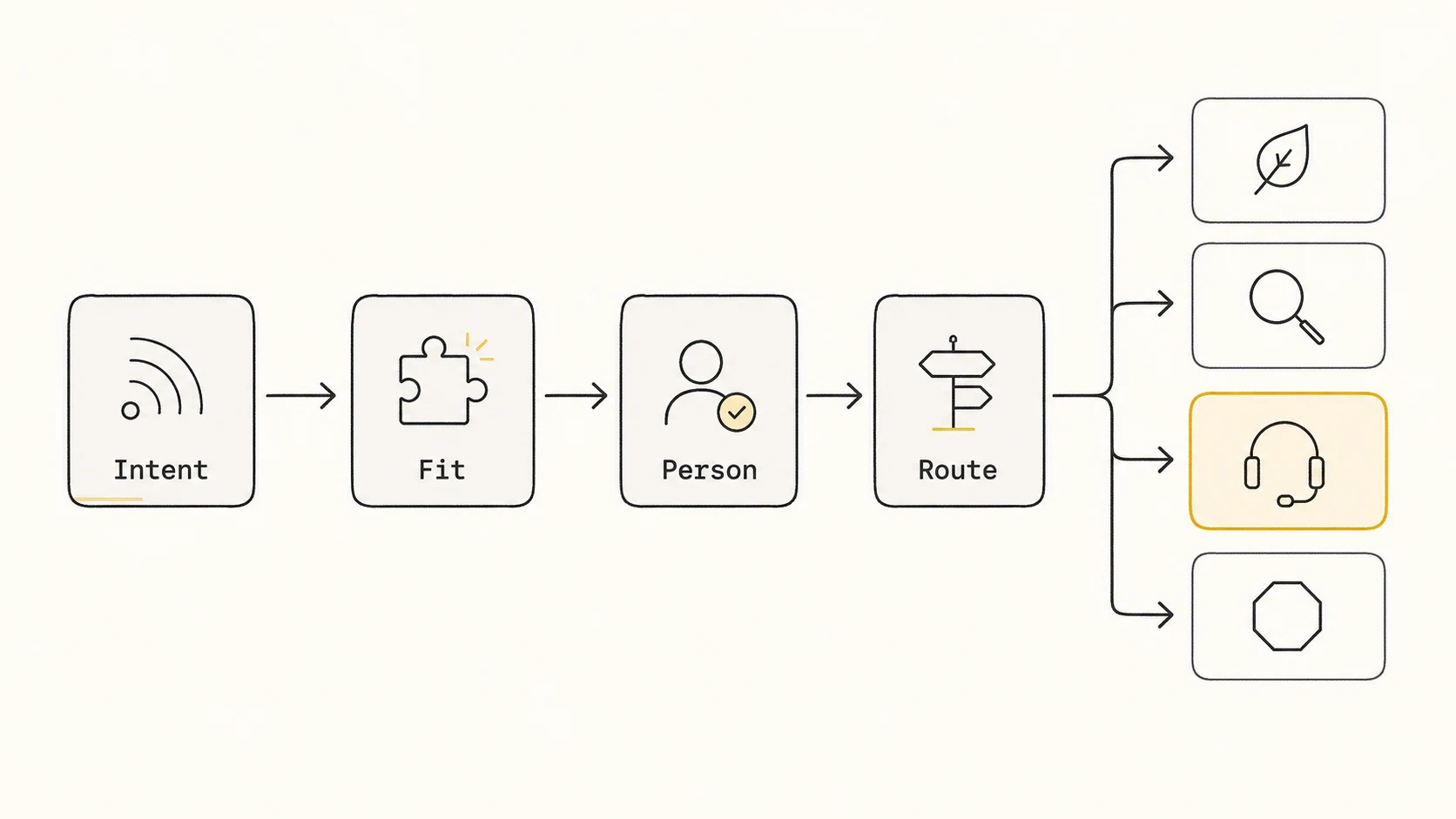
INTENT is most useful when always-on signals are paired with freshness, type, and strength. More alerts alone do not help. Better routing does.
A healthy intent workflow also needs stop conditions.
If the account does not fit the ICP, suppress it.
If the contact cannot be verified, enrich first.
If the signal is weak, nurture it.
If the signal is strong but the buyer is unknown, send it to research.
Without stop conditions, automation only creates CRM noise faster.
The Better Workflow: Stack Signals Before You Send Outreach
More intent volume does not fix noisy intent.
The better workflow is signal stacking. A single signal should rarely decide a sales action. Multiple pieces of evidence should build confidence until the next action becomes obvious.
Start with ICP fit
The first question is not who is surging. It is whether the account is worth sales time.
If the company is outside your target industry, size, region, or use case, even a strong signal may be a distraction. ICP fit is the first filter.
A poor-fit account with strong activity can still enter a marketing audience or future research list. It should not pollute the sales queue.
Verify account and contact data
Next, verify the account and the person.
BUILD fits here because waterfall data enrichment is not about stacking vendors for fun. It is about filling and verifying missing fields only when the workflow needs them.
For intent workflows, enrichment should answer:
- Is this person still at the company?
- Does the title connect to the pain?
- Is the email reachable?
- Is there a phone number or LinkedIn profile as backup?
- Is there a more relevant buying committee member?
Bad contact data kills the motion quietly. The account looks right, the signal looks interesting, and the rep still sends the message to the wrong person.
Add first-party or observable behavior
Third-party intent gives direction. First-party and observable signals usually add confidence.
Examples:
- Pricing page visits
- Comparison guide downloads
- Hiring for RevOps or SDR Ops
- New CRO or VP Sales appointment
- Expansion of an outbound team
- Tech stack change
- Website messaging shifting toward a new market
Paired with account-level intent, these signals help answer the real sales question: why now?
Route based on confidence
A practical workflow can look like this:
- INTENT detects relevant account activity.
- The system checks ICP fit; poor-fit accounts get suppressed or nurtured.
- FIND identifies likely buying committee roles instead of random contacts.
- BUILD verifies contact data and fills missing fields.
- The workflow scores signal strength, freshness, and contact confidence.
- Sales receives a person, reason, evidence, and next action.
- CRM outcomes feed back into the thresholds: reply, meeting, pipeline, closed-won.
That is where intent data starts to affect sales motion. It does not replace judgment. It reduces guessing around the wrong account, wrong person, and wrong time.
What To Check Before Renewing Your Intent Data Contract
If you spent $20k and got no meetings, do not start by switching vendors.
Audit 90 days first.
Check:
- How many intent alerts were created in the last 90 days?
- How many flagged accounts matched your ICP?
- How many alerts included a clear keyword, content source, event, or behavior?
- How long did signals take to reach CRM?
- Did sales receive accounts or verified contacts?
- What was the reply rate by signal type?
- Which signals produced meetings?
- Which signals created only research work?
- Which signals were repeated false positives?
- Do SDRs trust the alerts?
- Do marketing and sales use the same threshold?
- Can CRM trace alert -> outreach -> reply -> meeting -> pipeline?
- Would those meetings have happened without the intent provider?
The audit is not about proving the tool failed. It is about finding the failure point.
If most alerts miss ICP, you have a targeting problem. If accounts are right but contacts are wrong, you have a FIND and enrichment problem. If contacts are right but the message has no evidence, activation is broken. If signals influence pipeline but nobody can attribute it, measurement is the issue.
A new provider may help. But replacing the vendor before diagnosing the workflow often just moves the same problem into a new dashboard.
What To Do If You Already Spent $20k And Got No Meetings
First, stop sending every intent alert straight to SDRs.
Small move. Big effect.
Once sales loses trust in alerts, rebuilding that trust takes time. Start by separating weak signals from real sales triggers.
Use this sequence:
- Export the last 90 days of alerts.
- Label each alert by ICP fit, signal type, freshness, contact availability, and outcome.
- Separate marketing cues from sales triggers.
- Set a minimum sales threshold: ICP fit, fresh signal, relevant role, verified contact.
- Create a research queue for medium-confidence signals.
- Enrich contacts, titles, emails, phone numbers, and recent context.
- Rewrite outreach around evidence, not creepy surveillance.
- Track replies, meetings, and pipeline by signal combination.
- Kill signal types that only produce false positives.
- Review the threshold monthly until sales trusts the queue again.
The message matters too.
Avoid this:
We saw you were researching sales intelligence.
Try something closer to this:
Noticed your team is hiring for SDR operations while expanding outbound coverage. Teams at that stage often run into data accuracy and routing issues before sequence volume becomes the real bottleneck.
The second message has context, timing, and a reasonable business hypothesis. It feels less like surveillance and more like a relevant conversation.
The Real Goal Is Less Guesswork, Not More Intent Data
Intent data is valuable when it reduces uncertainty.
It can show where demand may be forming, which accounts deserve research, and when a team might be entering a buying window. But if the signal cannot help sales decide who to contact, why now, and what to say, it is not sales-ready yet.
The point is not "never buy intent data." The sharper rule is this: do not treat an account-level clue like a sales-ready trigger.
The fix starts with intent data accuracy, but it cannot end there.
A healthy workflow helps sales guess less about three things:
- Is this account worth action?
- Which person likely owns the problem?
- What message fits the timing and evidence?
If your current intent workflow gives sales only "surging accounts," Lev8 can help connect INTENT, FIND, and BUILD into a cleaner path: always-on signals, qualified company and people search, and waterfall enrichment before outreach.
Do not give sales more alerts. Give them fewer, better sales actions.