



Apollo and Lev8 can both turn natural-language instructions into prospecting work.
That makes the comparison less obvious than "database versus AI agent." Apollo is no longer simply a contact database connected to filters and sequences. Its AI Assistant can find and qualify prospects, conduct web-powered research, prioritize accounts, enrich records, build lists, generate messages, create sequences and workflows, and analyze outbound performance.
Lev8 can also begin with a business outcome, investigate people and companies across mainstream and specialized data sources, structure the findings, and turn the result into a practical GTM output. Its research is not limited to news, social activity, or ordinary company pages. Depending on the task, agents can look for less obvious commercial evidence such as patent activity, technology-stack changes, hiring patterns, and other long-tail signals.
The meaningful difference is not whether either platform has AI. It is the type of work each product is organized to complete.
Apollo is strongest when AI needs to execute and optimize a defined outbound motion inside an established sales system. Lev8 is designed for open-ended people and business intelligence tasks, especially when a team still needs to determine what to investigate and how to structure the result. Lev8 can then enrich and verify contact data, prepare or execute multichannel outreach, and continue monitoring the task in the same workspace.
Quick Answer
Choose Apollo when your team wants contact data, prospecting, enrichment, sequences, workflows, deliverability, and performance analysis in one sales platform. It is a strong fit when the destination is already clear: build a qualified list and move it into outbound execution.
Choose Lev8 when the work begins with a less structured GTM question or depends on evidence that standard sales records may not surface. It is better suited to researching across specialized sources, combining long-tail signals, refining the research direction, verifying email and phone data, and carrying the resulting intelligence into outreach.
The two platforms overlap, but the decision becomes clearer when the team identifies what the workflow should be organized around: execution inside Apollo's established sales system, or an open intelligence-to-outreach task in Lev8.
Apollo Is No Longer Just a Contact Database
Any fair comparison must begin by acknowledging how far Apollo has expanded.
Apollo's AI Assistant lets users describe an outcome in natural language and take action across the platform. It can find ICP matches, identify decision-makers, conduct research, refine target lists, generate messages, build sequences and workflows, and answer questions about deliverability and sales performance.
Apollo also provides an AI Context Center where teams can define their company, products, value proposition, customer pain points, competitors, and target audience. Apollo uses that context to tailor research, recommendations, messaging, and other AI-assisted actions.
Its AI Research capability can turn a prompt into a reusable field on people or company records. Teams can filter by the result, reuse it in messaging, or use earlier findings as inputs for further research.
This means the comparison should no longer be framed as:
- Filters versus natural-language instructions
- Manual configuration versus AI execution
- Structured data versus web research
- Database search versus business-context understanding
Apollo can now operate on both sides of these categories. A useful comparison therefore has to look beyond whether the product supports AI-assisted research and execution.
The Core Difference: What Happens After You Ask?
Both Apollo and Lev8 can begin with a request. What changes is the operating environment behind that request and the form the work is expected to take.
Apollo's AI works inside a mature sales data and engagement platform. Its research is naturally connected to contact and company records, and those records can move into lists, sequences, workflows, and performance analysis.
Lev8 organizes the work around the intelligence task. Agents can seek evidence beyond the sources normally used in day-to-day prospecting, combine different signal types, and adapt the research path as new information appears. The result does not have to begin or end as a standard sales record: it can continue into contact enrichment and verification, personalized messaging, multichannel outreach, and monitoring.
This source depth matters because useful buying evidence is not always announced in a press release or visible in a social feed. A patent filing may point to a new technical direction. A technology-stack change may indicate migration, integration, or infrastructure work. When combined with hiring, leadership, expansion, or partnership evidence, these long-tail signals can reveal a commercial situation that no single mainstream source explains on its own.
This is less about which platform is "more intelligent" and more about which operating model fits the work.
Scenario 1: Use Apollo When the Target and Next Action Are Already Defined
A cybersecurity company wants to launch an outbound campaign by Friday. The brief is specific:
- US SaaS companies with 50-500 employees
- Currently hiring a compliance or security leader
- Target contacts: VP of Security, Head of Compliance, or CISO
- Required output: 200 enriched contacts in a six-step email and LinkedIn sequence
The team is not trying to discover a new market. It already knows the segment, the roles, the qualification rule, and what should happen after a prospect is found.
This is an Apollo task.
The AI Assistant can build and refine the list, research the selected accounts, enrich contact records, draft the sequence and workflow for review, and later help analyze replies and deliverability inside the same system.
The value is operational continuity. The same prospect can move from a search result to a researched record, then into a sequence and performance report. The team does not need to design a separate intelligence project or decide how every research output should be stored.
Lev8 could add more research around the companies, but that is not the main constraint in this example. The team already knows what evidence matters and where the result should go. Adding a separate exploration layer may create more work than value.
Choose Apollo when the job is to move a defined target from search to execution with fewer handoffs.
Scenario 2: Use Lev8 When the Opportunity Has to Be Discovered First
A data infrastructure vendor wants to find European manufacturers that may be preparing to modernize their R&D and data systems.
There is no database field called "preparing for an R&D systems upgrade." The team must construct that judgment from evidence such as:
- New patents in automation, computer vision, or digital manufacturing
- Recent adoption of cloud, data, or AI technologies
- Hiring for data platform, machine learning, or transformation roles
- New factories, research centers, or technical partnerships
- Leadership changes in engineering, IT, or digital operations
The research may begin with patents and hiring, then reveal that a technology-stack change is the stronger indicator. It may also uncover a buyer role the team did not include in the original brief.
This is a Lev8 task.
Lev8 agents can investigate the specialized sources, connect the evidence to companies and relevant people, build a dynamic table, explain why each company may be entering a commercial window, verify available email and phone data, and generate or execute outreach for the strongest opportunities.
The table might include fields that did not exist at the beginning of the project:
- Patent theme and filing date
- Technology added, removed, or mentioned in technical hiring
- Related factory, research, or partnership development
- Evidence recency and source
- Likely commercial change
- Relevant buyer roles
- Recommended next research or outreach action
The point is not to treat every patent filing or technology change as a buying signal. A patent alone may only show technical activity. A new technology alone may reflect a small experiment. The opportunity becomes more credible when several pieces of evidence describe the same change: a patent direction, a growing engineering team, a new data platform, and a senior leader responsible for the initiative.
Apollo can also perform web-powered research and attach the result to account or contact records. But in this example, the team has not yet determined which evidence fields should drive qualification. The work is centered on discovering the pattern, not applying an established research field across a known list.
Choose Lev8 when the team must discover and structure the opportunity before it can define the outbound motion.
Figure 1. Two AI Workflows, Different Centers of Gravity
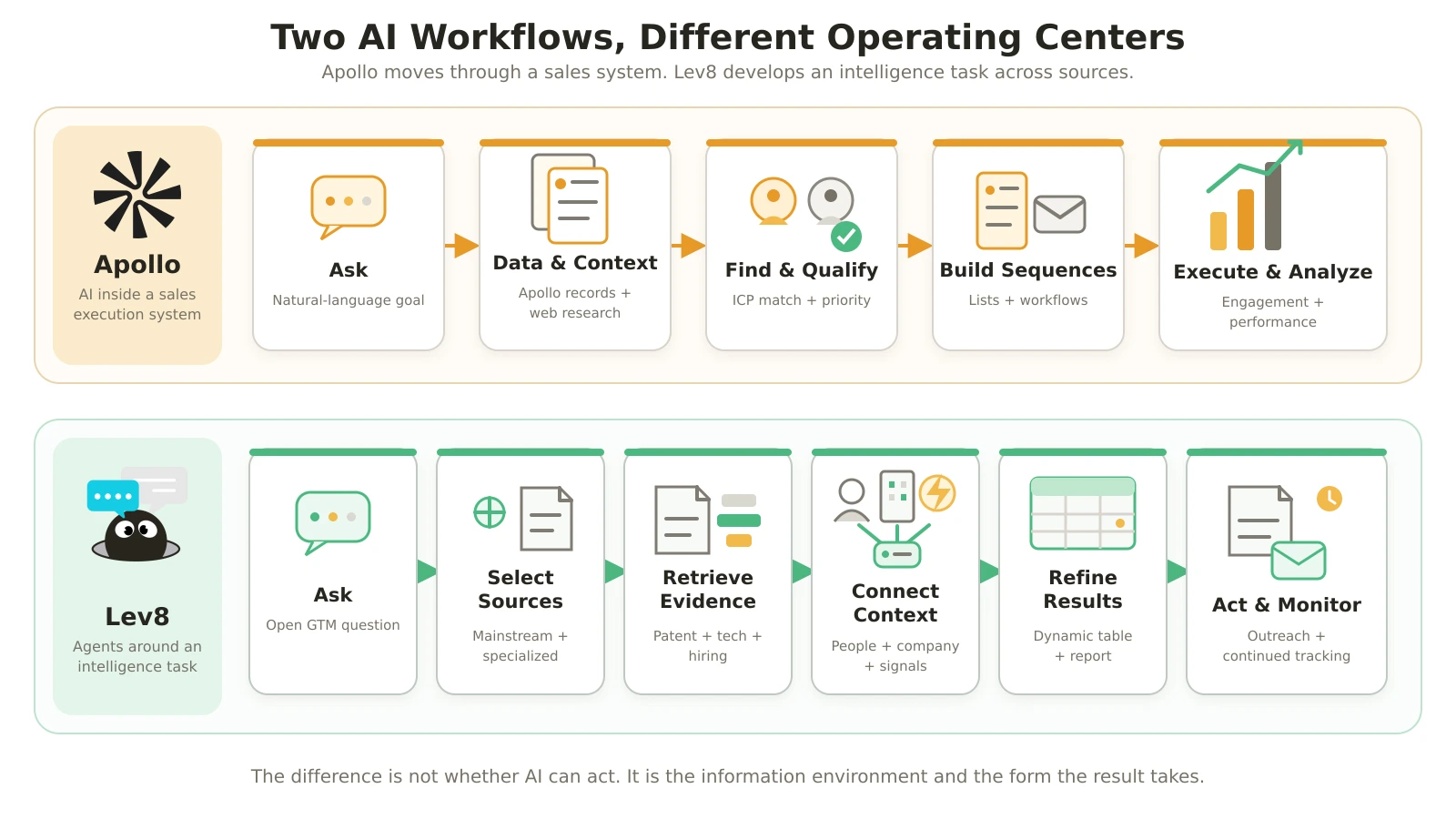
Figure 1. Apollo moves through a sales execution system, while Lev8 develops an intelligence task across specialized sources.
Both workflows begin with an outcome. Apollo pulls that outcome toward sales execution. Lev8 allows the intelligence result to remain exploratory for longer and take different forms before action.
Table 1. Apollo vs. Lev8 at a Glance
| Decision area | Apollo | Lev8 |
|---|---|---|
| Product center | Sales data and outbound execution | Intelligence discovery through verified outreach execution |
| Primary environment | Contacts, companies, lists, sequences, workflows, mailboxes, and analytics | Open-ended research tasks spanning mainstream web sources and specialized data such as patents or technology-stack changes |
| Typical starting point | A prospecting or outbound outcome | A market, people, company, or commercial intelligence question |
| Research result | Records, lists, scores, and reusable AI research fields | Dynamic tables, structured intelligence, reports, and outreach context |
| Execution | Native multichannel sequences, workflows, mailboxes, and performance analysis | Contact enrichment and verification, personalized messaging, multichannel outreach, and continued monitoring |
| Best fit | Running and optimizing a defined sales motion | Investigating and constructing the intelligence behind a GTM motion |
Which Platform Should You Use? Start with the Task
Use Apollo
Use Apollo when the team can already state the ICP, roles, qualification criteria, and outreach destination. A typical output is an enriched prospect list that moves directly into a sequence, workflow, or campaign.
Use Lev8
Use Lev8 when research itself is the hard part: entering a new market, investigating an unfamiliar industry, combining specialized evidence, or determining which fields and buyer roles matter as the work develops. The team can then verify contact details and continue into outreach without treating Apollo as a required execution layer.
Figure 2. Two Workflow Choices, Different Operating Centers
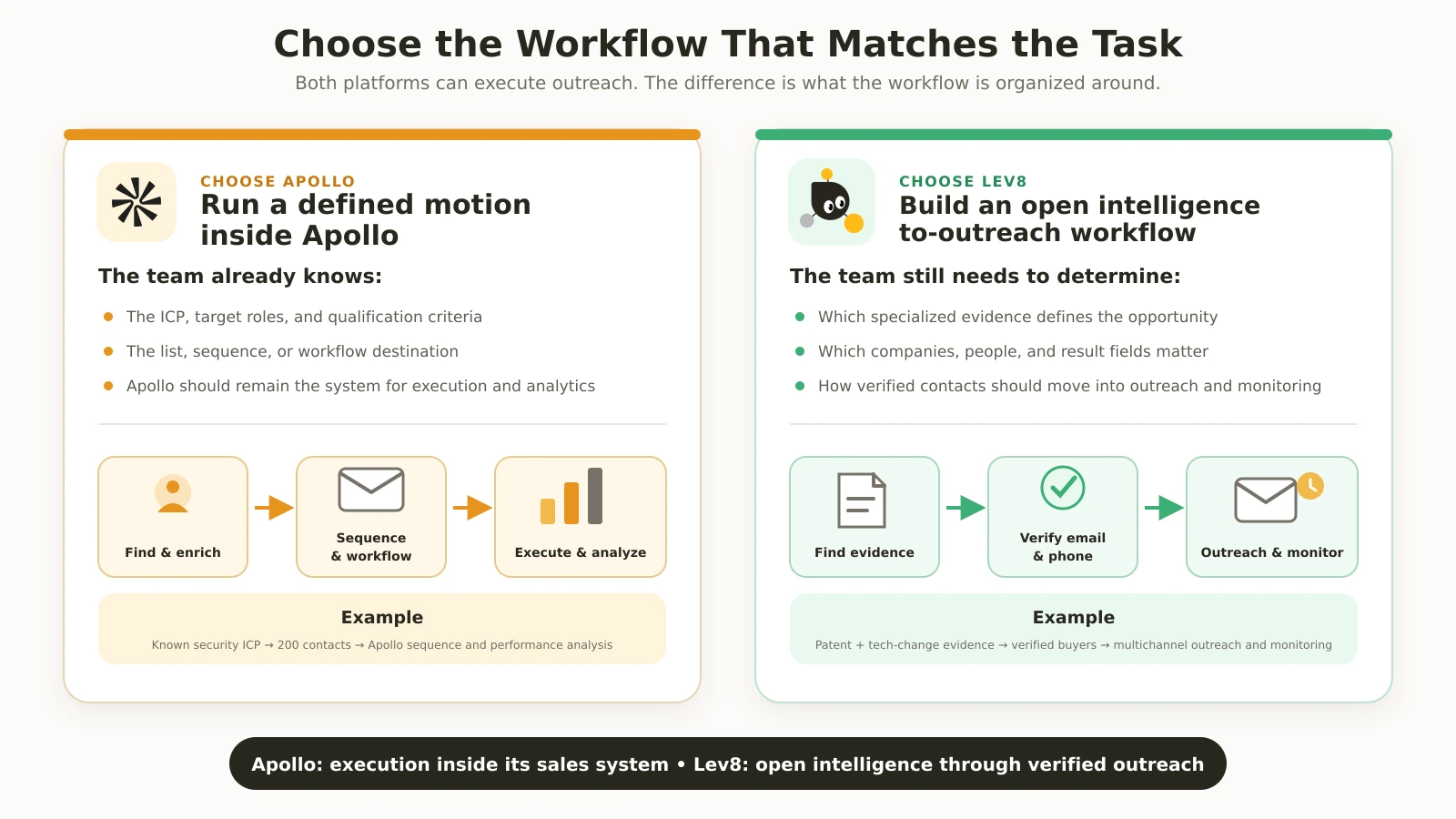
Figure 2. Choose Apollo when a defined motion should run inside its sales system. Choose Lev8 when the task must move from open intelligence and specialized evidence through contact verification, outreach, and monitoring.
What Are You Actually Paying to Improve?
Pricing matters, but subscription cost alone does not explain the buying decision.
If a team already understands its target market and primarily needs more prospecting, enrichment, sequencing, and execution capacity, an integrated Apollo workflow may remove the most friction.
If the team already has contacts but repeatedly struggles to investigate unfamiliar markets, identify relevant commercial changes, decide what evidence matters, or turn scattered information into a reusable result, additional execution capacity may not address the underlying constraint.
The real cost also includes:
- Manual research time
- Repeated context gathering
- Poorly defined qualification logic
- Large but weakly prioritized lists
- Generic outreach caused by missing evidence
- Intelligence that disappears after one campaign
- Handoffs between research and execution tools
The better platform is the one that removes the most expensive constraint in the current workflow.
Final Verdict
Apollo and Lev8 should not be compared as a traditional contact database and a modern AI agent.
Apollo now applies AI across prospecting, research, prioritization, engagement, workflows, and performance analysis. For teams that want to execute a defined outbound motion inside one mature sales system, Apollo offers the more complete operating environment.
Lev8 is differentiated by the way work is organized around an open-ended intelligence task and by the depth of sources agents can bring into that task. It is better suited to situations where a team must investigate specialized evidence, combine long-tail signals such as patent activity or technology-stack changes with broader company context, dynamically structure the result, verify contact data, and carry that intelligence into outreach and monitoring.
The practical choice is:
Use Apollo when the motion should run inside Apollo's established sales system. Use Lev8 when the team needs an open intelligence-to-outreach workflow built around the task.
The choice is therefore not "database or AI." It is which operating center better matches the work the team needs to complete.
What's Next
Before choosing either platform, map where your prospecting workflow loses the most time:
- Defining the market or business question
- Finding relevant companies and people
- Researching why they may be worth attention
- Structuring and prioritizing the result
- Finding verified contact information
- Creating outreach
- Executing sequences
- Monitoring engagement and performance
If the target is already defined and the team primarily needs execution inside established lists, sequences, mailboxes, workflows, and analytics, Apollo may be the better fit.
If the hardest work happens in stages one through four—or the investigation keeps changing as new evidence appears—Lev8 may provide the more appropriate intelligence workspace.
Build Your Next GTM Intelligence Task with Lev8
Start with a market, people, or company question. Use Lev8 to investigate mainstream and specialized sources, combine long-tail signals, structure the findings, verify contact data, and turn the result into multichannel outreach or another practical GTM output.