



B2B teams do not have a tool shortage. They have a selection problem.
The 2025 Marketing Technology Landscape now tracks 15,384 martech tools across 49 categories. For B2B teams, choosing tools has become part of the growth challenge. CRM, prospecting, AI writing, email automation, design, and sales management all have too many options. Yet teams still get stuck on the same questions: who should we contact, why now, what do we know about this account, what should the first message say, and how do we keep the lead engaged?
The right way to choose B2B sales and marketing tools is not to look for one platform that does everything. It is to give each tool a clear job.
The five tools below map to five common parts of a B2B growth workflow: finding prospects, managing pipeline, producing content, creating marketing assets, and nurturing leads.
1. Lev8: For B2B Lead Gen, Prospecting, and Enrichment
The hard part of B2B prospecting is not finding more contacts. It is finding contacts that are accurate, timely, and useful enough for sales to act on.
Recent public feedback around Apollo, HubSpot, and similar tools shows the same pattern. Users often value the efficiency gains, but still raise concerns about data accuracy, product complexity, pricing growth, credit usage, and learning curve.
This points to a larger issue. B2B teams do not just need a contact database. They need a way to start from ICP, signals, and account context, then decide who deserves attention first.
Pros
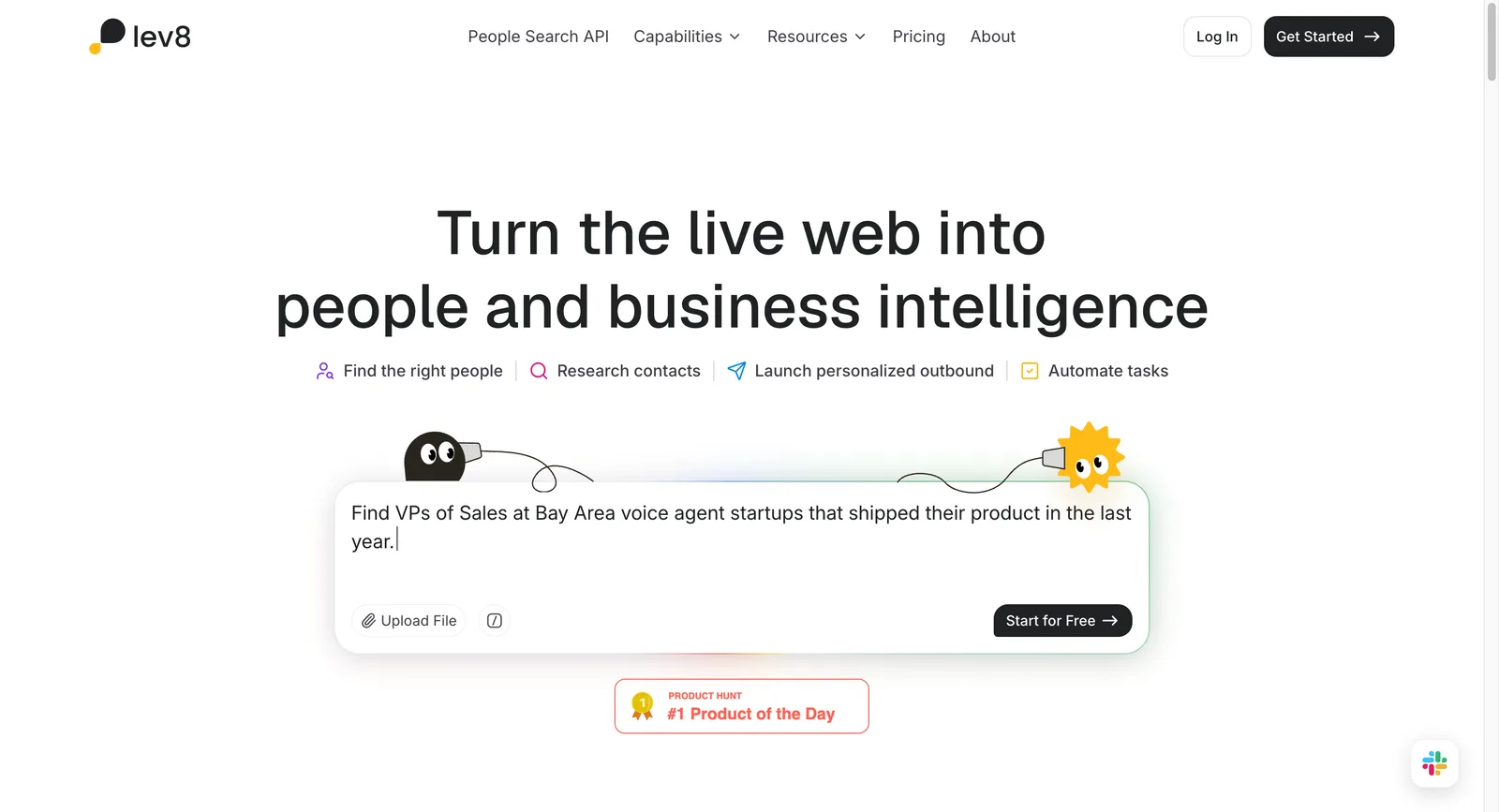
Lev8 is built around AI real-time people search. Users describe the people, company types, filters, or intent signals they care about. Lev8 searches for matched profiles and adds useful context.
Lev8 fits in front of the B2B prospecting workflow for three main reasons:
First, it helps teams move from ICP to prospect list. A team can describe industry, region, company size, role, tech stack, hiring signals, or business changes, then find companies and decision makers that match the search.
Second, it enriches lead profiles. Lev8 can add contact, company, role, social, background details, and intent context, so sales teams know not only who to contact, but why that person may be relevant.
Third, it helps teams prioritize outreach. Lev8 uses intent data, social signals, and lead scoring to help teams identify prospects with stronger needs, clearer timing, or a better reason to respond.
Lev8 can also generate personalized email drafts or opening lines from enriched profile data. This is useful for outbound teams that need stronger first-touch relevance.
Cons
Lev8 is strongest for prospecting, lead enrichment, intent signals, and outreach copy preparation. It should not be treated as a CRM or a full sales management system.
Teams that need advanced pipeline management, contract workflows, customer service processes, or large marketing automation still need a CRM or marketing automation tool.
Pricing
Lev8's pricing page lists a Free plan at $0/month with 300 credits/month. Starter is $49/month with 5,000 credits. Pro is $199/month with 25,000 credits. Scale is $499/month with 65,000 credits.
A typical matched lead costs about 20 credits per lead. Lead Generator Agent is listed at about $0.25 per lead. Different searches, enrichment actions, and AI draft actions use different amounts of credits, so teams can start with a smaller test before expanding usage.
2. HubSpot: For CRM and Pipeline Management
Once a team has leads, it needs a system to manage customer relationships, sales stages, tasks, meetings, and communication history. This is where HubSpot often fits into a B2B stack.
Users tend to value HubSpot for ease of use, automation, and centralized customer data. As contact volume and feature usage grow, users also mention higher cost, learning curve, and support concerns.
Pros
HubSpot helps teams manage contacts, companies, deals, tasks, forms, email campaigns, and pipeline in one system.
For B2B teams, it works well after leads enter the sales process. Sales, marketing, and leadership can work from the same customer records.
HubSpot is also useful for teams moving away from spreadsheets, especially when they need to track lead source, campaign performance, and deal stage.
Cons
HubSpot's main tradeoffs are cost and complexity.
If a team is still validating a market and does not yet have a steady lead source or sales process, HubSpot may feel too heavy. It also does not solve the earliest prospecting and enrichment problem by itself.
Pricing
HubSpot's pricing page lists a Free plan for Marketing Hub. Starter starts at $7/month/seat when billed annually. Professional starts at $800/month. Enterprise starts at $3,600/month. Professional and Enterprise may also include onboarding fees, so HubSpot is a better fit for teams with a more mature budget and process.
3. Jasper: For B2B Content Production and Thought Leadership
B2B marketing depends on trust. Buyers rarely make a purchase after one ad or one email. They compare vendors, involve other stakeholders, and judge whether a brand understands their problem.
The Content Marketing Institute 2026 B2B content trends report notes that most B2B marketers create thought leadership content, but far fewer consider their programs mature. The issue is not whether teams want to produce content. The issue is whether they can publish useful content with enough consistency and quality.
Pros
Jasper helps B2B teams speed up content production. It can support blog posts, LinkedIn posts, landing page copy, email copy, campaign briefs, case study drafts, and sales enablement content.
Jasper's Brand Voice can identify tone, style, and key characteristics from content samples, then help teams keep brand voice consistent.
Users often value Jasper for saving time, creating first drafts, and helping teams get past writer's block.
Cons
Jasper still needs human editing, especially for technical B2B topics, industry-specific insights, and opinion-led content.
Some users feel the output can be generic or repetitive, and many teams still need fact-checking and expert review. Jasper is better for drafts and structure than for replacing subject matter expertise.
Pricing
Jasper's pricing page lists Pro at $59/month when billed yearly, or $69/month when billed monthly. Business uses custom pricing. Jasper also offers a 7-day free trial, which makes sense for teams that want to test brand voice, content quality, and workflow fit first.
4. Looka: For Brand Assets and Marketing Materials
Not every B2B company starts with a designer, brand team, or full marketing department. Many small businesses, distributors, agencies, local service providers, and early-stage startups first need basic visual assets they can use right away.
A buyer will not choose a B2B vendor because of a business card alone. Still, weak logos, quote sheets, email signatures, and product one-pagers can hurt the first impression.
Pros
Looka helps teams create logos, business cards, social posts, email signatures, letterheads, brochures, proposals, newsletters, and other basic brand materials.
Looka's Brand Kit includes 300+ branded templates based on a team's logo, colors, fonts, and industry.
Users often find Looka easy to use and fast for creating logos and brand kits, especially for small teams.
Cons
Looka is better for early brand assets and basic marketing materials than for full brand design or advanced creative work.
Public reviews also mention limits around editing and customization. That makes Looka more useful for getting started than for handling every long-term design need.
Pricing
Looka's pricing page lists the Basic Logo Package at a one-time $20 fee and the Premium Logo Package at a one-time $65 fee. Brand Kit Subscription is $96/year. Brand Kit Web Subscription is $129/year.
If a team only needs a logo, a one-time package may be enough. If it needs business cards, social graphics, email signatures, and branded templates, Brand Kit is the better fit.
5. Mailchimp: For Email Marketing and Lead Nurturing
Not every B2B lead converts after the first touch. Many buyers take weeks or months to enter an active purchase cycle, especially when several stakeholders are involved. This makes long-term nurturing important.
Mailchimp is a better fit for warm leads than for cold prospecting. Examples include newsletter subscribers, webinar attendees, existing contacts, trial users, and people who have shown interest but are not yet in a sales process.
A Reddit discussion about MarketingAutomation reflects a similar pattern. Teams often use automation for email sequences, lead scoring, CRM-based follow-ups, and reactivation messages, not for a fully automated marketing system.
Pros
Mailchimp works well for newsletters, email campaigns, lead nurturing, product updates, event invitations, and basic automation.
Users often value Mailchimp for ease of use, templates, automation, and campaign management. For small teams without a large marketing department, it can help build a basic email nurture process quickly.
Cons
Mailchimp's main tradeoffs are pricing at scale and limits around complex automation.
Costs rise as contact lists grow. Lower-tier plans have limited features, and advanced segmentation, personalization, and automation may not match more specialized platforms. Some users also raise concerns about support, accounts, and billing.
Pricing
Mailchimp's pricing page lists a Free plan for up to 250 contacts. Essentials starts at $13/month. Standard starts at $20/month. Premium starts at $350/month. Standard is a better fit for teams that need automation, personalization, and optimization tools.
What a Good B2B Sales and Marketing Stack Should Do
A good B2B stack is not about owning more tools. It should help the team make better decisions at each stage of the funnel.
First, it should improve prospect quality. The team should not only collect more contacts. It should be able to judge priority based on ICP fit, company context, intent signals, and lead score.
Second, it should help sales and marketing work from the same customer understanding. Lead source, funnel stage, content engagement, and next owner should be clear and easy to update.
Third, it should help the team build trust over time. B2B buyers rarely move forward after one touch. Content, brand assets, case studies, nurture emails, and sales conversations all shape how buyers evaluate the company.
Fourth, it should reduce repetitive manual work. Finding prospects, cleaning profiles, drafting content, creating basic marketing assets, and maintaining email lists can slow the team down if everything depends on manual effort.
A practical B2B sales and marketing stack should cover five core needs: use Lev8 to find and understand better-fit prospects, HubSpot to manage pipelines, Jasper to speed up content production, Looka to create basic brand assets, and Mailchimp to nurture leads over time.
A Practical B2B Sales and Marketing Stack
| Tool | Role in the Stack | What It Helps Teams Do | Best Fit |
|---|---|---|---|
| Lev8 | Prospecting and enrichment | Find better-fit prospects, enrich lead profiles, review intent signals, and prepare more relevant first-touch messages | GTM, sales, growth, and founder-led teams that need higher-quality prospects |
| HubSpot | CRM and pipeline management | Organize contacts, companies, deals, tasks, forms, campaigns, and customer records in one place | Teams with active pipeline and repeatable sales or marketing processes |
| Jasper | Content production | Turn briefs, customer insights, and product messaging into drafts for blogs, emails, landing pages, and sales content | B2B teams that need to publish useful content more consistently |
| Looka | Brand assets and marketing materials | Create logos, business cards, social graphics, email signatures, proposals, and basic branded templates | Small businesses and early-stage teams without a dedicated design team |
| Mailchimp | Email marketing and lead nurturing | Send newsletters, product updates, event emails, and nurture campaigns to warm leads | Teams with subscribers, event signups, trial users, or existing contacts to nurture |
For most B2B teams, prospect quality comes first. CRM, content, brand assets, email nurture, and sales activity all depend on one question: are you reaching the right people?
That is why Lev8 belongs near the front of the stack. It helps teams start B2B sales and marketing with more accurate prospects, fuller account context, and clearer reasons to reach out.