




TL;DR: The best buying signals are not the loudest ones. Prioritize signals that prove fit, timing, relevance, and actionability. Single signals can provide context, but stacked signals are stronger when they point to real buying motion and measurable outcomes.
Most Buying Signals Look Useful Until SDRs Waste Time on Them
Buying signals are everywhere now. Funding rounds, hiring spikes, new executives, website visits, competitor reviews, tech stack changes, LinkedIn posts, G2 activity, pricing-page behavior. Every one of them can look like a reason to reach out.
Most are not.
The real question for outbound sales is not whether a signal exists. It is whether the signal helps your team answer three practical questions: why this account, why now, and why this person?
Some intent signals look shiny but do not line up with when budgets actually move. A company announcing funding, for example, may look like a perfect account to target. In practice, the week after the announcement may be the worst possible moment if you are competing with 50 vendors in their inbox.
That does not make funding useless. It makes it noisy.
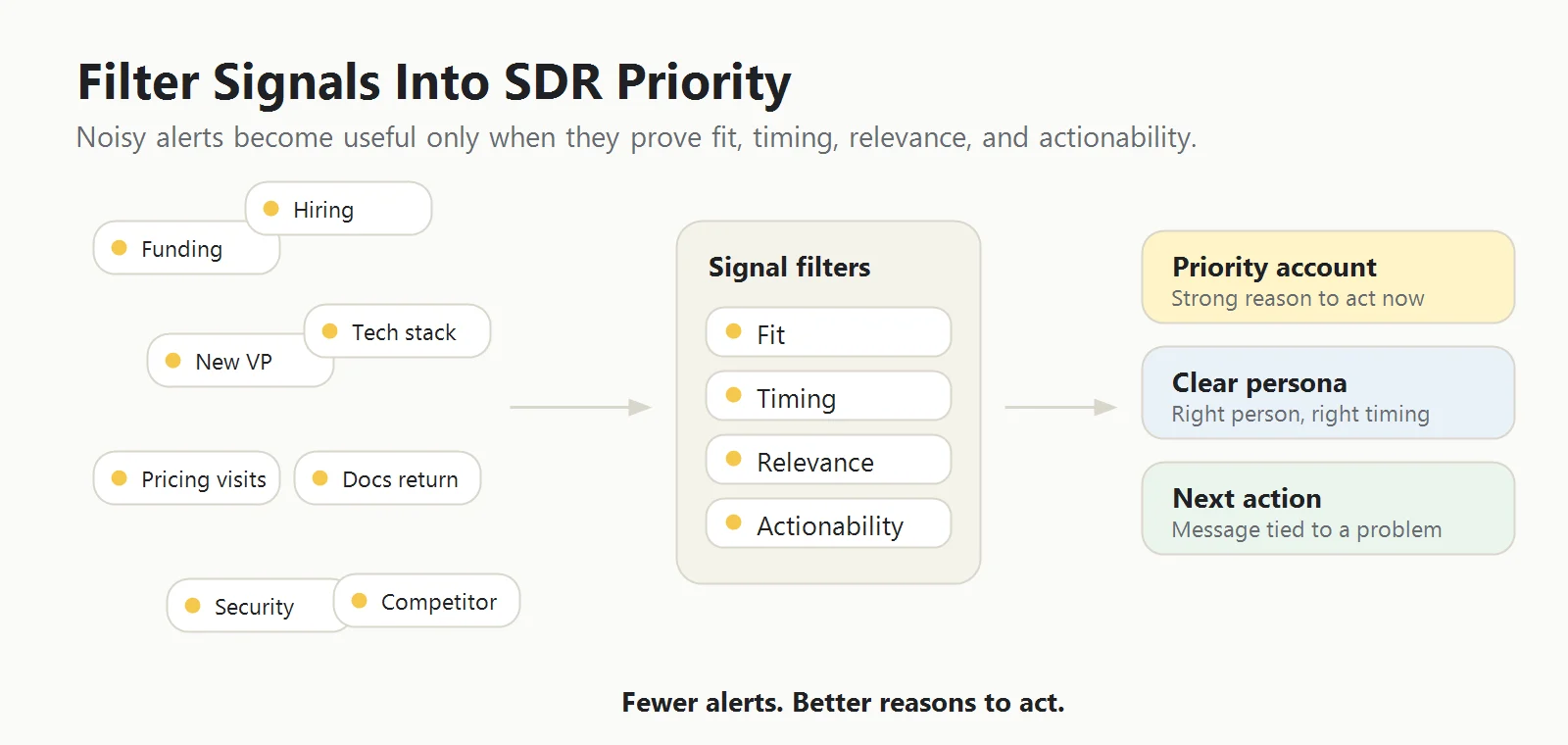
The best outbound teams in 2026 will not win by tracking more prospecting signals. They will win by filtering harder, acting faster, and turning fewer signals into better conversations.
What Makes a Buying Signal Worth Following?
A buying signal only matters if it changes an outbound decision.
If a signal does not change who you contact, when you contact them, what you say, or how you prioritize the account, it is background context. Useful, maybe. Not a sales trigger.
Firmographic fit is not timing. A blog visit is not buying motion. A single email click is not a reason to launch a sequence. But multiple people from the same account returning to decision-stage content in the same week? That starts to look different.
Use five filters before giving a signal to an SDR:
- ICP fit: Does the account match your best customer profile?
- Persona relevance: Is the signal connected to a buyer, user, influencer, or operator?
- Signal strength: Does the behavior suggest budget movement, process change, or active evaluation?
- Noise level: How easily could this signal be misread?
- Response window: How long does the signal stay useful?
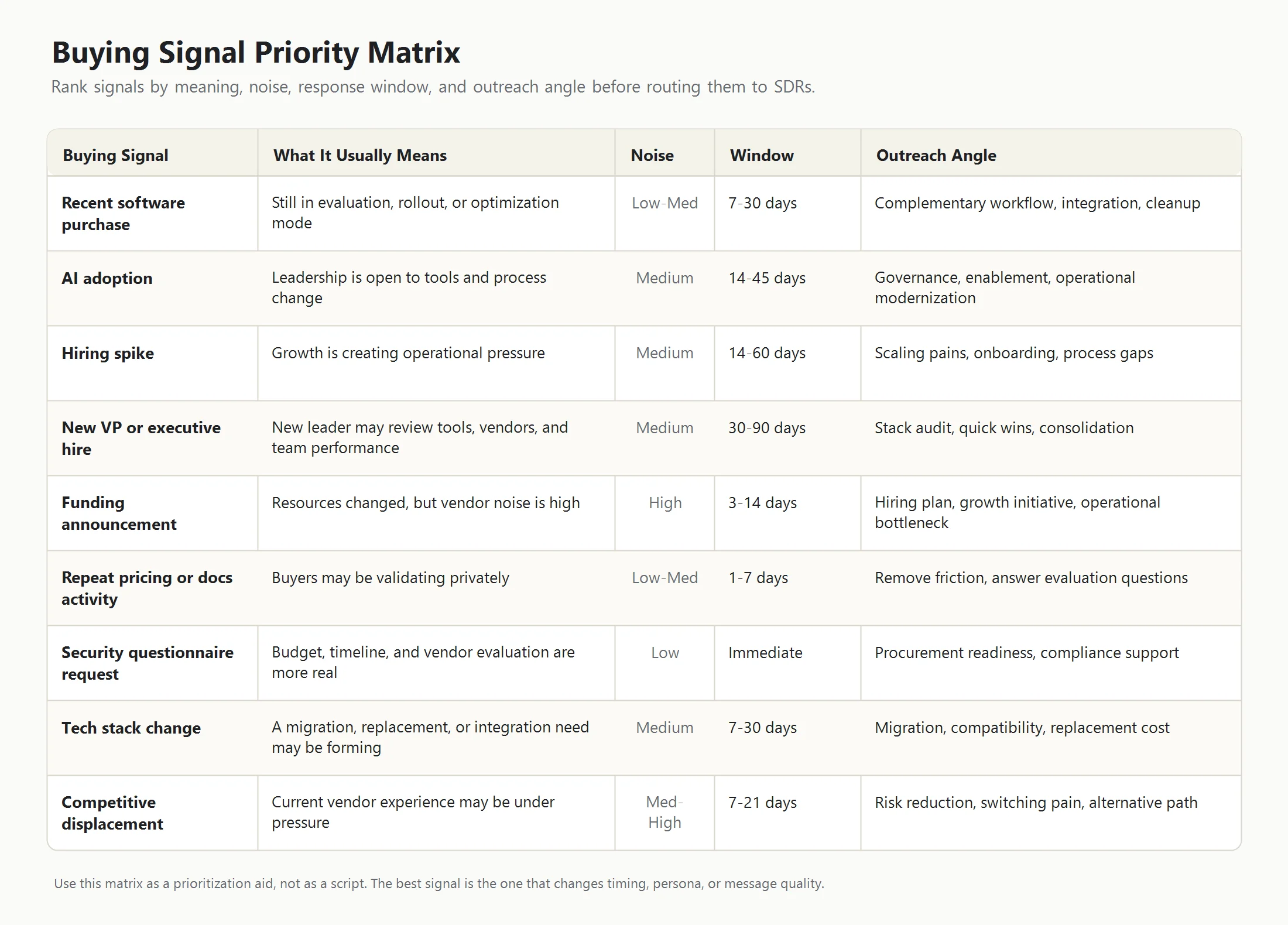
The table is not a script. It is a sorting mechanism. A low-noise signal with a clear business problem and a short response window deserves more attention than a flashy signal everyone else can see.
The Best Buying Signals for Outbound Teams in 2026
The strongest buying signals usually point to change.
Recent software purchases are high-quality signals because they show a company has already entered a buying or implementation cycle. If they just bought one tool, they may still be mid-evaluation for adjacent workflows: integrations, permissions, data migration, team adoption, reporting, or vendor consolidation.
That is low-hanging fruit when the connection is real. The outreach angle should not be "you bought software." It should be the operational problem that often follows the purchase.
AI adoption is also worth watching in 2026, but not because every AI adopter wants another AI tool. The stronger read is cultural and operational: leadership approved a new way of working. Once leadership greenlights one new tool, they have already done the internal selling. The next buying motion may involve governance, data quality, enablement, permissions, or workflow redesign.
Hiring spikes are practical because growth creates pressure fast. A sales team adding SDRs may need better routing, onboarding, territory planning, or pipeline visibility. An engineering team growing 40% may create security, documentation, access, and collaboration issues. Hiring is not intent by itself, but it often reveals where pain is about to show up.
New executive hires remain useful, with a caveat. A new VP often spends the first 30-90 days auditing people, process, tooling, and vendors. Too early, and they may not have context. Too late, and the first wave of decisions may already be made. The better play is a stack audit, benchmark, or quick diagnostic, not a product pitch.
Website behavior and first-party intent can beat declared interest. Demo requests are still strong signals, but many buyers validate quietly before filling out a form. Repeat visits to workflow pages, deeper docs usage, multiple people from the same account showing up close together, and post-outreach content review can all signal private evaluation.
Quiet does not equal low intent.
Security questionnaire requests are easy to overlook. They look like procurement paperwork, but they often point to a real budget, timeline, and vendor evaluation process. For B2B SaaS teams, this can be more reliable than broad content engagement.
Funding announcements still matter, but they need restraint. Funding shows resources changed. It does not prove the company needs your category right now. A better trigger appears when funding overlaps with hiring, a new executive, a strategic initiative, geographic expansion, or a tech stack change.
Competitive displacement signals can be valuable, but they are easy to use badly. Competitor reviews, G2 category activity, public complaints, and stack replacement can point to switching pressure. The outreach should focus on migration risk, integration pain, data cleanup, or internal tradeoffs. Naming the frustration too directly can feel opportunistic.
Signal Stacking Beats Single-Signal Outreach
On their own, most signals are weak.
A RevOps job opening may be ordinary hiring. A new VP may simply be settling in. A pricing-page visit may be curiosity. A funding announcement may be noise. But when several strong signals appear around the same account, in a short window, across roles or channels, the account starts to look alive.
That is where signal stacking matters.
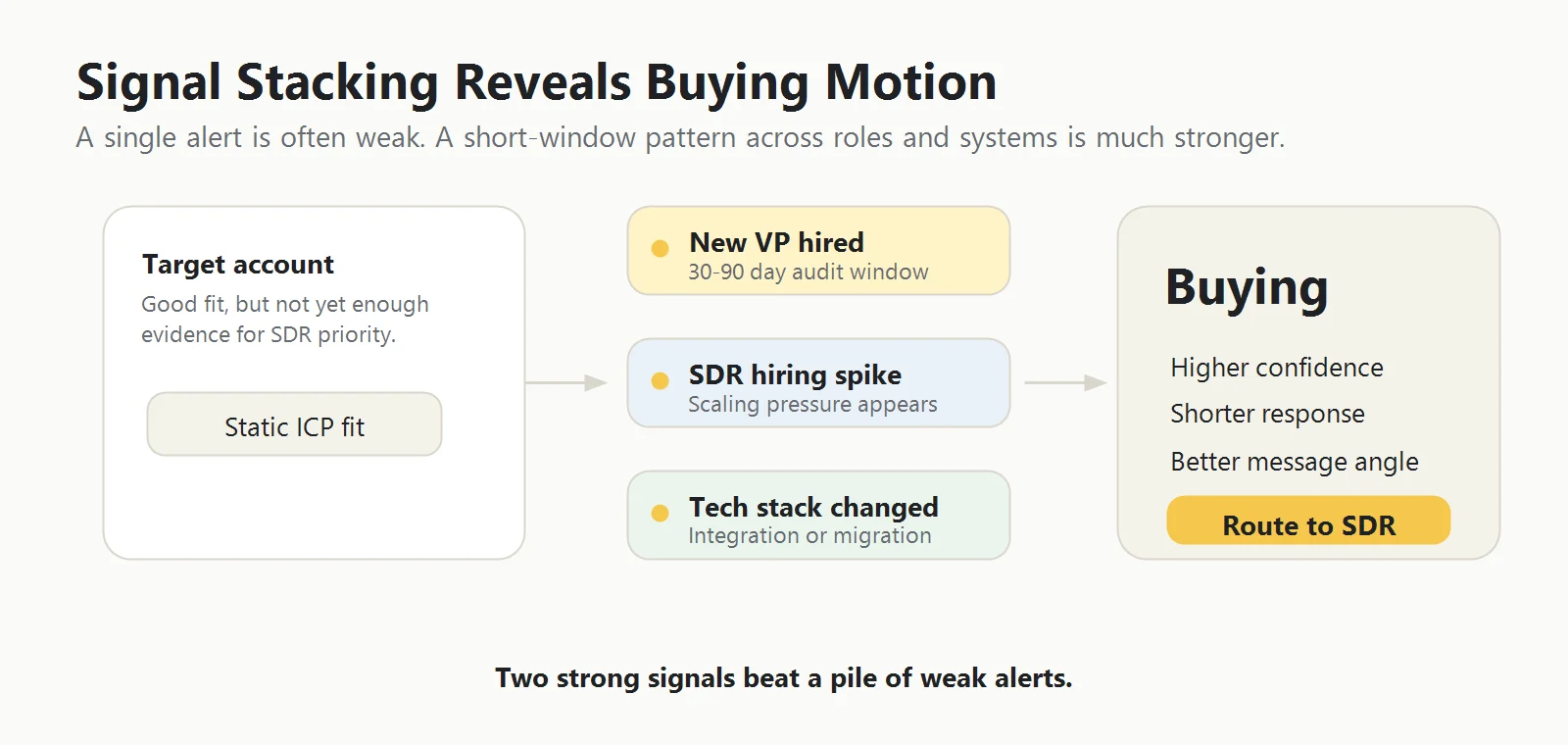
For example, a company hires a new VP Sales. Two weeks later, it starts hiring SDRs. Around the same time, its CRM or sales engagement stack changes, and multiple people from the same domain view integration or security content. That is no longer a single sales trigger. It is buying motion taking shape.
A practical rule: only trigger outbound when two strong signals fire together, especially if the first signal is noisy.
Not any two signals. Two strong ones.
"Funding plus a generic blog visit" may still be weak. "New VP plus SDR hiring plus tech stack change" deserves a closer look. Signal stacking helps teams avoid chasing every alert and gives SDRs a stronger reason to prioritize one account over another.
It also reduces internal arguments. Many teams try to score everything, then sales and marketing spend more time debating the score than acting on the account. A smaller set of high-confidence signal combinations is easier to trust, easier to explain, and easier to improve.
How to Turn Buying Signals Into Outbound Actions
Signal detection is only the first step. Execution decides whether it creates pipeline.
Start with a signal map. Different products should care about different signals. A cybersecurity company may prioritize security questionnaires, compliance hiring, identity provider rollouts, and cloud migrations. A RevOps tool may care more about CRM changes, sales hiring, pipeline coverage discussions, and new sales leadership. A developer tool may watch engineering headcount, docs usage, GitHub activity, and technical migrations.
Next comes enrichment. A signal rarely tells the whole story. You still need account size, industry, tech stack, team structure, relevant contacts, recent company changes, and existing tools. Without enrichment, SDRs can have a real signal and still contact the wrong person. A structured waterfall enrichment workflow can help teams validate whether a signal is tied to the right account, persona, and timing before it enters a sequence.
Then score the signal, but keep the model explainable. The score should answer a few questions: Does this account fit? Is the signal strong? Is there a second signal? Is there a clear persona? Is the response window still open? If your team needs a lightweight way to formalize this logic, a lead scoring workflow can help turn signal quality into a consistent prioritization model.
If not, put the account into a watchlist or nurture motion. A weak signal does not need an SDR sequence.
The next step is contact selection. Company-level buying signals answer "which company should I target?" They do not automatically answer "which person inside that company is ready to talk right now?" AI adoption, for example, may point to RevOps, IT, security, sales operations, or a business owner depending on the category. For deeper persona discovery, this guide on how to find decision makers from a company URL can support the handoff from account-level signal to contact-level action.
Then turn the signal into a message. This is where many teams lose the plot. The signal should provide context, not become the whole email. A good message connects the signal to a likely business problem and gives the buyer an easy next step.
In a tool-assisted workflow, a GTM workflow agent like Lev8 can help monitor market changes, enrich account context, score signal quality, and route high-confidence opportunities into outbound actions. The point is not to replace judgment. It is to remove the manual drag between signal discovery, validation, and execution.
What to Say When You Reach Out
Signal-based outreach should feel relevant, not watched.
If an account visits your pricing page three times, avoid telling them you saw it. That may be true, but it is not a good opening. A better approach is to frame the likely evaluation problem: teams comparing tools often need to understand rollout effort, security review, or workflow fit before they can move forward.
If the signal is hiring, do not lead with "I saw you are hiring SDRs." Tie it to the pressure created by hiring. More reps usually create stress around onboarding, routing, CRM hygiene, sequence governance, and pipeline visibility.
If the signal is a new VP, skip the hard pitch. New leaders are often mapping the stack, looking for quick wins, and identifying legacy problems. A short audit, benchmark, or risk checklist may land better than a feature-heavy email.
If the signal is competitor displacement, be careful. "Looks like you are unhappy with your vendor" is a fast way to sound invasive. A better angle is: teams replacing a vendor often underestimate migration cost, data cleanup, or internal adoption risk.
The best signal-based messages make the buyer feel understood. They should not make the buyer feel monitored.
Common Mistakes That Make Buying Signals Useless
The first mistake is chasing the loudest signals. Funding, executive changes, and major hiring news are easy for every vendor to see. They can work, but only when paired with category relevance, timing, and a sharper point of view.
The second mistake is treating fit like timing. A perfect-fit account with no recent change may belong in your target list, not today's SDR queue. Outbound is not only about finding good companies. It is about finding the accounts where action makes sense now.
The third mistake is scoring everything. Page visits, email opens, LinkedIn engagement, hiring, funding, content downloads, job changes, and review activity can all enter the model. Soon the score looks sophisticated but becomes impossible to explain. More scoring can create more arguments, not better prioritization.
Another failure mode is missing the CRM loop. If a signal triggers outreach, the outcome needs to come back into the system: follow-up speed, message angle, reply, meeting, opportunity, pipeline, closed revenue. Otherwise, the team never learns which signals create meetings and orders, not click rates.
Speed also matters. Some buying signals fade quickly. Post-outreach engagement may be useful for only a few days. Funding announcements can become crowded in a week. New executive signals may work best across a 30-90 day window. Waiting for perfect certainty often means missing the useful moment.
How to Measure Whether Your Buying Signals Are Working
Open rates are not enough. Click rates can lie.
Measure buying signals by the outcomes they improve: positive reply rate, meeting booked rate, signal-to-meeting conversion, opportunity creation, pipeline generated, sales cycle influence, and signal source ROI.
Break performance down by signal type. Funding may create a lot of activity and weak replies. Security questionnaires may create fewer alerts but stronger conversion. Website behavior may require more careful messaging but better timing. If every signal gets blended into one score, the differences disappear.
Review signal performance every 30-60 days. Keep the combinations that create qualified meetings and pipeline. Lower the weight of noisy triggers. Remove alerts that only make the team feel busy.
Outbound teams do not need more alerts. They need fewer, better reasons to act.
Conclusion: Prioritize Buying Motion, Not Noise
The best buying signals in 2026 are not the easiest ones to monitor. They are the ones that prove fit, timing, relevance, and actionability.
A single signal can provide context. A strong combination of signals can justify SDR priority. Funding, hiring, new executives, AI adoption, website behavior, tech stack changes, and competitive displacement can all matter, but only when they connect to your category, persona, response window, and business problem.
The work is not to find more signals. The work is to identify buying motion and turn it into timely, relevant, low-friction outbound.
If your team already tracks hiring, funding, tech stack changes, and first-party intent, but still lacks a reliable signal scoring and routing workflow, Lev8 can help turn real-time buying signals into prioritized accounts, contact context, and next-step outbound actions.