




A viral post on X framed agentic context engineering as the death of fine-tuning. The claim traveled because it sounded simple: let an agent rewrite its own prompt, learn from every run, and keep getting smarter without changing a model weight.
The engineering problem is less convenient. What should the agent learn? Which observations deserve to survive the current run? What happens when its "living notebook" becomes stale, bloated, expensive, or simply wrong?
I treat agentic context engineering as a feedback-controlled context system, not an invitation to keep more text. It selects evidence for the task in front of it, evaluates what happened, and promotes only defensible lessons into reusable context. Learning is the claim; verification is the work.
TL;DR
Agentic context engineering (ACE) turns execution feedback into an evolving, inspectable playbook. It is narrower than context engineering, which governs the full inference-time environment, and it does not replace retrieval, memory, or fine-tuning. The production challenge is deciding which evidence enters a run, which outcome deserves to become a reusable lesson, and when that lesson should expire.
A reliable implementation uses seven stages: observe, select, structure, execute, evaluate, curate, and retrieve. Every learned item should carry provenance, scope, permissions, verification status, and freshness. The system should optimize accepted outcomes rather than memory size, and reject or supersede lessons that fail regression tests. ACE is most useful for repeated workflows with meaningful feedback; ambiguous work still needs human review or stronger external evaluators.
What Agentic Context Engineering Actually Changes
ACE Is More Than a Longer Prompt
The prompt is only one layer. Traditional prompt optimization often rewrites one large instruction block. Each revision may look cleaner, yet rare constraints, failure details, and domain-specific exceptions can disappear during summarization. The ACE paper names this pattern context collapse and proposes an evolving playbook made of discrete strategies, rules, examples, and error-handling lessons.
That distinction matters. A 20-page system prompt is still a blob. A structured playbook can identify where a lesson came from, which task it applies to, whether anyone verified it, and when it should expire.
ACE also sits inside the broader field of context engineering. Anthropic's context engineering guide describes the wider inference-time environment: instructions, retrieved evidence, tool definitions, session state, memory, permissions, and output constraints. ACE focuses on the part that changes through execution feedback.
Strong retrieval and context isolation do not necessarily create ACE. Neither does appending notes to lessons-learned.md. Addressable lessons still need evaluation, scope, retrieval rules, and removal.
Generator, Reflector, and Curator
ACE separates the learning loop into three roles:
- The Generator performs a task using the current context and produces a trajectory, tool results, and environment feedback.
- The Reflector examines the outcome and extracts possible tactics, mistakes, or root causes.
- The Curator turns useful findings into small delta updates instead of rewriting the full playbook.
The split is elegant, but each role adds a model call and another error surface. Coordination overhead grows quickly when reflection and curation run without a deterministic success signal.
Code can pass a test, and an API call returns a status. Sales research, market analysis, and writing rarely offer such clean feedback, so a Reflector produces candidate knowledge, not truth.
Suppose a data provider times out three times. A weak Curator records, "Never use this provider again." A better update says, "After two consecutive timeouts, switch to the fallback and retry the primary source after 30 minutes." The granularity of that lesson decides whether the playbook becomes useful or brittle.
No, ACE Did Not Kill Fine-Tuning
What Context Adaptation Is Good At
The headline traveled farther than the caveat. Context adaptation fits knowledge that changes fast and must remain inspectable: API constraints, customer preferences, workflow rules, recent failures, and account-specific evidence. Teams can update, trace, and roll back these items without retraining a model.
Ambiguous work is harder. A content agent may receive no signal beyond "looks good." An outbound agent may see no reply without knowing whether the buyer, message, channel, timing, or email delivery failed. In those cases, rapid self-improvement can become rapid self-deception.
What Still Belongs in Model Weights
Fine-tuning remains useful for durable capabilities, stable behavior, output distributions, and gaps that context cannot patch. Instructions cannot guarantee that a missing capability appears. Update frequency is a practical filter: daily or weekly knowledge usually belongs outside the weights, while behavior that must stay consistent across customers and sessions should not depend on a fragile instruction file.
The economics differ too. ACE adds reflection, curation, and evaluation calls; fine-tuning carries training costs up front and may reduce prompt burden later. Compare cost per accepted outcome because single-call pricing hides too much.
Why More Context Becomes Worse Context
Context Bloat Dilutes Attention
More context is not automatically better context. Append-only memory works during short sessions, then punishes long-horizon agents with higher cost, slower inference, and weaker attention. The window need not be full before quality drops; a constraint can lose influence among irrelevant tokens. Anthropic recommends finding the smallest set of high-signal tokens that improves the outcome.
Tool output drives much of the growth. A web fetch can return navigation, scripts, repeated boilerplate, and 40 pages of text when the final decision relies on three sentences. A database query may return 5,000 rows when the agent needs three fields from two records. Raw output belongs in an auditable store; working context needs verified evidence, a source reference, and a way to retrieve the original result.
Retrieval Can Fail Silently
The problem is not always missing data. The correct document may exist in the store but never reach the agent because semantic search retrieves a similar, older item while ignoring a newer source with different wording. The final answer still sounds plausible, so neither the user nor the system notices the omission.
Similarity is candidate generation, not authority. Production retrieval also needs task relevance, freshness, source quality, scope, and permission checks. A high cosine score cannot tell the system whether a former employee's profile should override the company website or whether one team is allowed to see another team's customer notes.
The review surface matters here. A context engine should return more than chunks. At minimum, an operator should be able to inspect the source, timestamp, confidence, semantic type, and access boundary attached to the evidence that shaped an action.
Bad Reflection Can Become Permanent Policy
One failed run can produce a confident rule. Once stored, that rule influences later runs, and those later outcomes may appear to validate it. The system has created a self-reinforcing error loop.
Memory magnifies learning, and it magnifies mistakes too. A binary remember-or-forget model is too crude. Learned items need states such as proposed, verified, rejected, and superseded; a tentative pattern should remain tentative until independent evidence or a reliable evaluator supports it.
Scope provides another guardrail. A workaround for one API version should not become global policy. A buyer preference observed for one account should not alter every campaign. Wider rules require broader regression tests.
A Production Architecture for Agentic Context Engineering
The Seven-Step Context Loop
A controlled implementation starts with the paper's learning loop and adds production gates:
- Observe: Capture task state, tool results, source evidence, and outcome signals.
- Select: Admit only context relevant to the current decision and permission boundary.
- Structure: Separate facts, policies, hypotheses, prior decisions, and learned strategies before the model sees them.
- Execute: Let the agent act against that controlled working set.
- Evaluate: Test whether the run satisfied a deterministic check or an approved human criterion.
- Curate: Write auditable updates, merge duplicates, and reject lessons that outrun their evidence.
- Retrieve: Return the right item for a similar future task instead of replaying the entire history.
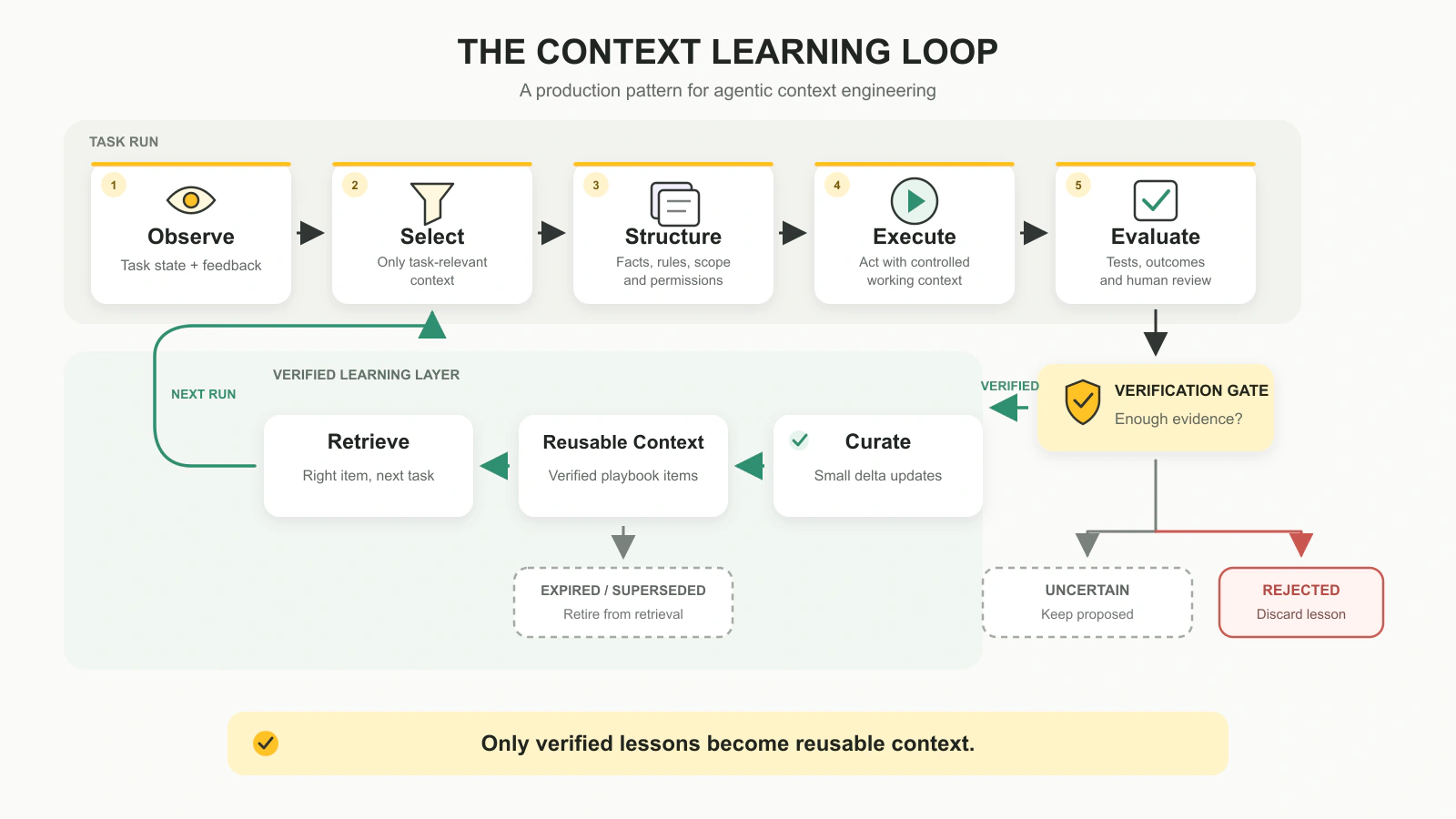
The verification gate sits between Evaluate and Curate. A verified lesson enters reusable context, an uncertain one stays proposed, and a rejected lesson is discarded. Expired or superseded items stop appearing in retrieval while their audit trails remain available; retrieval then feeds Select and closes the loop.
Add a Verification Gate Before Memory
Verification should match task risk. Code generation can run tests. Data workflows can validate schema, source completeness, and write integrity. Subjective tasks may need human review, multiple independent evaluators, or a longer observation period.
No evidence is a valid outcome. The system should stop at proposed instead of manufacturing certainty to complete a self-improvement cycle. Scope changes the threshold: a short-lived local workaround may need one verified incident, while a global rule affecting data writes, permissions, or customer communication needs broader evidence. Human review need not block every update; low-risk preferences can activate automatically, while high-risk rules wait for approval or regression tests.
What a Production Context Item Must Store
| Field | Purpose |
|---|---|
type | Distinguish a fact, policy, strategy, hypothesis, preference, or prior decision |
content | Store the smallest useful reusable statement |
source | Point to original evidence, a tool result, or an execution trace |
observed_at | Establish freshness and temporal priority |
confidence | Limit how strongly the item should influence a decision |
scope | Define the task, account, persona, environment, or workflow where it applies |
permission | Control which users or agents may retrieve it |
evaluation_status | Mark it proposed, verified, rejected, or superseded |
expires_at | Keep stale knowledge from becoming permanent truth |
Not every prototype needs all nine fields on day one. Three are difficult to remove safely: source, scope, and evaluation status. Without them, an evolving playbook becomes an unexplained pile of rules.
ACE vs. Prompt Engineering, RAG, Memory, and Fine-Tuning
The labels overlap in casual conversation. The mechanisms do not.
| Mechanism | What Changes | Best Use | Main Failure Mode |
|---|---|---|---|
| Prompt engineering | Instructions for the current task | Format, constraints, and one workflow | Brittle manual maintenance |
| RAG | External evidence retrieved for this run | Dynamic knowledge and large document sets | Wrong, stale, or unauthorized retrieval |
| Agent memory | Information persisted across runs | Continuity, preferences, and prior state | Noise accumulation, privacy, and scope drift |
| ACE | Reusable strategies and playbook items | Repeated tasks with meaningful feedback | Context bloat and self-reinforcing errors |
| Fine-tuning | Model weights | Durable capabilities, behavior, and output distribution | Slow updates, opaque changes, and data cost |
These layers can work together. RAG retrieves current evidence, memory preserves confirmed state, ACE turns validated outcomes into reusable tactics, and fine-tuning supplies durable behavior. Clear ownership makes debugging possible: was evidence missing, was the wrong item retrieved, did a bad strategy intervene, or did the model lack the capability?
How to Evaluate Whether the Agent Actually Learned
Measure Accepted Work, Not Memory Size
A larger playbook proves nothing. Useful evaluation begins with outcomes the team would accept in production: task acceptance rate, regression rate after updates, retrieval precision, stale-context rate, human correction rate, and cost and latency per accepted task. Context-Bench is one sign that the category is moving from advice toward repeatable measurement, although each production team still needs task-specific acceptance criteria.
The rejection rate for proposed lessons belongs on the dashboard too. If the system never rejects its own reflections, it probably lacks a verification layer. It is saving summaries automatically.
Average scores can hide costly damage. A playbook update might improve 18 routine tasks and break one high-risk workflow that writes incorrect data to the CRM. That update should not ship merely because the mean went up.
Separate Context Failure From Model Failure
Start with historical failures. Freeze the model version, task set, major tools, and evaluator. Run a baseline with the old context, then add a small batch of verified delta updates and compare acceptance, error categories, token usage, and latency.
Trace the context items used on every run. When quality changes, the team can attribute the difference to the model, platform, tool output, retrieval decision, or playbook update rather than relying on a vague sense that the agent became smarter or worse.
- Reproduce: Trigger the original failure under a frozen model, toolchain, task set, and evaluator.
- Test regressions: Confirm that the lesson improves its target case without damaging adjacent tasks.
- Check freshness: Verify that every retrieved item is current, authorized, and backed by an inspectable source.
- Run an ablation: Disable the lesson and rerun the case. If the gain remains, the lesson has not earned credit.
- Measure economics: Confirm that extra calls and tokens improve cost per accepted outcome, not merely one benchmark score.
- Trace causality: Identify the exact context item that changed the action.
- Audit curation: Track how many proposed lessons are later rejected or superseded.
- Test portability: Repeat the evaluation with a second model or evaluator.
Context engineering needs regression thinking. Otherwise, "the agent learned" remains an anecdote.
What Agentic Context Engineering Means for GTM
A Lead Record Is Not Decision Context
A complete contact record can still be useless. A name, title, company, and email establish that a person may exist. They do not explain why the account matters now, whether the person has decision power, what evidence supports the outreach, or what happened in the previous campaign.
Decision context requires more: account fit, resolved buyer identity, a live signal, source evidence, timestamps, prior workflow state, and constraints on the next action. Without those fields, the failure begins in the data model before it reaches the prompt.
Conflicting records expose the weakness quickly. One provider lists a contact as VP of Sales. Another shows that person left three months ago. The CRM, company website, and professional profile all carry different states.
An agent should not concatenate the records and guess. A waterfall enrichment workflow can resolve evidence across providers, but the context layer still needs provenance, temporal priority, and a stop condition when confidence remains too low for automatic outreach. The agent may write a good email and still have no right to send it.
A Signal-to-Action Example
Synthetic example: A target account starts hiring several RevOps and Sales Operations roles. The system first resolves the company, confirms the timing, identifies the relevant team, and checks supporting evidence such as leadership changes, funding, hiring patterns, or technology adoption.
Only then can the hiring event become decision context. The evidence may support a working hypothesis that the company is experiencing GTM scaling pressure. The agent maps likely buyers, prepares an outreach angle tied to the operational change, and records what happens next.
Feedback must stay decomposed. No response could indicate the wrong buyer, a weak message, poor timing, a blocked email, or no real need. Labeling every non-response as "bad signal" teaches the wrong layer of the system.
Replies, meetings, disqualifications, delivery events, and verified account changes provide different evidence. Several consistent outcomes may justify changing a signal weight. One silent inbox does not. This is the practical bridge from intent signals to sales action: evidence changes a decision only after identity, timing, and workflow constraints are resolved.
Where Lev8 Fits
In a context-first GTM workflow, One-Prompt Prospecting expresses the job and ICP. Live Signals supply current changes, Waterfall Enrichment helps resolve identity, Customer 360 organizes buyer evidence, and multichannel outbound turns selected context into action.
Lev8's role is not to place the entire internet into one agent window. Parallel agentic search can gather candidate evidence; the harder job is assembling the company, person, signal, and workflow evidence needed for the decision in front of the agent.
That is not a claim of complete ACE implementation. The accurate position is narrower: Lev8 provides an execution layer for context-first agentic GTM.
Conclusion: The Moat Is the Context Loop
Agentic context engineering is not unlimited memory. It is a controlled loop for selecting, evaluating, updating, retrieving, and removing knowledge. Models will change, and tools will change faster; the difficult asset is trusted context connected to a task, its evidence, and an observed outcome. My test is simple: the strongest agent is not the one that remembers the most. It knows what should not enter the next run.
Build a context-first GTM workflow with Lev8. Turn live signals, verified account data, and buyer context into decisions your agents can explain. Start with Lev8.
For a broader operating model, see how GTM loop engineering connects signals, actions, outcomes, and the next decision.