



Most GTM teams are not short on tools anymore.
They have lead databases, buyer intent signals, enrichment workflows, email sequencers, CRM dashboards, and sometimes a stack stitched together from Clay, n8n, Apify, APIs, and LLM prompts.
Still, pipeline quality often barely moves.
That is where GTM loop engineering starts. Not with another automation step. With a system that learns from what happens after the step runs.
A static list does not learn. An intent alert does not learn. A sequencer does not learn. It just moves faster.
A GTM system starts learning only when the result of one motion changes the next decision: which signal gets trusted, which account gets prioritized, which buyer gets mapped, which message gets sent, and which records should never enter the workflow again.
When I audit GTM workflows, the break usually appears in the same place. The team has data, but the data does not change the next action.
A company raises funding, so it enters a campaign. Another company posts a RevOps role, so it goes into a target account list. An account appears in an intent dashboard, so sales gets a task.
The steps look reasonable. The loop is missing.
Before a signal becomes action, the system has to answer three questions:
- Why this account?
- Why now?
- What should change after the outcome?
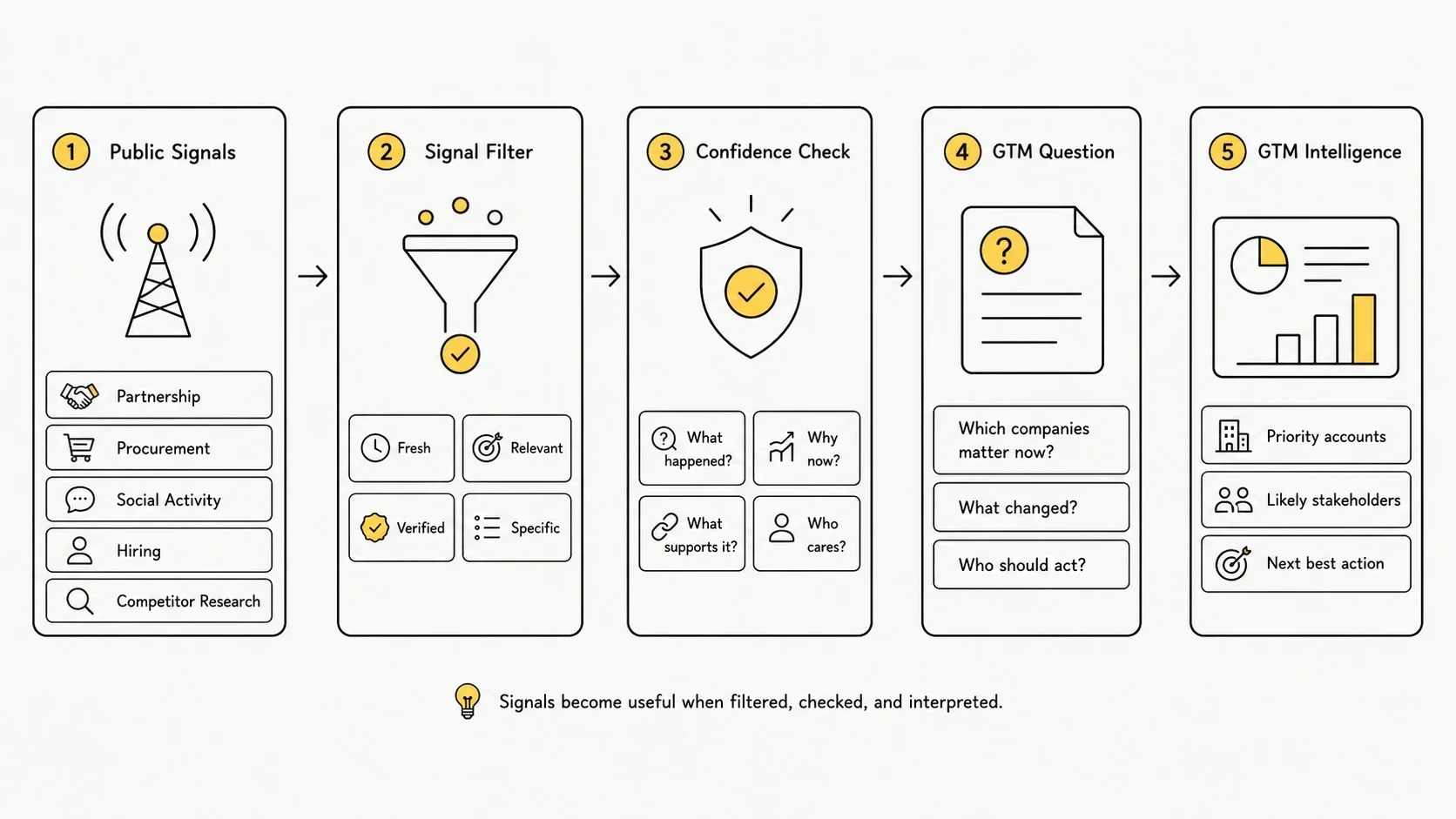
Automation executes. GTM loop engineering improves the judgment behind execution.
Lev8 fits this conversation because the future of GTM is not "more leads." It is a cleaner path from live signals to account context, buyer mapping, verified data, and outbound action.
What Is GTM Loop Engineering?
The phrase sounds more complex than the work should be.
GTM loop engineering is the practice of designing go-to-market workflows where market signals, account fit, buyer context, outreach actions, and pipeline outcomes continuously feed back into one another.
That gap matters.
Traditional GTM engineering often focuses on building automated revenue workflows: scraping data, enriching fields, calling APIs, generating copy, routing records, or syncing to a CRM. Useful work. But the deeper question is different:
Does the system get smarter because of the last result?
If the answer is no, the team has automation. Not a loop.
| Concept | What It Optimizes | Where It Usually Stops | What Is Missing |
|---|---|---|---|
| Lead list building | More accounts or contacts | CSV export or CRM sync | Timing and evidence |
| Intent data | Earlier account visibility | Alert or dashboard | Buyer mapping and next action |
| Sales engagement | More touches and follow-up | Sequence activity | Signal quality |
| RevOps automation | Process consistency | Rule-based workflow | Experiment learning |
| GTM loop engineering | Signal-to-pipeline learning | Outcome feedback | The loop itself |
The distinction is not academic.
A team that builds a bigger database optimizes coverage. A team that pushes intent alerts to sales optimizes visibility. A team that writes 500 AI-personalized emails optimizes output.
Pipeline does not improve just because output increases.
A real signal-to-pipeline system treats every signal as a hypothesis. Not proof. The system still has to test account fit, buyer relevance, timing, evidence, and actionability.
Then the outcome has to come back.
That is the loop.
The Signal-to-Pipeline Loop
The best GTM loops rarely start with "find contacts."
They start with a testable GTM hypothesis.
For example:
B2B SaaS companies hiring RevOps and Sales Ops after a funding round may be dealing with routing, forecasting, CRM hygiene, or sales process scaling.
That is not a conclusion. It is a hypothesis.
A useful signal-to-pipeline loop breaks that hypothesis into eight stages:
- Signal capture
- Fit filter
- Account reasoning
- Buyer mapping
- Enrichment and verification
- Outreach context
- Activation
- Outcome feedback
Order matters.
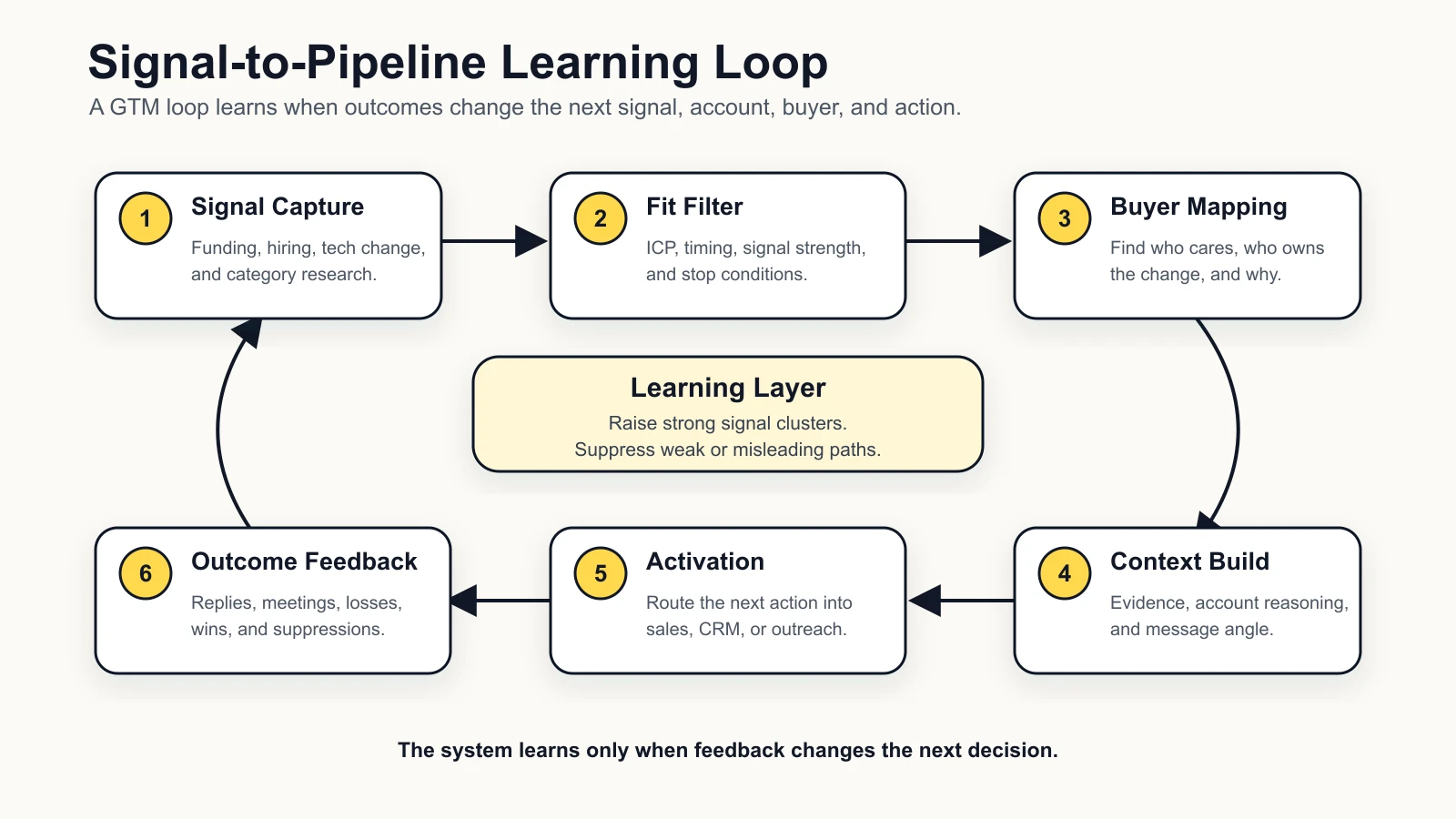
Many GTM workflows jump from signal to enrichment, then from enrichment to sequence. A company posts a hiring signal, so the workflow finds emails. A company announces funding, so the system launches outbound.
That skips judgment.
If the fit filter is weak, buyer mapping is missing, and signal strength is never scored, enrichment simply adds fields to the wrong object. Worse, the workflow can sync bad records downstream and pollute the CRM.
When I look at this as a GTM systems problem, it is a data-model failure before it is a copywriting failure. A better email cannot fix the wrong account, wrong persona, or wrong moment.
Signals are not unique; synthesis is the hard part.
Lev8 is most useful in the early and middle parts of this loop: finding relevant companies from live signals, reasoning about why an account matters now, mapping the people tied to that change, and turning the context into something sales can act on.
The final learning layer still needs rules. What counts as a positive reply? What counts as a qualified conversation? Which disqualification should lower a signal weight?
Without those rules, the loop becomes a dashboard.
Why Most GTM Automation Fails
GTM automation usually fails quietly.
On the surface, it looks like an execution problem. SDRs were slow. Emails were generic. The intent vendor was noisy. Contact data was stale. CRM fields were incomplete.
Sometimes all of that is true.
The deeper failure is that the system never decided whether each step should happen in the first place. That is the same gap between intent signals to sales action: seeing activity earlier is not enough if the team still lacks context, buyer mapping, and a next move.
| Failure Mode | What the Team Thinks It Has | What It Actually Lacks |
|---|---|---|
| Static account list | TAM coverage | Timing |
| Funding alert | Buying intent | Business constraint |
| Hiring signal | Trigger event | Persona relevance |
| Enriched contact | Reachability | Reason to engage |
| AI email | Personalization | Evidence and relevance |
| CRM activity | Data | Learning loop |
Static lists are weak on timing.
An account can match the ICP perfectly and still have no active reason to care. No team change. No budget pressure. No technology shift. No internal priority. Outreach starts cold, even if the list looks clean.
Generic intent signals create a different problem. An account appearing in a dashboard does not prove buying motion. It could be research, competitor activity, a student project, a single anonymous visitor, or a weak topic match.
Alerts without evidence become noise.
Enrichment gets misused too. A common workflow enriches every record first and figures out action later. Better systems reverse that order: decide whether the record deserves to enter the workflow, then enrich only what affects the decision.
A good GTM workflow has stop conditions:
- Poor account fit: stop.
- Signal is too old: stop.
- Buyer persona is unclear: research before sequencing.
- Email verification is weak: keep it out of cold outbound.
- Signal does not change the message angle: treat it as background context.
Without stop conditions, automation spreads weak assumptions faster. It can waste credits, dirty the CRM, and make a segment look unresponsive when the real issue was bad routing.
More AI copy will not fix that.
AI can make an email sound more natural. It cannot prove that the signal deserved action.
What Makes a GTM Signal Worth Acting On?
A signal is a clue.
It is not intent by itself.
Signal-based outbound gets sloppy when teams treat every new event as a reason to send. Funding becomes a trigger. Hiring becomes a trigger. Website visits become a trigger. Content engagement becomes a trigger.
That creates volume, not judgment.
A signal is worth acting on only when it changes at least one GTM decision: who to contact, when to contact them, what to say, how to prioritize the account, or what to suppress.
If the team is still defining which signal deserves action, start with a sharper framework for buying signals before routing anything into outbound.
Use seven filters before a signal turns into action:
- Fit: Does this account match the ICP?
- Timing: Is the signal recent enough to still matter?
- Strength: Does it suggest business pressure, not routine activity?
- Specificity: Does it point to a concrete constraint?
- Persona relevance: Does it connect to a buyer, champion, or operator?
- Evidence: Can sales explain why the signal matters?
- Actionability: Does it change who to contact, why now, or what to say?
If a signal does not change action, it is context.
Take funding. A funding round by itself is often too broad. A company that raised money 45 days ago, is hiring RevOps and SDR managers, mentions Salesforce routing in job descriptions, and is expanding outbound coverage tells a stronger story.
That is a signal cluster.
The same principle applies to hiring, technographics, website behavior, category research, competitor activity, and executive changes. A single signal can be useful, but it is often thin. Multiple signals pointing to the same business constraint are much stronger.
Watch the false positives.
A hiring post may reflect growth, or it may replace someone who left. A technology change may signal a new initiative, or it may be a script update. A website visit may suggest interest, or it may be irrelevant traffic.
The question is not "did something happen?"
The better question is:
Is this signal specific enough to change the next GTM decision?
If not, it belongs in monitoring. Not outreach.
How Signal-to-Pipeline Systems Actually Learn
Reporting is not learning.
Reporting tells the team what happened. Learning changes what happens next.
Most CRMs contain activity data: sent, opened, clicked, replied, booked, lost, won. Those fields are useful, but they often sit in the reporting layer. They describe the past without changing the next account selection, signal score, buyer hypothesis, or message logic.
A signal-to-pipeline system learns when outcomes become inputs.
| Feedback Input | What It Should Change |
|---|---|
| No reply | Message angle, persona hypothesis, or channel timing |
| Positive reply | Signal weight, account pattern, and buyer profile |
| Meeting booked | Account-fit and buyer-fit assumptions |
| Disqualified | Suppression rule or weaker signal label |
| Closed won | Lookalike pattern and stronger signal cluster |
| Closed lost | Competitive context, budget timing, or routing logic |
Suppose a campaign targets companies with RevOps hiring signals. After two weeks, positive replies come only from accounts that also have a new VP Sales, rapid SDR hiring, and job descriptions mentioning Salesforce cleanup.
The system should not raise the weight of every RevOps job post.
It should raise the weight of that cluster.
Likewise, if funding-based outreach keeps getting "not a priority" replies, the workflow should learn that funding alone is not a trigger. Funding plus a concrete GTM change may be.
The loop is not more automation. The loop is learning which signals create pipeline.
That is why I do not like reducing GTM loop engineering to "build a Clay table" or "connect more APIs." More APIs do not make a system learn. More providers do not make a record trustworthy. More enrichment steps do not move an account closer to pipeline.
Learning happens when outcomes change the rules.
A minimum viable GTM feedback loop can stay simple:
- Define the signal hypothesis before the campaign starts.
- Record the trigger signal and message angle for each account.
- Tag replies as positive, negative, wrong persona, bad timing, or not ICP.
- Review which signal clusters created qualified conversations.
- Raise strong clusters and suppress weak ones in the next run.
No need to overbuild.
But the loop has to exist.
Where Lev8 Fits In
Lev8 should not be positioned as "more leads."
That framing is too small.
The stronger role for Lev8 is helping GTM teams build a cleaner signal-driven workflow: find relevant accounts, understand why they matter now, map the right people, enrich and verify context, and prepare outbound action.
Example workflow: RevOps hiring signal to pipeline action
| Step | Example |
|---|---|
| Signal | A B2B SaaS company raises funding and posts RevOps, Sales Ops, and SDR Manager roles within 14 days. |
| Fit | The company matches target size, region, sales motion, and tech stack. |
| Account reasoning | The signal cluster may point to routing cleanup, forecasting pressure, CRM hygiene, or sales process scaling. |
| Buyer mapping | Identify VP Sales, Head of RevOps, Sales Ops lead, and Growth leadership. |
| Enrichment | Verify contact data, title, company context, and source evidence. |
| Outreach angle | Avoid "saw you are hiring." Anchor the message around the operational pressure created by team expansion. |
| Feedback | Track reply quality, meeting outcome, and disqualification reason to tune the next signal model. |
Lev8 can support the FIND, BUILD, INTENT, and ENGAGE parts of this workflow. It can help teams discover companies and people from live market signals, build usable context, understand why timing matters, and turn that context into outreach-ready action.
The healthier claim is not that Lev8 replaces GTM judgment.
It reduces the gaps between signal and action.
Less glue. More judgment.
That matters for small teams. Maintaining scrapers, enrichment providers, workflow automations, dedupe rules, and CRM sync logic is not free. A stack that looks impressive in a demo can become operational debt by next Tuesday.
A GTM loop only works if the team can keep running it.
How to Evaluate GTM Loop Engineering Tools
Buy the right layer.
A tool that finds emails is not automatically a GTM loop platform. A tool that sends sequences is not automatically a signal-to-pipeline system. A tool that shows intent alerts is not automatically an action engine.
The evaluation should start with the decision chain.
| Criterion | Weak Tool | Strong GTM Loop Platform |
|---|---|---|
| Signal quality | Generic funding or hiring alerts | Signals tied to business constraints |
| Identity | Company name only | Company, buyer, champion, and role context |
| Evidence | Black-box score | Explainable reason and source context |
| Enrichment | Bulk lookup | Fit-gated, verified, workflow-ready data |
| Activation | CSV export | Outreach-ready angle and next action |
| Feedback | Activity dashboard | Outcomes inform the next signal and play |
| Operator fit | Complex DIY stack | Repeatable workflow for lean GTM teams |
This is not a ranking table. It is a layer check.
Some tools are excellent enrichment providers. Some are strong engagement systems. Some intent platforms are useful for account visibility. But if the tool cannot help sales understand who to contact, why now, what evidence supports the action, and what should change after the result, it stops before the loop.
I would look hardest at three things.
First, the identity layer. Company, person, role, source, and signal evidence cannot be mixed loosely. If identity is weak, downstream automation will sync the wrong context.
Second, the stop conditions. Not every signal should trigger enrichment. Not every enriched record should enter a sequence.
Third, feedback structure. Even if the feedback loop is not fully automated, the system should help the team see which signal clusters led to qualified conversations and which ones wasted time.
A tool that only increases output is an executor.
A GTM loop tool improves judgment.
Common Mistakes
Treating every signal as intent
A signal is not a buying committee.
Funding, hiring, website visits, content engagement, and category research can all be useful. They can also be misleading. The difference comes from context: account fit, buyer relevance, timing, and evidence.
Buying more data before defining the loop
Teams often buy a database, add enrichment, connect a sequencer, and then wonder why pipeline did not improve.
The order is backwards. Define which signals enter the workflow, which accounts get excluded, what outcome counts as success, and when the system should stop.
Automating outreach before verifying identity
The wrong persona in a sequence is worse than a missing contact.
A missing contact is a gap. A wrong contact pollutes the CRM, burns sending capacity, and can make a good segment look bad.
Measuring replies instead of qualified conversations
Reply rate can lie.
A polite reply, vendor reply, student reply, wrong-persona reply, and real buyer reply may all look positive in a dashboard. GTM loop engineering needs to learn from qualified conversations, not every response.
Letting CRM become a warehouse
A CRM should not only store activity.
If closed-lost reasons, bad timing, wrong persona, and not-ICP tags never change the next campaign, the CRM is a warehouse. Not a learning layer.
Mistaking a workflow for a strategy
A complicated automation can still be strategically weak.
If the team cannot explain why this signal matters, why this buyer is relevant, and why this message fits the current moment, the workflow is just a polished batch sender.
The damage compounds.
Conclusion: The Next GTM Advantage Is a Learning Loop
GTM loop engineering is not about more leads or longer automation chains.
It is about helping the GTM system learn which signals matter, which accounts deserve action, which buyers should be mapped, and which messages create qualified conversations.
The next advantage will not come from the biggest database.
The edge is learning speed.
Teams that turn outcome feedback into better signal selection, sharper ICP refinement, and cleaner outreach logic will reduce noise faster than teams that keep adding tools to the stack.
Build a cleaner signal-to-pipeline workflow with Lev8.
If your team is still stitching together spreadsheets, scrapers, intent alerts, enrichment tools, and sequencers, Lev8 can help connect live signals, buyer mapping, verified context, and outbound action into a clearer GTM workflow.