




Intent Data Isn't Broken. The Follow-Up Motion Is.
B2B sales teams have spent the last few years trying to solve the same problem:
How do we reach buyers before they raise their hands?
Inbound forms often arrive late. Cold outbound is getting harder to personalize. Static account lists go stale quickly. By the time a buyer is ready to speak with sales, they may have already compared vendors, shaped internal requirements, and built a shortlist.
That is why intent data became so attractive.
The promise was simple: if sales teams could see which accounts were researching a relevant topic, they could reach out earlier, prioritize better, and start more relevant conversations.
But many GTM teams discovered a second problem.
Seeing interest earlier does not automatically tell sales what to do next.
The Dashboard Looks Promising. The Meetings Do Not.
It usually starts with a dashboard that looks promising.
A group of accounts is showing intent. Some are researching the category. A few are comparing vendors. One or two look like they might be moving into an active buying cycle.
Marketing sees momentum.
Sales sees another list of accounts to chase.
Then the pipeline meeting comes around.
Question: If these accounts are showing intent, why are we not booking more meetings?
That is the gap this article is about.
Intent data can help teams see interest earlier, but it does not automatically tell an SDR who to contact, why the account matters now, what message to send, or how to follow up before the buying window closes.
Core thesis: Intent data does not fail because buyers are not researching. It fails when GTM teams stop at the signal.
Key idea: Intent data shows interest. Meetings depend on what happens after the signal.
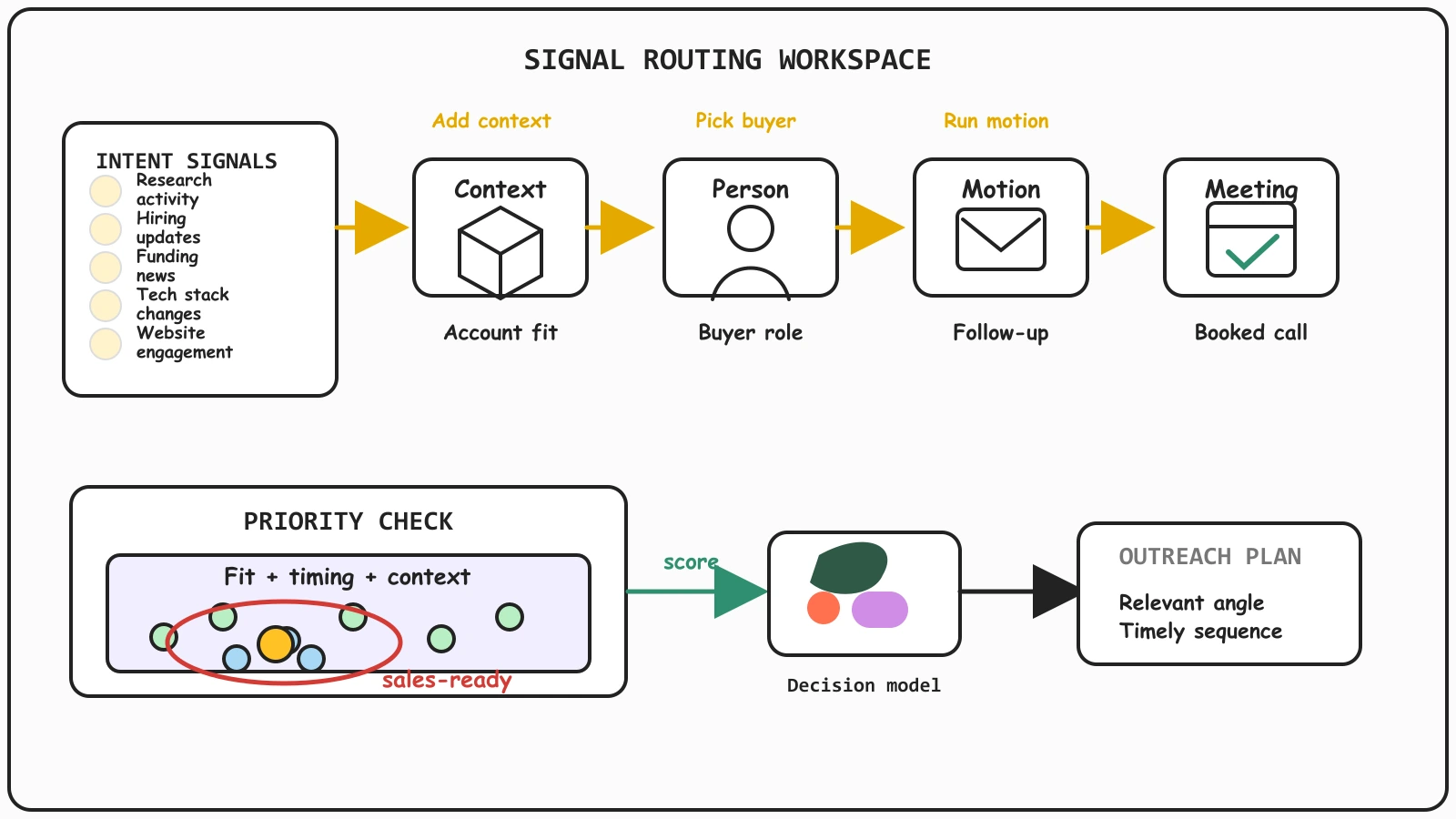
The Meeting Gap Behind Intent Data
Intent data gives GTM teams something they did not have before: earlier visibility.
Instead of waiting for a form fill or starting from a cold list, teams can see which accounts may be exploring a relevant problem, comparing solutions, or consuming content around a category.
That visibility is valuable. It helps teams avoid completely cold outreach. It gives marketing and sales a shared starting point. It can also help SDRs focus on accounts that are more likely to care.
But visibility is not the same as sales readiness.
A signal may tell you that an account is active. It may suggest that someone at the company is searching, reading, comparing, or evaluating.
But it does not automatically answer the questions sales actually needs answered.
- Is this account a good fit?
- Is the timing real?
- Is the right buyer involved?
- Should the team act now?
At first, the problem often looks like a data problem.
Maybe the topics are too broad. Maybe the accounts are not really in-market. Maybe SDRs are not acting fast enough. Maybe the vendor is not accurate enough.
Sometimes those things are true. Intent data accuracy matters.
But accuracy is only the floor.
Even a clean signal still has to become a decision.
Operating checkpoint: Intent data is useful only when the team knows what decision the signal should trigger.
This is why intent data accuracy is not sales readiness. A signal can tell the team where to look. It does not always tell the team how to move.
Why the Signal Feels Useful but Not Usable
Take an account that is researching AI prospecting.
On the surface, that looks promising. The company is exploring a topic related to your product. It may be comparing tools, reading category content, or trying to understand how AI can improve outbound sales.
But the signal is still unfinished.
Example: An account is researching AI prospecting The signal tells you the account may be interested. It does not tell you whether the company is hiring SDRs, whether a new sales leader just joined, whether the team is replacing a sales engagement tool, or whether the right buyer sits in Sales, RevOps, Growth, or the founder's office.
Without that context, the signal creates activity, not direction.
Marketing sees a strong account signal. RevOps sees something that needs scoring and routing. Sales sees a vague alert that still requires manual research before it becomes useful.
The rep is left to answer the practical questions alone:
- Who owns this problem?
- Why would this account care now?
- Is this a real buying window or just category research?
- What message would feel relevant?
- Should this trigger one email, or a full follow-up sequence?
That is too much interpretation to leave to every individual rep.
Some reps will ignore the alert. Some will send a generic email. Some will chase the account too early. Others will follow up too late, after the moment has already passed.
Key idea: The meeting is usually lost in the gap between signal and action.
Where the Workflow Breaks
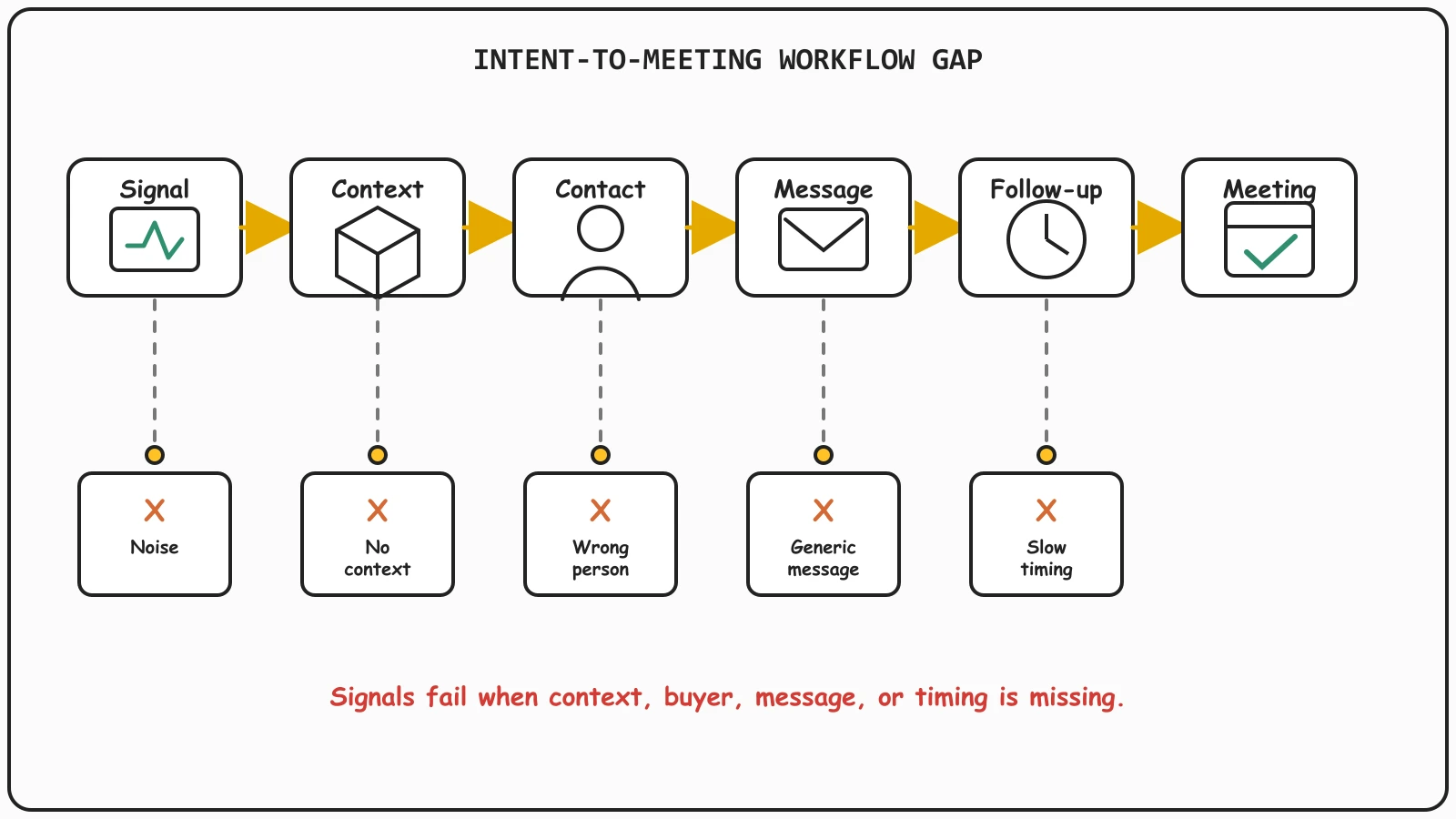
Most intent-to-meeting failures happen in the middle of the workflow, not at the top of the funnel.
The account may be active. The signal may be real. But if the team cannot connect signal, context, person, message, and follow-up, the meeting never materializes.
There are three common breakpoints.
The Account Is Not Prioritized
Not every intent signal deserves the same sales action.
Some accounts may be casually researching. Some may be too small, too early, or outside your ICP. Others may show a stronger combination of fit, timing, and need.
If every signal becomes an SDR task, reps quickly stop trusting the alerts.
A better workflow scores the account before it enters a sales motion.
- Account fit + Signal strength + Timing + Business context + Contactability + Actionability = Sales-ready priority
Return to the AI prospecting example.
An account researching AI prospecting is interesting. But if that same account is also hiring outbound reps, expanding into a new market, and bringing in a new VP Sales, the signal becomes much stronger.
The research signal shows interest. The surrounding context explains why the account may be worth acting on now.
The Buyer Is Not Identified
An account signal is not the same as a buyer.
A company may show interest, but the rep still needs to know who is most likely to care.
For an AI prospecting signal, the right contact could be a VP Sales, Head of RevOps, SDR Leader, Growth Lead, or Founder. The right choice depends on company size, sales motion, team structure, and the nature of the signal.
If the rep reaches the wrong person, even a good signal can turn into a weak conversation.
That is why teams need to move from account-level activity to persona-level action.
- Account signal -> likely function -> relevant persona -> contact path -> message angle
Before outreach begins, teams need a repeatable way to find decision makers from a company URL and connect the account signal to the right buying role.
The Message Is Not Connected to Timing
A signal does not create relevance unless it changes the message.
This is where many outbound motions fall flat. The rep may technically have intent data, but the email still sounds like a generic cold message.
A weak message says:
I noticed your company may be interested in sales automation.
A stronger message interprets the signal:
Teams expanding outbound often reach a point where more contacts do not create more meetings. The harder part is knowing which accounts are worth acting on now.
The second message does not just say, "I saw you were researching." It connects the likely business situation to a problem the buyer may recognize.
That is the difference between personalization and relevance.
Operating checkpoint: A signal should not enter an SDR queue until it has context, contact logic, and a message angle.
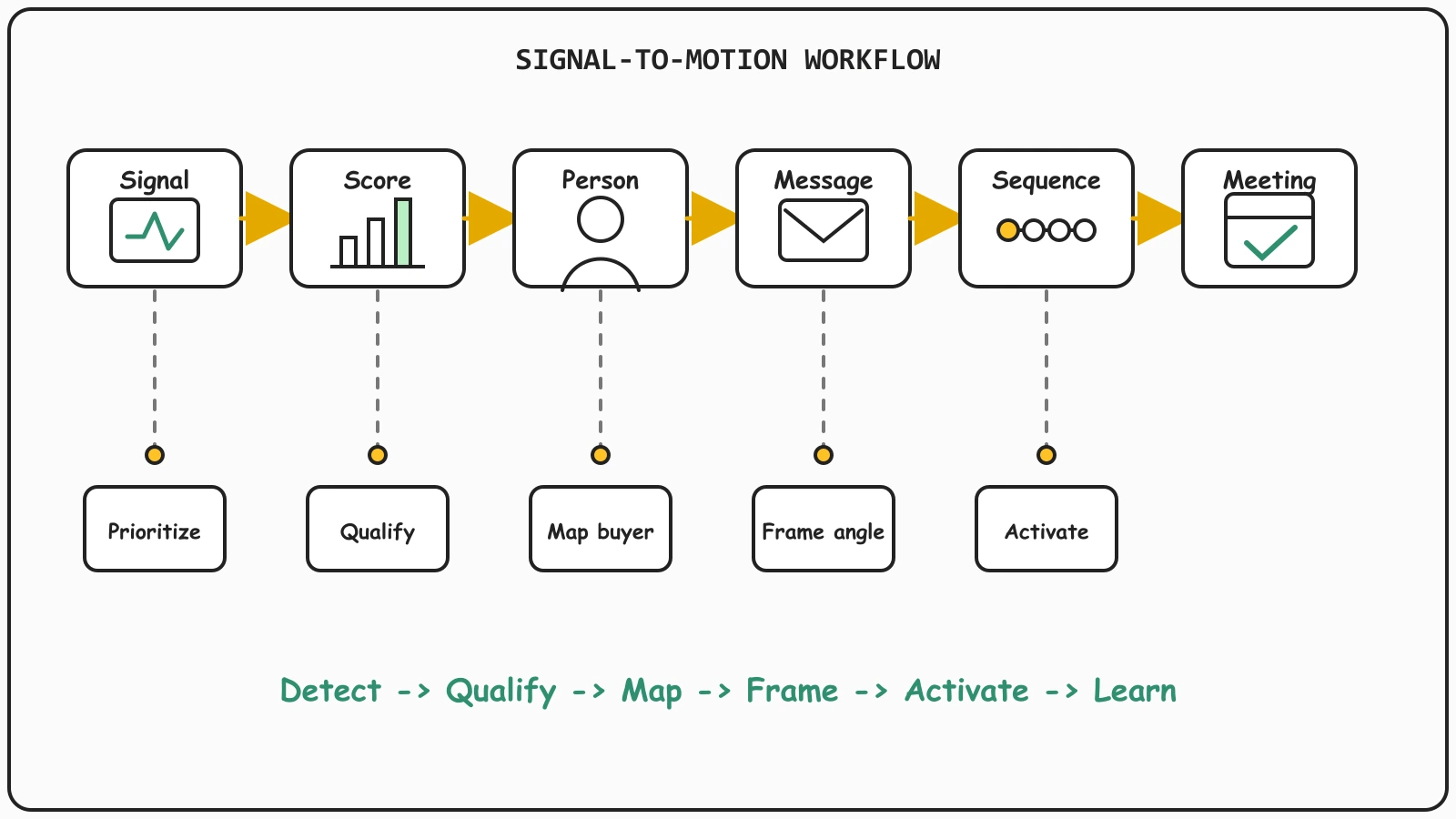
What a Better Signal-to-Motion Workflow Looks Like
A better workflow does not ask SDRs to interpret every signal manually.
It turns each signal into a series of sales decisions.
The motion should look less like this:
Account shows intent -> SDR sends email
And more like this:
Detect -> Qualify -> Map -> Frame -> Activate -> Learn
The goal is not to move faster from signal to email. The goal is to move more intelligently from signal to action.
Start with the same example: an account is researching AI prospecting.
A basic workflow sends that account to an SDR queue. A stronger workflow asks:
- What changed?
- Is this account worth acting on now?
- Who is most likely to own the problem?
- Why would this matter to them today?
- What follow-up motion should run?
- What can we learn from the outcome?
That changes the role of intent data. The signal is no longer just an alert. It becomes the first step in a decision workflow.
Detect
The workflow starts by detecting what changed.
An account may be researching a relevant topic, comparing vendors, hiring for a related role, expanding into a new market, replacing a tool, or showing activity around a competitor.
At this stage, the goal is to identify that something may be happening.
Qualify
Next, the team decides whether the signal deserves action now.
Not every signal should become an SDR task. Some accounts are a poor fit. Some are too early. Others may show a stronger pattern of timing and need.
For example, an account researching AI prospecting becomes more compelling if the company is also hiring SDRs, expanding outbound coverage, or bringing in a new VP Sales.
The research signal shows interest. The surrounding signals explain why the account may be worth acting on now.
Map
Once the account is qualified, the workflow needs to identify who is most likely to care.
For an AI prospecting signal, the right contact might be a VP Sales, Head of RevOps, SDR Leader, Growth Lead, or Founder.
A stronger workflow maps the signal like this:
- Account signal -> likely business problem -> relevant function -> buyer persona -> contact path
Frame
Once the buyer is identified, the signal needs to become a message angle.
A weak message says:
I noticed your company may be interested in sales automation.
A stronger message interprets the signal:
It looks like your team may be expanding outbound coverage while exploring AI prospecting. Teams at that stage often run into the same issue: more contacts do not automatically create more qualified conversations.
That is the difference between personalization and relevance.
Activate
A strong signal should not trigger one isolated email. It should trigger a follow-up motion.
The first touch introduces relevance.
The second touch clarifies the pain.
The third touch makes the use case concrete.
- Signal: AI prospecting research
- Context: outbound expansion
- Buyer: VP Sales
- Angle: more contacts are not creating more qualified meetings
- Motion: three-touch executive outreach sequence
The point is to make sure that a timely signal becomes a timely conversation.
Learn
The workflow should not stop after outreach.
Teams need to learn which signals, accounts, personas, and message angles actually create replies, meetings, and pipelines.
The team should not only ask, "Did this account show intent?" It should also ask, "Which signals actually turned into sales conversations?"
That is how intent data becomes more than a dashboard. It becomes part of a self-improving GTM motion.
Operating checkpoint: A strong signal should trigger a decision workflow, not just an email task.
From Intent Data to Buying Signals
Intent data is one type of buying signal.
But it is rarely enough on its own.
A company reading about a category may be curious. A company reading about a category while hiring for a relevant role, expanding into a new market, replacing a tool, or bringing in a new GTM leader is much more interesting.
That is why GTM teams should move from isolated intent alerts to buying signal combinations.
Research signal + Hiring signal + Leadership change + Funding or expansion + Technology stack change = Stronger buying window
The goal is not to collect every possible signal. The goal is to understand which combinations create a credible reason to act.
- Category research + new sales hiring
- The account may be scaling outbound capacity.
- Competitor research + tech stack change
- The account may be re-evaluating its current workflow.
- Leadership change + GTM content consumption
- A new leader may be reviewing tools and process changes.
- Funding + hiring + category activity
- Growth pressure may create a stronger buying window.
This is why buying signals for outbound teams matter. They help teams move beyond "someone is researching" and toward "this account may have a real reason to act."
Intent data tells you interest may exist. Buying signals help explain whether that interest deserves action. Opportunity signals go one step further by helping teams identify real buying windows before buyers raise their hands.
Key idea: Sales teams do not need more alerts for their own sake. They need a better way to understand timing.
How Lev8 Turns Signals Into Action
Before replacing an intent data source, it may be worth asking a different question:
Where does the signal stop becoming actionable?
For many GTM teams, the issue is not that there are no signals. The issue is that signals do not move cleanly into account prioritization, contact discovery, message generation, follow-up, and learning loops.
Lev8 helps teams close that gap.
Instead of treating intent data as a static alert, Lev8 helps GTM teams build a live signal-to-motion workflow.
Lev8 helps teams detect live public signals, identify relevant accounts, connect signals with account context, find the right contacts, generate outreach angles, and trigger follow-up before the opportunity goes cold.
That matters because most GTM teams do not fail from a lack of data. They fail because the data does not become action quickly enough.
Lev8's live signals capability helps teams track buyer intent data and market movement in real time, then route stronger signals into a workflow that sales can actually use.
This is also why AI sales agents are changing the GTM workflow. The shift is not just from manual to automated. It is from static list building to signal-driven action.
The old workflow looked like this:
Buy list -> enrich contacts -> send generic outbound -> hope for replies
The new workflow looks more like this:
Detect signal -> understand context -> find the right person -> generate a relevant angle -> launch a motion -> learn from results
That is the real promise of intent data.
Not more alerts. Better timing, better context, and better follow-up.
Final CTA
Stop letting intent signals sit in a dashboard.
Use Lev8 to turn live public signals into account priority, buyer mapping, relevant outreach, and follow-up motion.