




Most teams searching for AI tools for prospecting are not trying to send a few more emails. They are trying to fix an upstream mess: stale lists, weak timing, bad contact data, and reps who cannot explain why an account deserves attention now.
If your team is moving from static databases to real-time buyer intent signals, the buying criteria changes. The right tool should help you find accounts entering a buying window, identify the people worth contacting, and turn that signal into a clear next action.
That is the line between automation and actual prospecting intelligence.
What Signal-Based Prospecting Actually Changes
Static prospecting starts with a list. Signal-based prospecting starts with a reason.
That difference matters because a perfectly enriched list does not help much if you reach out before someone has a reason to care. Better data is useful, but timing is often what moves the needle: a job change, a funding announcement, a hiring spike, a competitor mention, or a public shift in priorities.
| Old Prospecting Habit | Signal-Based Prospecting Shift | Why It Matters |
|---|---|---|
| Start with a static company list | Start with recent buyer intent signals | Reps prioritize accounts with a current reason to care |
| Filter by title and industry only | Filter by ICP fit, timing, and reachability | The list becomes smaller, but more actionable |
| Use AI to write more emails | Use AI to interpret context and next steps | AI supports judgment instead of just volume |
| Measure sends and opens | Measure positive replies, meetings, and signal-to-meeting conversion | The workflow is judged by pipeline quality |
A useful signal should answer five questions:
- Where did this signal come from?
- How recent is it?
- Does it match your ICP?
- Can you reach the right person?
- What should sales do next?
If a tool only says "this company has intent," that is not enough. Reps need a business reason, a target contact, and a relevant opening angle. Otherwise, signal-based prospecting turns into another noisy dashboard.
How to Evaluate AI Tools for Prospecting by Buyer Intent Signals
The best AI tools for prospecting are not the ones with the most AI features. They are the ones that help you separate signal from hype.
Start with the signal layer. Good tools should capture buying signals such as hiring growth, funding, executive moves, tech-stack changes, category engagement, competitor activity, and public company updates. Better tools should also score those signals by strength, recency, fit, and reachability.
A funding round, for example, is not automatically a sales opportunity. If the round supports international expansion and you sell compliance workflow software, there may be a reason to engage. If the company raised money for consumer brand expansion and you sell developer infrastructure, the same signal may be noise.
The tool has to make that distinction.
Look for these evaluation criteria:
- Signal coverage: which public and private sources does it monitor?
- Recency: does it catch signals within days, or months later?
- ICP fit: can it filter signals against your actual target account profile?
- Contactability: can it identify reachable decision-makers?
- Context: can it explain why the signal matters?
- Action: can it recommend the next best step?
A real signal workflow does more than find activity. It turns activity into judgment.
The Best AI Prospecting Tools Are Not All the Same
"AI prospecting tool" has become a messy category. Some products are databases. Some are enrichment tools. Some are sequencers with AI writing. Some are AI SDRs. Some are signal engines.
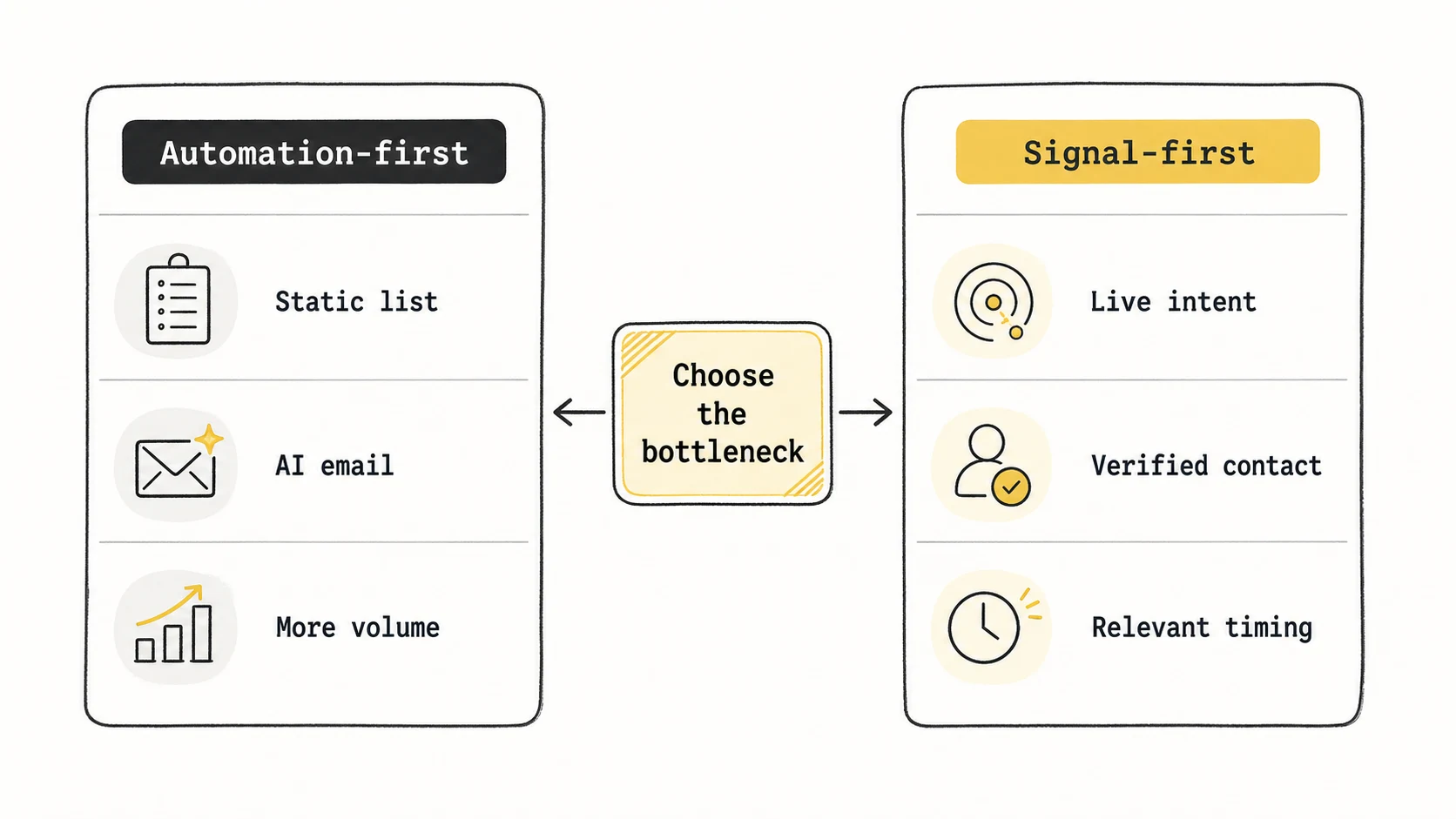
Different tools solve different bottlenecks.
| Tool Category | Best For | What It Handles Well | Where It Usually Falls Short |
|---|---|---|---|
| Contact databases | Fast starting lists and broad account discovery | Company and contact search, basic filters, quick exports | Data can age quickly; timing is often missing |
| Enrichment tools | Filling missing company and contact fields | Waterfall enrichment, firmographics, email data, role context | Enrichment alone does not tell reps why now |
| Signal detection tools | Finding accounts with current buying triggers | Hiring, funding, executive moves, tech changes, competitor activity | Signal noise can be high without ICP scoring |
| Sales engagement tools | Sequencing and follow-up execution | Email sending, multichannel cadence, deliverability workflows | They amplify list quality; they do not create it |
| AI SDR / AI agent tools | Research, personalization, and workflow automation | Drafting, routing, task automation, some account research | Weak inputs lead to robotic outreach at scale |
If your issue is finding the right accounts, you have a data and signal problem. If your issue is sending at scale, you have an automation problem. If your issue is bounce rate, you probably have a data quality or sender infrastructure problem. Mixing those up leads teams to buy tools that make the wrong workflow faster.
Some AI SDR tools are just a glorified sequencer. The good ones handle research, context, personalization, and routing before anything gets sent.
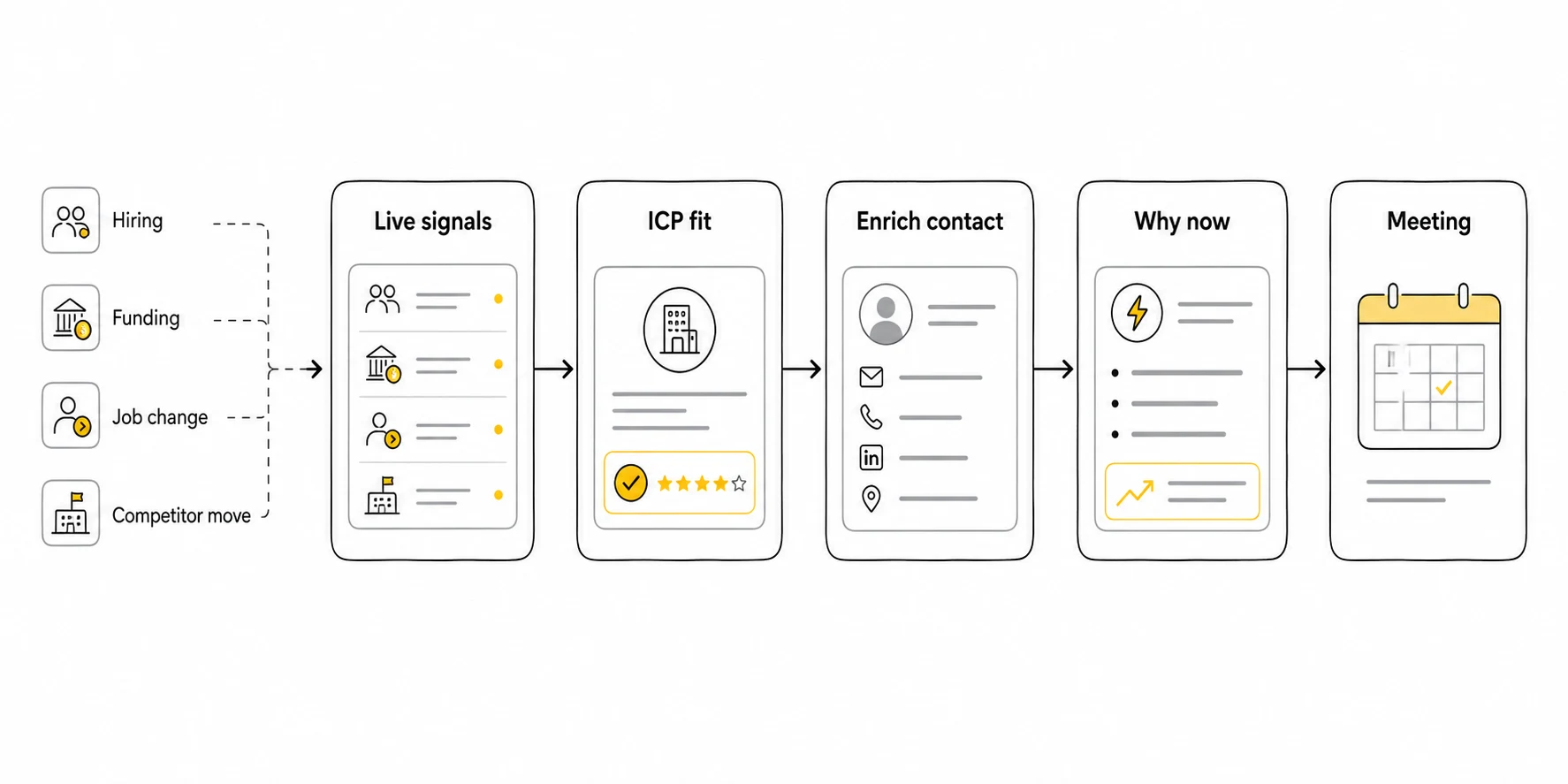
The Signal-Based Prospecting Workflow From Signal to Meeting
A clean workflow beats a crowded stack.
Capture the Signal
Start narrow. Early-stage teams do not need 20 weak signals. They usually need 3-4 strong signals tied to a specific sales hypothesis.
Examples include:
- A new VP joins and is likely reviewing team systems.
- A company raises funding and starts hiring for revenue roles.
- A competitor is mentioned in public complaints or migration threads.
- A team posts about scaling outbound, pipeline coverage, or GTM hiring.
Forget volume, think precision. A small list of 100-200 ideal prospects can teach you more than a huge cold list with no timing logic.
Enrich the Account and Contact
A signal is not a lead yet. You still need account context, role relevance, contact data, and a reason to believe the person can influence the buying process.
Bad data ruins everything upstream. If the contact is outdated, unreachable, or irrelevant, the rest of the workflow gets polluted. The AI message may look polished, but it is still attached to a bad target.
Score Urgency, Fit, and Reachability
Every signal needs a score. Not a vanity score, a working score that helps a rep decide what to do next.
A practical scoring model should include:
- Urgency: did the signal happen in the last 24-72 hours, this month, or last quarter?
- Fit: does the company match your ICP?
- Role relevance: can you identify the buyer, influencer, or champion?
- Contactability: is the email or LinkedIn profile reachable?
- Message angle: is there a credible reason to start a conversation?
More signals do not always mean better coverage. Sometimes they just create more ways to distract the team.
Generate the First Touch
AI helps when the inputs are specific. It struggles when the only inputs are company name, title, and industry.
A strong signal-based opener should connect a business event to a relevant problem. That might mean referencing a hiring surge, a new revenue leader, a public initiative, or a competitor displacement moment. The message should feel timely, not creepy.
Example: generic vs signal-based opener
Generic:
"Congrats on the growth at Acme. I thought you might be interested in improving outbound efficiency."Signal-based:
"Noticed Acme is hiring three SDR managers after bringing in a new VP Sales. Teams usually revisit routing, account scoring, and rep research at that point. Worth comparing how you are prioritizing accounts before the new team ramps?"
A weak AI opener says the prospect is "growing fast" and might want to "drive efficiency." A stronger opener explains why a recent business change creates a specific operational pressure.
Measure Signal-to-Meeting Conversion
Open rate is not enough. Send volume is even less useful.
Signal-based prospecting should be measured by positive reply rate, meeting booked rate, signal-to-meeting conversion, time-to-first-touch, and bounce rate. If a campaign gets attention but no meetings, the signal may be interesting but not commercially strong enough.
The AI can help with execution. It cannot replace the judgment loop.
Common Mistakes When Choosing AI Sales Prospecting Tools
The first mistake is buying the AI label. Many teams need cleaner data, sharper ICP logic, and fewer but stronger signals. Another writing assistant will not fix that.
The second mistake is scaling low-quality outreach. If a tool sends hundreds of emails without genuine relevance or timing, you end up burning through lists quickly. In worse cases, teams burn domains fast because the system optimizes for volume over relevance.
The third mistake is treating bounce rate as a copywriting problem. The AI cannot fix a 35% bounce rate. That usually points to old databases, weak verification, catch-all emails, poor sender setup, or neglected warmup.
The fourth mistake is over-personalization. Signal-based messaging should use business context, not private-feeling trivia. A relevant funding round, hiring pattern, tech change, or public initiative is fair game. A message that feels like surveillance is not.
One more trap: buying an AI SDR before the team has basic prospecting infrastructure. If reps lack CRM access, Sales Navigator, a defined ICP, clean contact data, and a simple sequence, automation just exposes the gap faster.
Where Lev8 Fits in a Signal-Based Prospecting Stack
Lev8 fits best as the intelligence and action layer in a signal-based prospecting workflow. It is not just a static contact database, and it is not just an email automation tool.
The stronger use case is connecting live market signals to ICP fit, people search, and next-best action. When an account shows a hiring spike, funding event, tech-stack change, or competitor movement, the team needs more than an alert. They need to know whether the signal matters, who to contact, and what angle to use.
That is where a workflow tool can reduce manual stitching. Instead of asking reps to jump between data vendors, LinkedIn tabs, enrichment tools, and message generators, the signal can become a ranked account, a validated contact, and a grounded outreach reason.
No tool replaces sales judgment. The better question is whether it gives reps better judgment inputs.
Checklist Before You Buy an AI Prospecting Tool
Use this checklist before adding another tool to the stack:
- Which signals does it actually capture: hiring, funding, job changes, LinkedIn activity, website intent, competitor movement, or only static firmographic data?
- How fresh is the data? Is verification happening only at import, or does the system refresh titles, emails, and account context over time?
- Can it explain signal strength, recency, and ICP fit in plain language?
- Does it identify reachable contacts, or just companies?
- Does it support email verification, role relevance, and source confidence?
- Can it push clean data into your CRM or sales engagement tool without creating duplicates?
- Does the AI messaging use business context, or does it just rewrite templates?
- Can you measure signal-to-meeting conversion, not just dashboard activity?
- Will it help a rep decide what to do next?
If you cannot answer those questions, pause the purchase. The tool may still be useful, but you do not yet know what job you are hiring it to do.
Conclusion: Choose for Timing, Not Just Automation
The best AI tools for prospecting do not simply send more messages. They help teams catch people in the moment, validate the account, find the right contact, and explain why now is a credible time to reach out.
If you are still deciding which signals deserve attention, start with this guide to the best buying signals. Then decide whether your stack needs better data, stronger signal detection, cleaner enrichment, or tighter outreach execution.
CTA: Build a signal-based prospecting workflow that helps your team find the right accounts, verify the right contacts, and act when timing is strongest.