




Intent data is no longer just a static view of account interest. Modern GTM teams need real-time signals that reveal when market attention is becoming actionable.
Overview
Intent data used to solve a visibility problem.
It helped B2B revenue teams see which companies were researching relevant topics before those companies raised their hands, filled out forms, or directly engaged with a vendor.
That visibility still matters.
But the traditional definition of intent data is now too static for modern GTM teams.
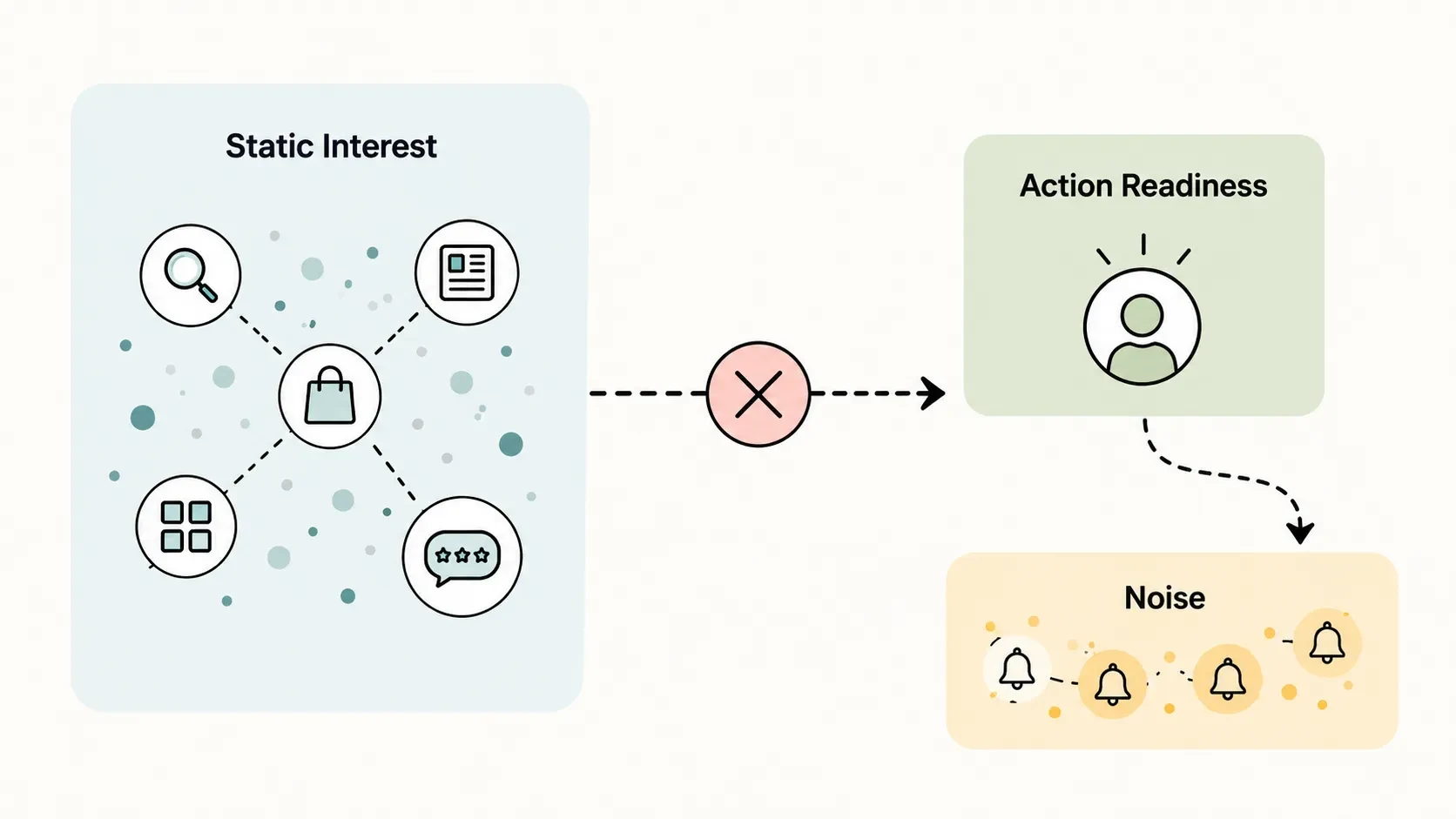
A company showing interest in a topic does not automatically mean the account is ready for action. Static interest can reveal attention, but it does not always explain timing, context, stakeholder relevance, or buying motion.
That is why intent data needs to be redefined.
The value is no longer just knowing which accounts are showing interest. The value is knowing which real-time signals suggest that interest is becoming actionable.
And once signals are layered properly, the impact goes beyond sales prioritization. It changes how the whole GTM team decides who to engage, how to segment, when to route, and what message should come next.
Static interest shows attention. Real-time signals reveal when attention is ready for action.
1. What Intent Data Used to Mean
Intent data traditionally refers to behavioral signals that suggest a company may be researching a topic, product category, or solution.
Industry definitions often frame intent data this way. Bombora describes intent data as a way to identify when buyers are actively researching solutions online, while 6sense defines intent data as digital signals that indicate when a company is actively researching a solution like yours.
These definitions are useful because they explain why intent data became valuable in the first place.
But they also show the limitation of the traditional definition: intent data is often framed around observed interest, not action readiness.
These signals may include topic research, keyword searches, article consumption, review site activity, vendor comparisons, product-category engagement, and repeated content interactions.
In simple terms, traditional intent data answers one question:
What are accounts paying attention to?
That is a useful question.
If an account begins researching AI sales agents, outbound automation, sales prospecting tools, or GTM intelligence platforms, that activity matters. It suggests the account may be paying attention to a relevant business problem.
But attention alone is not enough.
Intent data does not automatically tell you whether the activity is recent, whether the account is actively evaluating options, whether the right stakeholders are involved, or whether the timing matters now.
That is the limitation of the old definition.
Traditional intent data measures interest.
Modern GTM teams need to understand whether that interest is becoming actionable.
2. Why Static Interest Is No Longer Enough
Static interest was valuable when visibility was the main problem.
Before intent data, revenue teams relied heavily on explicit hand-raisers: demo requests, contact forms, event registrations, content downloads, and direct inquiries.
These signals were useful, but they often arrived late.
Modern B2B buying is rarely linear. Gartner's B2B buying journey research describes buying as a process shaped by multiple tasks, including problem identification, solution exploration, requirements building, and supplier selection.
By the time a buyer fills out a form, they may have already compared vendors, read category content, discussed the problem internally, or built early requirements.
Intent data helped teams see earlier signs of market activity.
But once more signals became visible, a new problem appeared.
Teams did not just need to know who was interested.
They needed to know which interest mattered.
A static interest signal can quickly become outdated. An account may have researched a topic last month, but that does not mean it is still active today. A research spike may come from one person, but that does not mean a buying group is forming. A category search may show curiosity, but not urgency.
This is why static interest creates uncertainty.
It helps teams see activity, but it does not always help them understand what the activity means.
Modern GTM teams need signals that are recent, contextual, connected to business change, linked to relevant stakeholders, and clear enough to support prioritization.
That is why intent data needs to move from static interest to real-time signals.
3. Where Traditional Intent Data Gets Misused
Traditional intent data gets misused when teams treat interest as buying readiness.
They are not the same.
A company can be interested without being in-market.
A company can be in-market without being ready for direct sales engagement.
A company can research a topic without having an active buying project.
That difference matters because intent data can describe several different states.
| State | What It Means | GTM Implication |
|---|---|---|
| Static interest | A company has shown attention around a topic | Useful for awareness and nurture |
| Active intent | A company is exploring a problem or solution category | Useful for account prioritization |
| Action readiness | A company shows timing, context, and stakeholder relevance | Useful for focused GTM action |
These states are connected, but they are not interchangeable.
When teams skip this distinction, intent data becomes noisy.
A "high-intent" account may simply be learning. A research spike may come from someone without decision influence. A topic surge may reflect curiosity, not urgency.
The signal may be real.
The interpretation may be wrong.
This is also why many practitioners have become skeptical of intent data when it is sold as a direct path to sales-ready accounts. In one B2B marketing discussion on Reddit, marketers debated whether intent data produces ROI or simply adds another layer of account-list noise.
That discussion should not be treated as statistical proof.
But it does reflect a real market concern: teams are not only asking for more signals. They are asking for better interpretation.
Intent data is not a sales trigger. It is the first signal layer in a real-time GTM intelligence system.
This is the key shift.
Intent data should not trigger action on its own. It should help teams understand which accounts may be becoming actionable, and why now.
4. Why Real-Time Signals Change the Picture
Real-time signals change the value of intent data because they add timing and context.
Instead of only asking whether an account has shown interest, real-time signals help teams understand whether something meaningful is happening now.
For example, an account researching "AI SDR software" becomes more meaningful when that activity appears close to other public signals:
- A new sales leader joins the company
- The team begins hiring outbound sales roles
- The company shows signs of expanding into a new market
This combination changes the interpretation.
The account is no longer just "interested."
It may be showing signs of a current business motion.
That is the difference between static interest and real-time signals.
Static interest says:
This account has paid attention to a topic.
Real-time signals help answer:
Is this attention connected to something that matters now?
This is where noise decreases.
The goal is not to collect more signals for the sake of volume. The goal is to connect signals into a clearer picture of timing, relevance, and action readiness.
Sales teams have voiced similar concerns. In a sales community discussion about intent data quality, practitioners questioned whether intent data still helps identify real opportunities or whether it often arrives as expensive noise.
The important point is not that intent data has no value.
The point is that intent data loses value when static interest is treated as action readiness.
For teams that want to go deeper into signal quality, Lev8's guide to buying signals for outbound teams explains how timing, fit, and signal combinations help separate meaningful account movement from research noise.
5. How Intent Data Becomes GTM Intelligence
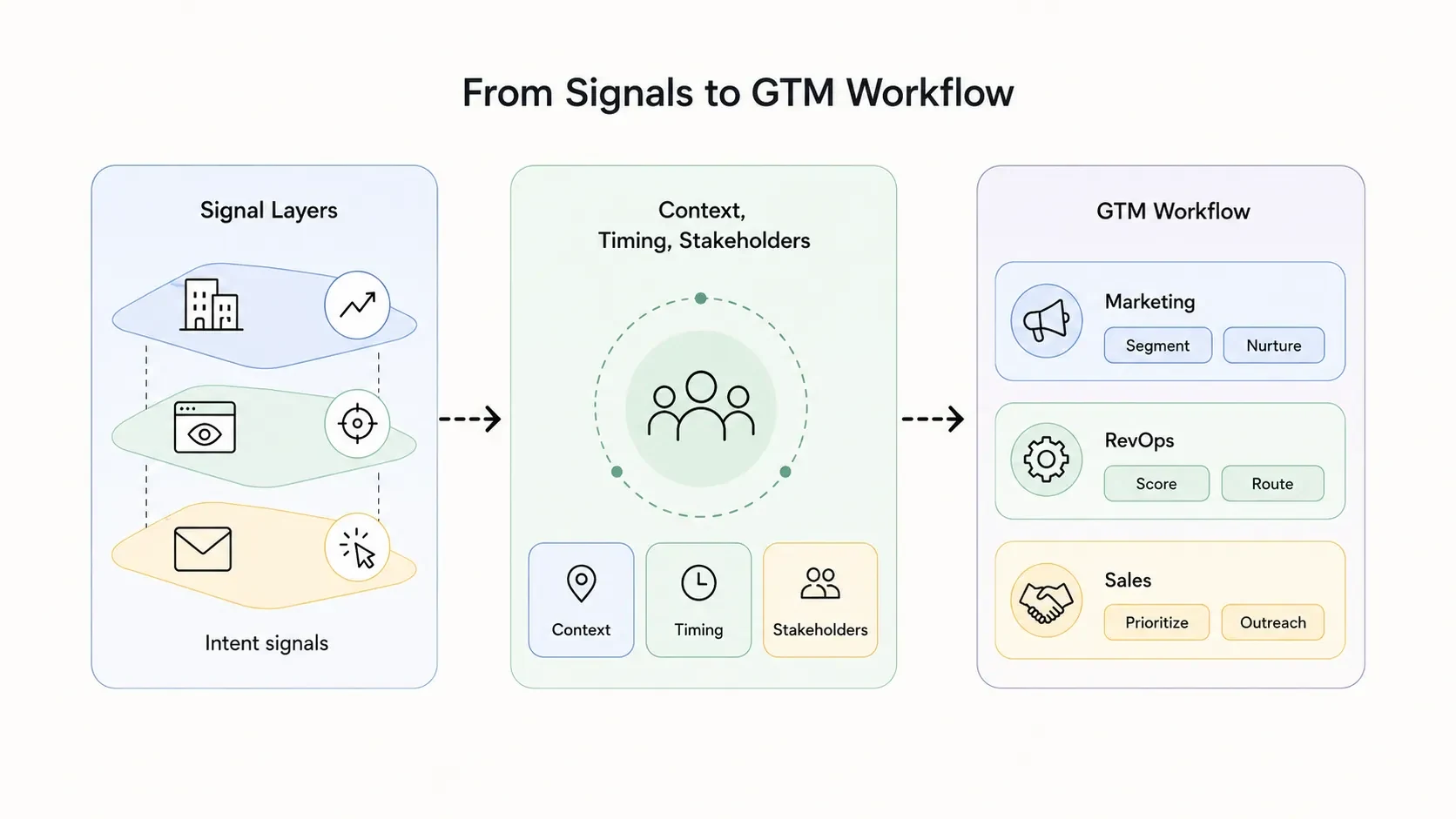
Intent data becomes more useful when teams stop treating every signal as a trigger and start treating intent as part of a layered GTM intelligence system.
A better framework has three levels.
Level 1: Intent Signals
At this level, intent data answers:
What are they paying attention to?
This includes topic research, category interest, competitor activity, product comparisons, and repeated content consumption.
The output is not a sales-ready lead.
The output is an interested account candidate.
Level 2: Context, Timing, and Stakeholders
At this level, the question becomes:
Why does this matter now, and who does it matter to?
This is where intent needs to connect with real-time context.
Relevant context may include hiring activity, leadership changes, expansion signals, technology movement, organizational structure, stakeholder roles, and public business initiatives.
For example, a company researching AI sales tools becomes more meaningful if that interest appears alongside a new revenue leader, a visible outbound hiring push, or a public growth initiative.
The output is no longer just interest.
The output is qualified account context.
Level 3: Action Readiness
At this level, the question becomes:
Is this account becoming actionable?
Action readiness requires recent signal activity, relevant business context, stakeholder relevance, clear timing, and a reason to prioritize the account now.
This is the level GTM teams actually need.
The goal is no longer just identifying interest.
The goal is understanding whether the account deserves attention now.
6. How Signal Layering Changes the GTM Workflow
The next generation of intent data is not about finding more accounts that show interest.
It is about understanding which signals deserve attention.
That is the shift from static intent data to real-time GTM intelligence.
Traditional intent data tells you where attention is forming.
Real-time signals help explain whether that attention is current, contextual, and relevant.
But the bigger shift is not only in the data.
It is in how the GTM team works around the data.
When signals are layered properly, intent data stops being a static account list and becomes a shared workflow across marketing, RevOps, sales, and growth teams.
At the first layer, intent signals help teams understand which topics, categories, competitors, or problems accounts are paying attention to.
Marketing can use this layer to shape content themes, audience segments, nurture tracks, and campaign priorities.
At the second layer, context, timing, and stakeholder signals help teams understand why the activity matters now.
RevOps and sales operations can use this layer to qualify accounts, enrich profiles, score fit, route accounts, and separate broad interest from meaningful account movement.
At the third layer, action readiness helps the team decide what should happen next.
Some accounts may belong in nurture.
Some may deserve closer monitoring.
Some may be ready for sales engagement.
Some may need a more specific campaign message based on recent hiring, leadership change, expansion activity, or technology movement.
This is where real-time GTM intelligence becomes useful.
It does not only tell one team that an account is "showing intent."
It helps the whole GTM team align around:
- Which accounts deserve attention
- Why those accounts matter now
- Which stakeholders are likely relevant
- What message should be used
- Whether the next step should be nurture, monitoring, routing, or outreach
That is a very different operating model from static intent data.
Static intent data creates lists.
Real-time GTM intelligence creates a workflow.
This is where Lev8 fits.
Lev8 treats intent data as one input in a broader GTM intelligence layer. It helps teams connect real-time public signals with account context, stakeholder relevance, and action readiness, so GTM teams can focus on accounts that are not only active, but meaningfully actionable.
The real advantage is not knowing that someone researched a topic.
It is knowing whether that research is becoming a revenue opportunity and how the GTM team should respond.
Static interest shows attention. Real-time signals reveal when attention is ready for action.