



Your best sales opportunities start before the demo request.
Opportunity signals help GTM teams spot company changes before buyers become obvious inbound leads.

The Starting Line Is Earlier Than the Demo Request
A demo request feels like a win.
An SDR follows up quickly, only to hear:
"We're already evaluating a few vendors. We'll reach out if we need anything."
The team was not slow.
They started from the wrong starting line.
Most CRMs make a sales opportunity look like it begins when someone fills out a form, requests a demo, or replies to an email.
But the buyer's decision clock often starts much earlier.
- The problem may already be clear.
- The budget may already be discussed.
- The buying group may already be involved.
- Competitors may already be in the room.
By the time a buyer raises their hand, your team may be joining a conversation that has already been shaped by someone else.
That is why the best GTM teams do not only wait for visible demand.
They look for the changes that happen before demand becomes visible:
- A company raises funding.
- A new VP Sales joins.
- The team starts hiring SDRs.
- A RevOps role appears for the first time.
- The company expands into a new market.
None of these events automatically means the company is ready to buy.
But together, they may reveal something important:
The company is changing.
That is where opportunity signals matter.
They help GTM teams understand when a target company is moving into a new business context, what kind of pressure may be forming, and whether the company deserves attention before it becomes an obvious inbound lead.
Signal is not opportunity. Context turns change into action.
A signal tells you what happened. Opportunity signals help explain what the company may need next.
The simple version is this: do not ask only whether a signal happened. Ask what the signal changes about the company.
Table 01: From Company Change to GTM Action
| What You See | What It May Mean | What GTM Should Do |
|---|---|---|
| One isolated event | Weak signal | Watch, but do not overreact |
| Hiring + funding + expansion | The company may be entering a growth phase | Gather company context |
| New VP Sales + RevOps hiring | The GTM system may be changing | Identify stakeholders and priorities |
| Clear pattern + relevant decision-maker | A sales-ready window may be opening | Launch targeted outreach |
Example:
Hiring SDRs + adding RevOps + entering a new market + new VP Sales -> The company may be rebuilding its GTM motion -> Your team should research the company, identify the right stakeholders, and prepare a relevant outreach angle.
This is the difference between tracking events and finding opportunities.
01 What Are Opportunity Signals?
Opportunity signals are company-level changes that suggest a target company may be entering a new buying window.
They are not the same as buying signals.
A buying signal usually shows interest:
- Someone visits a pricing page.
- Someone downloads a guide.
- Someone compares vendors.
- Someone requests a demo.
Those actions are useful, but they often appear after the buyer has already started thinking about the problem.
Opportunity signals look earlier.
They come from business changes that may create a reason to act:
- A company may be growing.
- A team may be under pressure.
- A new leader may be rebuilding a process.
- A market expansion may create new pipeline needs.
- A product launch may force the company to reach a new audience.
The key question is not:
Did something happen?
The better question is:
Does this change what this company may need next?
That is the difference between a random signal and a real opportunity signal.
Table 02: Buying Signals vs. Opportunity Signals
| Concept | What It Shows | What It Helps Decide |
|---|---|---|
| Buying Signals | Interest, research, or evaluation behavior | Is someone paying attention? |
| Opportunity Signals | Business change, timing, and company pressure | Is this company becoming more actionable? |
This keeps the article separate from our guide on best buying signals.
That article focuses on how to judge whether a signal is meaningful.
This article focuses on how to read the company context behind the signal.
02 Why Demo Requests Are Often Late
Visible demand is useful.
But it is not always early.
A demo request tells your sales team that someone is willing to talk.
It does not tell you when the problem started, who shaped the requirements, or which vendors already influenced the conversation.
This is why many teams feel confused by "hot" inbound leads.
The lead looks strong in the CRM.
But the sales conversation feels cold, late, or overly tactical.
The buyer may only want pricing.
They may already have a preferred vendor.
They may be collecting one more comparison.
They may not want to restart their evaluation from the beginning.
The issue is not always speed-to-lead.
Sometimes the issue is that the team only saw the buyer after the real buying window had already opened.
This matches how modern B2B buying actually works. Gartner describes the B2B buying journey as nonlinear, with buyers moving across problem identification, solution exploration, requirements building, and supplier selection before they become a clear sales conversation.
McKinsey's B2B research also shows that buyers rely heavily on digital, remote, and self-service channels throughout the buying process. That means much of the journey can happen before a rep is directly involved.
A CRM may show the journey like this:
Demo request -> Lead created -> SDR follow-up -> Meeting booked -> Opportunity opened
But the real story may have started earlier:
Business change -> New priority -> Internal discussion -> Vendor research -> Demo request -> Sales opportunity
The opportunity does not begin when a form is submitted.
It begins when change creates a reason to care.
03 The Best Signals Come From Company Change
Open LinkedIn or a company news feed and you will see signals everywhere.
A company just raised funding.
Another company is hiring 20 SDRs.
A new sales leader joined last month.
A RevOps role was added for the first time.
A new region is being launched.
Most teams react to these events in a predictable way:
"Congrats on the funding. Want to see our product?"
That rarely works.
The problem is not that the signal is bad.
The problem is that the signal was read too shallowly.
Funding alone does not tell you enough.
Hiring alone does not tell you enough.
A leadership change alone does not tell you enough.
But when those signals appear together, they may tell a much stronger story.
Example: The Weak Read
- Company raised funding
- Send generic congratulations email
This is noisy.
It does not show that you understand the company.
Example: The Better Read
- Company raised funding
- Hiring SDRs
- Entering a new market
- New VP Sales joined
- The company may be under pressure to build pipeline faster
- The sales leader may be rebuilding outbound strategy
- RevOps may need cleaner targeting and stakeholder intelligence
Now the signal has become a point of view.
The outreach angle is no longer:
"Congrats on the funding."
It becomes:
"Your team seems to be scaling outbound while entering a new market. That usually creates pressure around prioritization, SDR ramp, and stakeholder targeting."
That is a much stronger reason to start a conversation.
The same event can mean very different things depending on the company context. Use the table below to move from a shallow read to a better read.
Table 03: How to Read Common Company Changes
| Public Change | Shallow Read | Better Read |
|---|---|---|
| Funding | They have budget | They may now have growth pressure |
| SDR hiring | They are expanding sales | They may need more pipeline coverage |
| New VP Sales | New leader joined | The GTM process may be rebuilt |
| RevOps hiring | Operations team is growing | Routing, data quality, or sales process may be under review |
| Market expansion | They are entering a new region | They may need new company lists, messaging, and coverage |
| Product launch | They launched something new | They may need to reach a new buyer segment |
The best opportunity signals do not just describe what happened.
They help explain why the company may need to act now.
04 Use a Checklist Before You Act
Not every signal deserves outreach.
This is where many teams create noise for themselves.
They turn every hiring update, funding event, leadership change, or product announcement into an alert.
Then SDRs are left with a long list of "interesting" companies and no clear way to decide what to do next.
A better approach is to use a simple checklist.
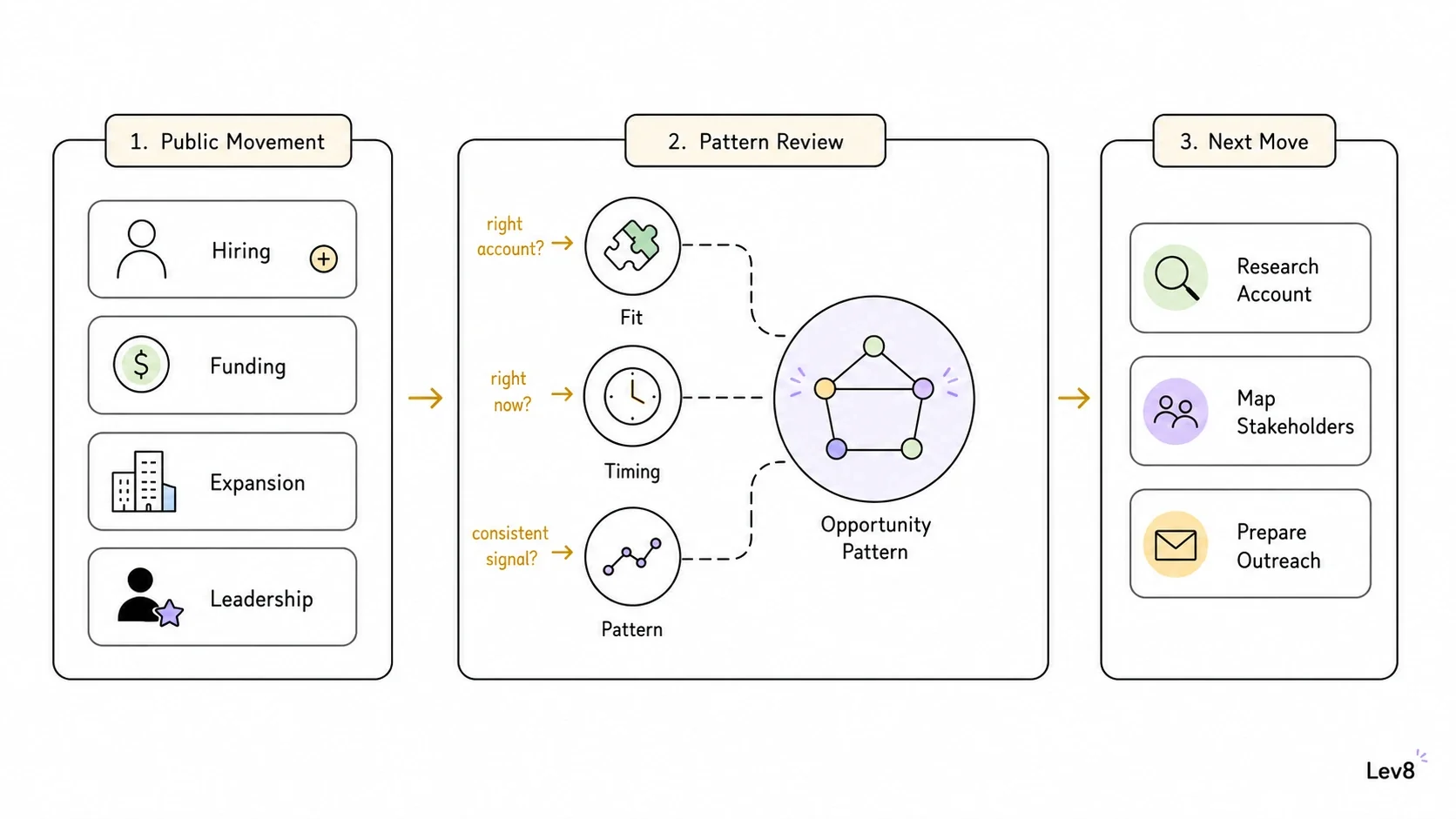
Before acting on an opportunity signal, ask three questions.
Table 04: Opportunity Signal Qualification Checklist
| Check | Question | Why It Matters |
|---|---|---|
| Fit | Is this company actually in our ICP? | A strong signal from a poor-fit company is still a distraction |
| Timing | Did the change happen recently enough to matter? | Old signals should not create false urgency |
| Pattern | Are several changes pointing in the same direction? | One event is weak; a pattern is stronger |
A company that raised funding two years ago is not automatically urgent.
A company that hires one SDR may simply be replacing someone.
A company that is outside your ICP should not jump to the top of the list just because something happened.
The real value comes from pattern recognition:
Good-fit company + recent change + multiple signals pointing in one direction -> worth deeper GTM attention.
This is also where many intent data programs break down.
They surface attention, but they do not always explain what action the team should take.
For that gap, see our breakdown of Why B2B Intent Data Fails to Book Meetings.
The goal is not to say:
This company had a signal.
The goal is to say:
This company is becoming more relevant, more urgent, or more sales-ready.
05 Match the GTM Motion to the Signal Context
The biggest mistake is treating every signal as a sales trigger.
Some companies should only be watched.
Some should be nurtured.
Some deserve deeper research.
Only a smaller group should receive direct sales outreach.
That is why opportunity signals need to be translated into GTM motion.
The question is not:
Should sales reach out?
The better question is:
What should we do with this company right now?
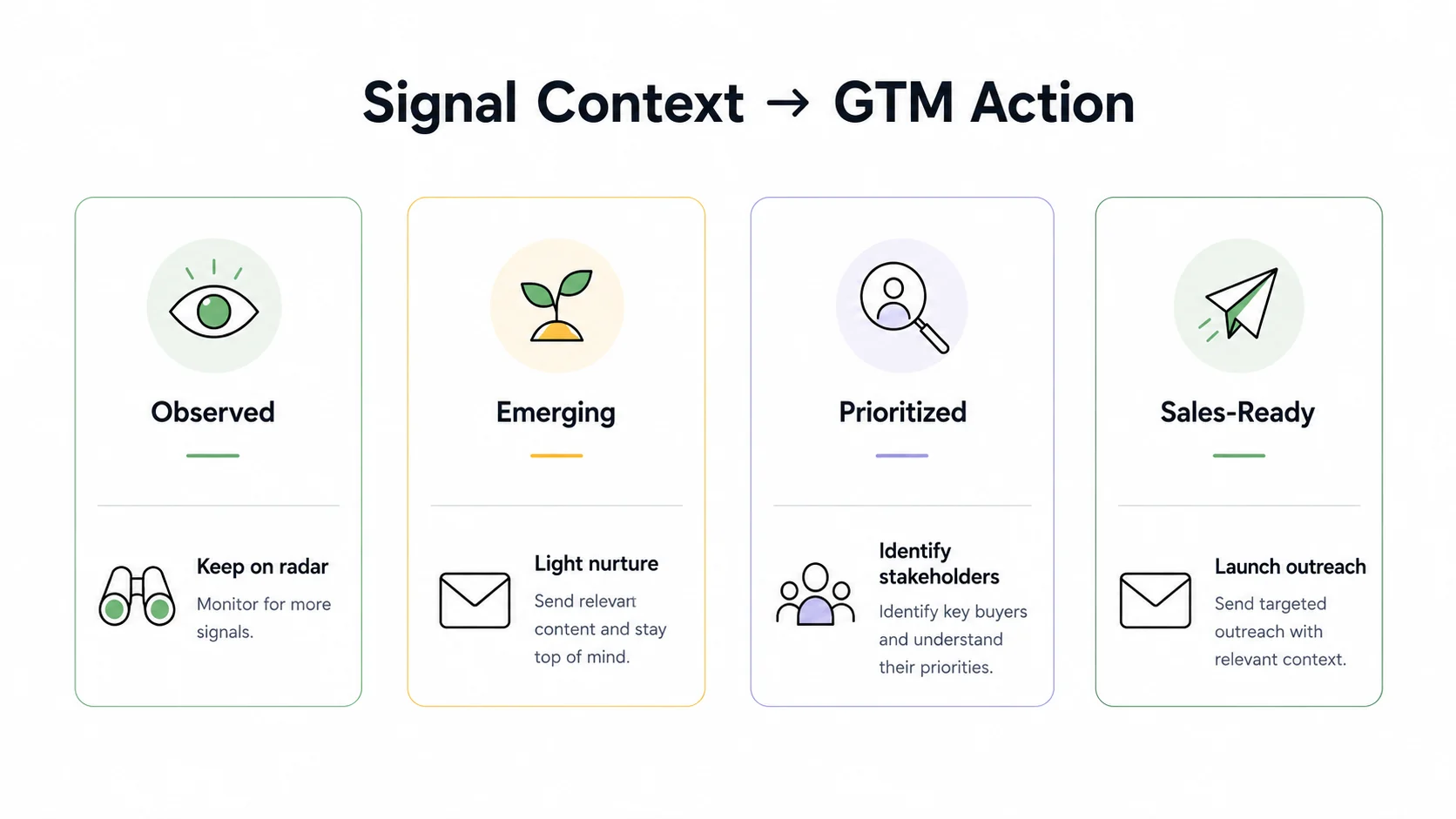
Table 05: Match Signal Context to GTM Action
| Signal Context | What It Means | Best GTM Motion |
|---|---|---|
| Observed | One or two movements exist, but the pattern is weak | Keep on radar |
| Emerging | Several movements are forming a pattern, but urgency is unclear | Light nurture |
| Prioritized | Fit, timing, and pattern are strong enough to justify research | Research stakeholders |
| Sales-Ready | The change is clear, recent, and tied to relevant people | Launch targeted outreach |
An Observed company should not receive a generic outbound sequence.
It should stay on the radar.
An Emerging company may deserve light nurture, social engagement, or closer monitoring.
A Prioritized company needs deeper context:
- What changed?
- Why does it matter?
- Who owns the problem?
- What business pressure may be forming?
A Sales-Ready company is where outreach begins.
But even then, the message should not sound generic.
A weak message says:
"Saw you were hiring. Want to chat?"
A stronger message says:
"Your team seems to be expanding SDR hiring while entering a new market. That often creates pressure around prioritization, stakeholder discovery, and outbound execution. We put together a short benchmark on how teams reduce SDR ramp time during expansion."
That is the difference between shallow personalization and useful relevance.
The goal is not to trigger more outreach. The goal is to choose the right GTM motion.
06 Turn Company Signals Into Stakeholder Action
Opportunity signals usually start at the company level.
But deals are created through people.
A funding event may matter to the founder.
A sales hiring spike may matter to the VP Sales.
A RevOps role may point to operational pressure.
A market expansion may involve sales, marketing, operations, and regional leadership.
So the motion cannot stop at:
"This company looks interesting."
The team needs to answer:
- Who likely owns the problem?
- Who influences the decision?
- What changed for them?
- What message would be useful now?
- What action should happen next?
This is where opportunity signals become practical.
They help teams move from company activity to stakeholder relevance.
LinkedIn's Hidden Buyer Gap research makes this point clear: the people who show visible buying behavior are not always the full buying group. Important stakeholders may influence the deal without leaving obvious digital signals.
Instead of saying:
Something happened at this company.
A better GTM motion says:
This company is changing. This change likely creates pressure for this team. These stakeholders may care. This is the message angle that fits the moment.
This is where Lev8 fits naturally.
Lev8 helps GTM teams turn public company changes such as hiring, funding, leadership movement, and expansion into clearer company context, relevant stakeholder discovery, and AI-assisted outreach.
The point is not to send more emails.
The point is to act with better timing, better context, and a more useful reason to reach out.
Don't Wait for the Buyer to Raise Their Hand
The best sales opportunities often start before the demo request.
They start when something changes inside the company:
- A company enters a new market.
- A new sales leader takes over.
- A team starts hiring.
- Funding creates growth pressure.
- RevOps becomes a priority.
Each event may look small on its own.
But together, they can reveal that the company is entering a new stage.
That is what opportunity signals are for.
Not more alerts.
Better judgment.
In AI-native GTM, the advantage is not tracking every possible signal.
It is knowing which signals reveal real company change, which companies deserve attention, and what motion makes sense before the buyer becomes obvious.
That is the shift from chasing signals to reading opportunity.
Start for free and get 300 credits per monthly cycle to discover opportunity signals, identify sales-ready companies, and generate your first AI-assisted outreach sequence with Lev8.