




Claude Sonnet 5 changes the model-choice question.
The useful debate is not whether it is "strong." It is whether a team should use it instead of Opus, GPT, or Gemini for the work that actually hits production: coding agents, browser tasks, long-context research, document synthesis, and repeated AI workflows where cost starts to matter.
That is the real search intent behind Claude Sonnet 5 vs Opus. Developers want to know whether their current prompts, agents, and budget assumptions still work. Product teams want to know whether Sonnet 5 is actually cheaper if it spends more tokens to solve the task. Operators want a default model they can trust without sending every workflow to the most expensive tier.
A spec table helps. But it does not answer the real question.
The better comparison is workflow-based: success rate, retries, tool-use reliability, latency, human review time, and cost per completed task.
Quick Verdict: Which Model Should You Use?
Start here if you only need a practical default.
| Use case | Best first model to test | Why |
|---|---|---|
| Daily coding agents, repo edits, Claude Code workflows | Claude Sonnet 5 | Strong fit for agentic work at a more practical cost profile than flagship models |
| Hard reasoning, ambiguous tasks, high failure cost | Opus | Better candidate when quality matters more than cost |
| OpenAI-native product stack, broad API ecosystem | GPT | Strong fit when the team already runs OpenAI tooling, evals, and integrations |
| Google ecosystem, multimodal work, Workspace or Vertex AI workflows | Gemini | Stronger fit when platform integration matters as much as model behavior |
| High-volume extraction, tagging, routing, simple formatting | Lower-cost models | Many simple jobs do not need Sonnet 5, Opus, GPT flagship, or Gemini Pro |
Claude Sonnet 5 is the first model many teams should test for agentic workflows. It should not become the default for every task.
Use Sonnet 5 when the work requires planning, tool use, code changes, or long-context synthesis. Use Opus when the task is harder, rarer, and more expensive to get wrong. Use GPT or Gemini when the surrounding ecosystem makes them the better operational fit.
The model is only one part of the system.
Claude Sonnet 5 At A Glance
Sonnet 5 matters because it moves more agentic capability into Anthropic's mainstream Sonnet tier.
According to Anthropic and Claude Platform documentation, Claude Sonnet 5 was released on June 30, 2026, with the API model ID claude-sonnet-5. It is positioned for coding, tool use, long-context work, and professional knowledge tasks.
| Field | Detail |
|---|---|
| Release date | June 30, 2026 |
| API model ID | claude-sonnet-5 |
| Main positioning | Agentic workhorse for coding, tools, and knowledge work |
| Context window | 1M tokens, based on Claude Platform documentation |
| Max output | 128k tokens, based on Claude Platform documentation |
| Main buyer question | Is it cheaper in real completed-task cost? |
Those numbers are useful, but they are not the decision.
A 1M-token context window tells you the model can hold more material. A 128k output limit tells you it can produce larger results. Neither tells you whether the model will make fewer bad edits, recover from a failed tool call, or reduce review time for a senior engineer.
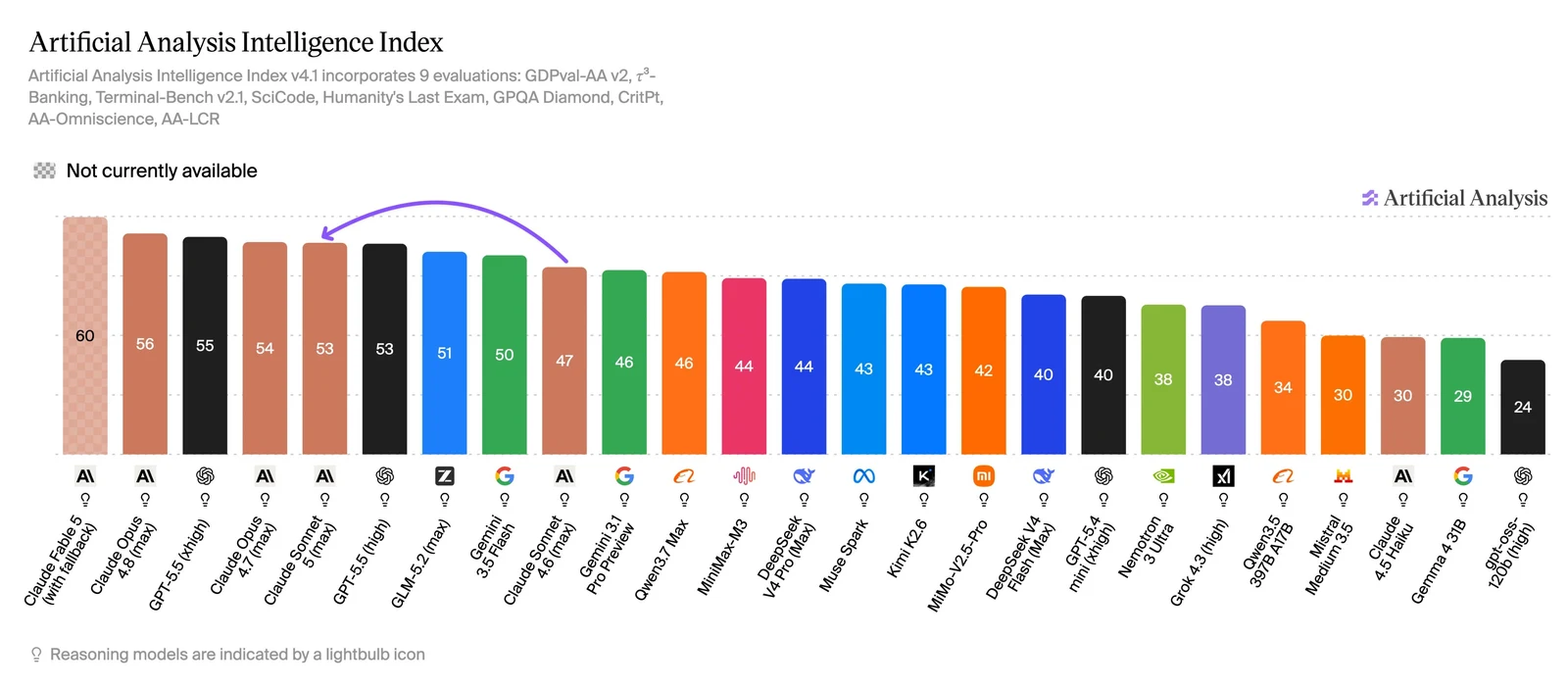
That is where the comparison gets more interesting.
The Comparison Criteria That Actually Matter
Model comparisons often get stuck on benchmark scores and token pricing.
That is too thin.
A production workflow cares about different metrics:
| Criteria | Why it matters |
|---|---|
| Task success rate | Did the model actually complete the work? |
| Accepted output rate | Could a human approve the result without major edits? |
| Input tokens | Long-context jobs can make input cost large fast |
| Output tokens | Agentic models may spend more tokens planning, checking, and revising |
| Retry count | Failed runs can erase apparent token-price savings |
| Tool-call reliability | Browser, terminal, code, and API tools need stable sequencing |
| Latency | A slow model can break high-frequency workflows |
| Human review time | The most expensive part may be the person cleaning up the result |
This is why "best model" is often the wrong frame. A model can win a benchmark and still be a poor default for a repetitive workflow. Another model can be slightly weaker on a leaderboard but cheaper per accepted result.
The question is narrower: which model gets this job done with the least waste?
Claude Sonnet 5 vs Opus
The Sonnet 5 vs Opus comparison is not just cheap versus smart.
A better frame: Sonnet 5 is the workhorse; Opus is the escalation model.
| Dimension | Claude Sonnet 5 | Opus | Practical meaning |
|---|---|---|---|
| Best role | Frequent agentic work | Hard reasoning and high-risk tasks | Start with Sonnet 5, escalate to Opus when needed |
| Cost profile | Better fit for repeated workflows | Usually more expensive | Frequency pushes teams toward Sonnet |
| Coding agent fit | Strong for daily repo work | Strong for complex judgment | Test Opus for architecture-heavy tasks |
| Failure cost | Better for medium-risk work | Better when failure is expensive | Higher stakes justify stronger models |
| Default strategy | First model to test | Specialist model | Avoid using Opus by habit |
For coding agents, Sonnet 5 is likely the more practical default. It is built for multi-step work: reading context, using tools, making changes, checking results, and producing a final response that a developer can review.
Opus still has a role. A big one.
If the task involves a subtle architecture decision, security-sensitive reasoning, ambiguous requirements, or a customer-facing output with high downside risk, Opus may be worth the additional cost. A more expensive model that prevents one serious mistake can be cheaper than a lower-cost model that creates rework.
The trap is using Opus for everything. The opposite trap is using Sonnet 5 for tasks where failure is too costly.
Route by risk.
For a related look at Claude model tradeoffs, see the Claude Opus model comparison.
Claude Sonnet 5 vs GPT
Claude Sonnet 5 vs GPT should be compared by workflow fit, not brand preference.
A team already running OpenAI tools, evals, logging, model routing, and product integrations may not gain much by switching a workflow to Sonnet 5 without a strong reason. The migration cost is real. Prompts, observability, safety controls, and evaluation baselines all have to move with the model.
| Question | Sonnet 5 may fit better when... | GPT may fit better when... |
|---|---|---|
| Coding workflow | The team uses Claude Code or Claude-native agent workflows | The team has built around OpenAI tools and SDKs |
| Agent behavior | The task needs sustained planning, code/context handling, and tool use | The task fits OpenAI's existing toolchain and product surface |
| Vendor stack | Anthropic is already part of production infrastructure | OpenAI is already the main model provider |
| Evaluation | The team cares most about agentic task completion | The team cares most about platform continuity |
This is where a lot of model debates get noisy. "Which one is better?" sounds simple, but it hides the real constraints.
Where are the tools? Where is the data? Where are the evals? Where is the security review? If switching models breaks those layers, a stronger model on paper may not be the better production choice.
Sonnet 5 deserves a serious test for coding agents and long-context workflows. GPT deserves a serious test when the product already lives in the OpenAI ecosystem.
The winning model is the one that survives the workflow.
Claude Sonnet 5 vs Gemini
Gemini is not just another name in the comparison table. For many teams, Gemini's value comes from the Google ecosystem around it.
That matters.
| Question | Sonnet 5 may fit better when... | Gemini may fit better when... |
|---|---|---|
| Primary workflow | Coding, browser/terminal agents, professional document work | Google Cloud, Workspace, multimodal, or Vertex AI workflows |
| Long context | The task combines code, docs, and tool use | The task depends on large document sets or multimodal inputs |
| Team stack | Anthropic and Claude Code are already in use | Google Cloud or Workspace is already central |
| Cost decision | The team measures accepted task cost | The team values platform integration and multimodal throughput |
Gemini can be the stronger operational choice when the task is tied to Google-native data, permissions, enterprise systems, or multimodal workflows. A model embedded in the right platform can beat a better standalone model because the surrounding workflow is cleaner.
Sonnet 5 is more compelling when the center of gravity is agentic execution: coding, planning, terminal actions, browser research, and long-context professional work.
For a Google-heavy enterprise, Gemini may be the easier model to operationalize. For a team building Claude-native agents or running repo-level coding workflows, Sonnet 5 should be tested early.
Context decides more than the model name.
Where Sonnet 4.6 Still Matters
Teams coming from Sonnet 4.6 should not treat Sonnet 5 as a silent drop-in replacement.
The model ID update may be simple. The workflow migration is not.
At minimum, retest four things:
- Prompt behavior A prompt written for Sonnet 4.6 may produce longer, more agentic, or differently structured output on Sonnet 5.
- Token budget If tokenization or output behavior changes, old budget assumptions can fail. This matters most in long-context and high-output workflows.
- Tool-use pattern More proactive tool use can help, but it can also create extra calls, extra traces, or different failure modes.
- Human review time If Sonnet 5 produces more complete-looking output but humans still spend the same 20 minutes fixing it, the upgrade did not improve workflow economics.
A model migration is a small system migration. Treat it that way.
Cost Per Completed Task
Token price is the visible cost. It is not the full cost.
For agentic workflows, use this formula:
Completed task cost =
(input tokens * input price) +
(output tokens * output price) +
(retry cost) +
(tool/runtime cost) +
(human review cost)
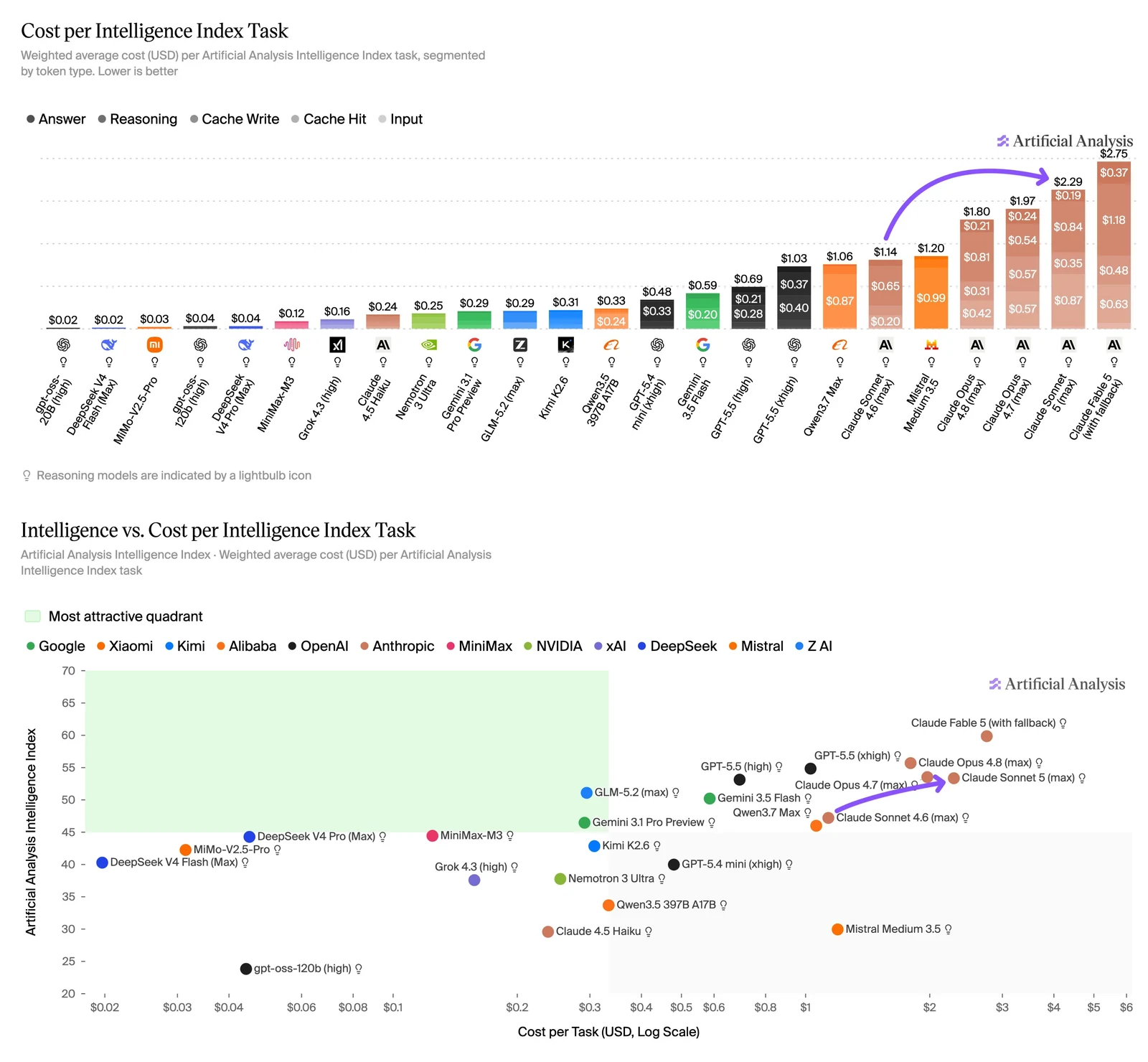
This is where "cheaper" can get slippery.
A model with lower token pricing can become expensive if it needs two retries, calls tools inefficiently, produces messy code, or forces a senior teammate to clean up the result. A more expensive model can be cheaper if it finishes correctly on the first run.
Output tokens deserve special attention. Agentic models often spend tokens on planning, checking, explaining, and repairing. That can be useful. It can also become waste if the extra output does not improve accepted results.
Ask three questions before calling Sonnet 5 cheaper:
- Did it reduce retries?
- Did it reduce human correction time?
- Did it increase the accepted output rate?
If yes, Sonnet 5 may be cheaper in the only sense that matters. If no, the token price is just a line item.
This is also why model choice and workflow design are inseparable. A strong model attached to fragmented tools still creates avoidable cost. The same pattern shows up in GTM systems where AI agents replace fragmented tool stacks.
Benchmarking Checklist
A small internal eval beats a long debate.
Use 5 to 10 real tasks. Not toy prompts.
Good candidates include:
- A multi-file code change with tests
- A bug investigation with incomplete starting context
- A long-document summary with citations
- A browser research task that requires source checking
- A terminal or API workflow with possible failure recovery
- A structured extraction task with validation
- A workflow that routes output into CRM, Slack, or another system
- A human-reviewed output that must be approved before publishing
Track the same metrics for Sonnet 5, Opus, GPT, and Gemini:
| Metric | What to record |
|---|---|
| Success rate | Did the task finish correctly? |
| Accepted output rate | Did a human accept the result? |
| Total input tokens | How much context did the task require? |
| Total output tokens | How much did the model spend responding and revising? |
| Retry count | How many extra runs were needed? |
| Tool-call count | Were tools used efficiently? |
| Latency | Did the workflow feel usable? |
| Human correction time | How much cleanup remained? |
| Final completed-task cost | What did one accepted result actually cost? |
This table will tell you more than a leaderboard.
Benchmarks show potential. Internal evals show fit.
The same discipline applies to long-context research work. For a deeper example of agentic research evaluation, see frontier deep research workflows.