




TL;DR: First-party intent signals are owned behavior signals that help B2B teams read buyer interest with more data privacy, more data control, and less dependence on noisy third-party intent data. They work when the team can explain what was collected, why it matters, who can act on it, and when the signal is strong enough for outreach.
Most teams talk about first-party data like it is a replacement part.
Third-party cookies get weaker. Platform reporting gets murkier. Intent data vendors feel noisy. So the advice becomes simple: collect more first-party data.
That advice is not wrong. It is incomplete.
First-party data becomes useful only when it turns into a controlled signal. A pageview is not intent. A form fill is not always sales readiness. A product event is not automatically a buying committee trigger.
The advantage is not just that the data is "yours." The advantage is that your team can control the full signal lifecycle: collection, consent, event definition, storage, enrichment, routing, retention, and feedback.
Used well, first-party intent signals make GTM more privacy-aware and more precise. Used badly, they become another tracking layer with a cleaner name.
- What are first-party intent signals?
- Behavioral signals from owned channels that suggest buying interest.
- Why do they matter for data privacy?
- They can be governed through direct collection, consent, and retention controls.
- Why do they matter for data control?
- The team controls the event definitions, source labels, routing rules, and action thresholds.
- Are they better than third-party intent data?
- Often more contextual, but narrower in reach.
- Should sales act on every signal?
- No. Weak signals belong in nurture or research, not direct outreach.
Most Teams Treat First-Party Data Like a Replacement Part
Privacy-era marketing has created a strange shortcut.
A team loses visibility in ad platforms. Attribution gets harder. Third-party intent data starts to feel noisy. Then someone says, "We need a first-party data strategy."
That sounds practical until the team has to operate it.
Owned data gives the company more control, but it also gives the company more responsibility. You now own the consent logic, event quality, identity mapping, CRM sync, activation thresholds, vendor data flows, and suppression rules.
That is a lot of plumbing for a signal that may still be weak.
The useful question is not, "Do we have first-party data?" It is sharper: which owned behaviors are meaningful enough to change the next GTM action?
If the answer is unclear, the team does not have an intent system. It has tracked events.
What Are First-Party Intent Signals?
A raw visit can look exciting in a dashboard and still tell sales almost nothing.
First-party intent signals are behavioral indicators collected from channels a company owns, such as its website, product, CRM, email, forms, webinars, support interactions, or customer community, that suggest a person, customer, or account may be moving toward a buying decision.
Examples include:
- Pricing page visits
- Demo requests
- Trial signups
- Product usage spikes
- Integration or security page views
- Competitor comparison page views
- Webinar attendance
- Email clicks on buying-stage assets
- Repeat visits from a target account
- CRM stage movement
- Form fills with role and company context
The distinction matters.
First-party data describes the source relationship. Intent describes the interpretation. A first-party intent signal is owned behavior that has been interpreted as buying-relevant.
That interpretation has to be earned.
First-party data
Data collected through owned channels or direct relationships
Assuming owned data is automatically useful
Intent signal
A behavior or pattern that suggests possible buying interest
Treating every activity as sales-ready
First-party intent signal
Owned behavior that is meaningful enough to guide GTM action
Sending outreach after weak or creepy tracking cues
First-Party Signals vs. Third-Party Intent Data
Third-party intent data can still be useful. It just answers a different question.
Third-party intent data often tells you that an account may be researching a topic somewhere else. First-party intent signals tell you what someone did with you.
That difference changes the risk profile and the sales workflow.
| Dimension | First-Party Intent Signals | Third-Party Intent Data |
|---|---|---|
| Source | Owned channels, CRM, product, email, events | Publisher networks, ad networks, vendor panels, external data providers |
| Context | Brand-specific behavior | Category or topic-level behavior |
| Control | High control over events, storage, routing, and retention | Lower control and more vendor dependency |
| Privacy governance | Direct responsibility for consent, access, and activation | Shared responsibility, often vendor-dependent |
| Scale | Limited to people and accounts that interact with you | Broader market coverage |
| Sales actionability | Strong when identified, recent, and contextual | Often needs validation before outreach |
| Main risk | Compliance burden, implementation gaps, over-triggering | Noise, opacity, stale signals, account-level ambiguity |
First-party signals are usually narrower. That is the tradeoff.
They can also be much sharper. A target account reading your integration docs, returning to your pricing page, and signing up for a webinar is more useful than a generic category surge from an account with 8,000 employees and no known buyer.
If your main problem is noisy third-party intent data, start with intent data accuracy before adding another signal source. A better data source will not fix a broken routing model.
Why Data Privacy Makes First-Party Intent More Important
Privacy-aware GTM is not only about having less data.
It is about being able to explain the data you have.
Browser restrictions, platform reporting limits, consent requirements, and customer expectations all push teams toward data they can govern more directly. First-party data helps because it comes from a direct interaction with your brand, but that does not make it automatically safe to activate.
Direct collection gives you a stronger starting point. It also removes a convenient excuse.
Teams still need to know:
- What was collected
- Where it was collected
- What consent state applied
- Which system stored it
- Which vendor processed it
- Which team can access it
- What action it triggered
- How long it will be retained
- How suppression and opt-out rules work
The NIST Privacy Framework is useful here because it frames privacy as a risk management discipline, not a banner configuration. The FTC guidance on protecting personal information also pushes a practical idea: understand what data you have, where it flows, and why you need it.
For marketing teams, that becomes an operating rule.
If a signal cannot be explained, it should not trigger sales.
Why Data Control Is the Real Advantage
"We own the data" is too vague to be useful.
Data control means the team can manage the signal from capture to action. A first-party signal is only as controlled as the workflow around it.
Control has several layers:
| Control Layer | What It Decides | Failure Mode |
|---|---|---|
| Collection control | Which events are captured and from which surfaces | Tracking everything because it is technically possible |
| Consent control | Which events can be used for analytics, marketing, sales, or suppression | Treating consent as a UI setting instead of workflow logic |
| Event definition control | What each event means and how it is named | Sales and marketing interpreting the same event differently |
| Identity control | How visitor, contact, account, and CRM records connect | Anonymous behavior being over-attributed to the wrong person |
| Storage control | Where signal data lives and who can access it | Sensitive data scattered across tools |
| Enrichment control | Which fields can be appended and from which sources | More data added without source labels or confidence levels |
| Activation control | Which signal triggers nurture, research, sales, or suppression | Every alert going straight to SDRs |
| Retention control | How long signal data remains usable | Old behavior resurfacing as fresh intent |
| Vendor control | Which downstream tools receive the data | Losing visibility after the first sync |
This is where first-party intent becomes more than a privacy story. It becomes a GTM operating model.
The team can decide what counts, what does not, and what happens next.
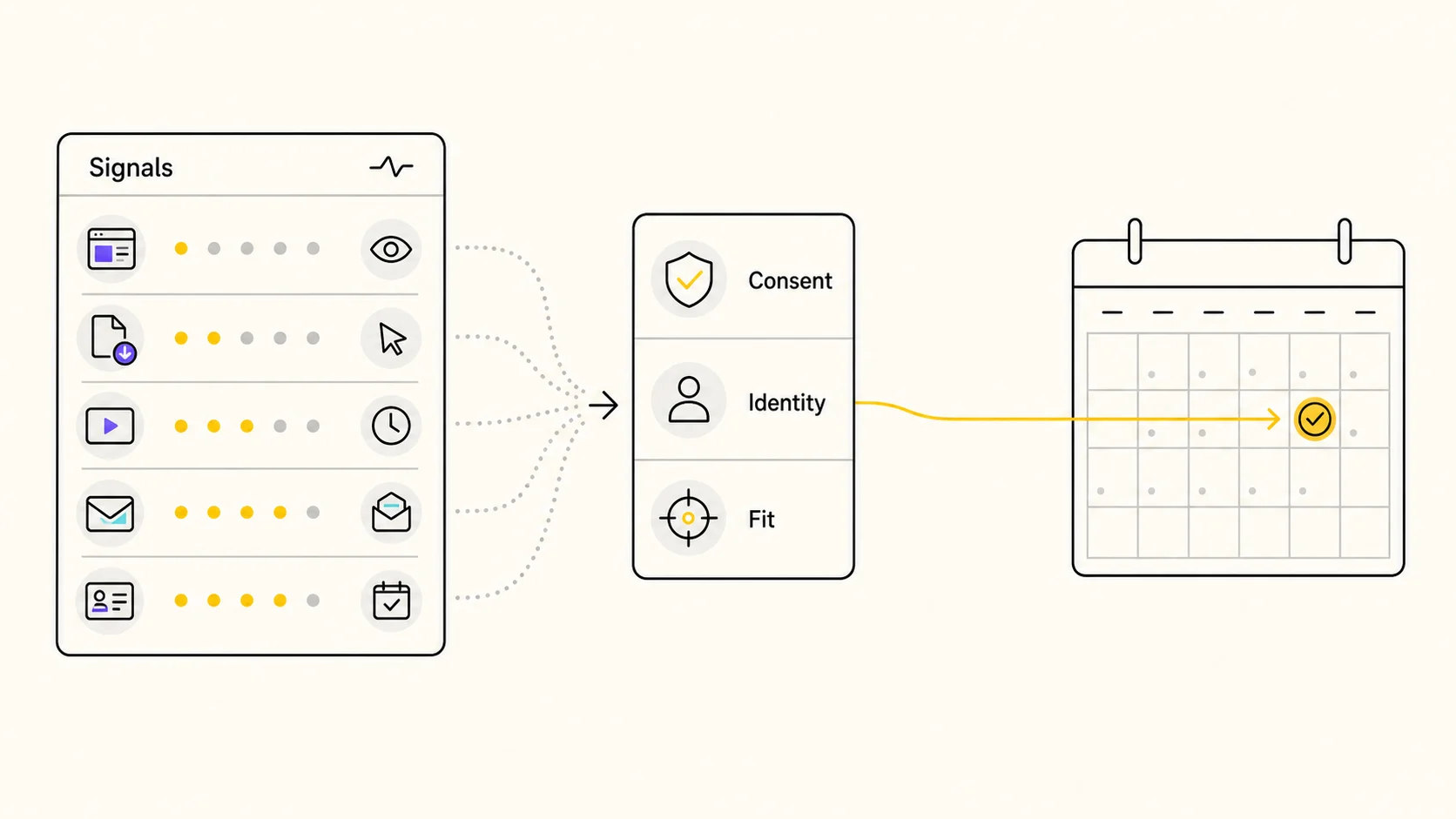
The First-Party Signal Quality Ladder
A pageview is not a trigger.
The signal has to climb a quality ladder before sales acts. Each step adds context, confidence, or permission.
| Ladder Step | Example | What It Adds | Best Route |
|---|---|---|---|
| Raw visit | Anonymous blog pageview | Minimal activity | Aggregate analytics |
| Consented event | Visitor accepts analytics or marketing consent | Permission context | Behavioral analysis or audience logic |
| Identified visitor or account | Form fill, login, account match, CRM connection | Identity confidence | Scoring or research |
| Relevant page or action | Pricing, demo, security, integration, comparison | Buying-stage context | SDR research or nurture |
| ICP-matched account | Target industry, size, region, use case | Fit confidence | Prioritization |
| Repeated or stacked behavior | Multiple high-intent actions in 7 to 14 days | Timing confidence | Sales queue |
| Enriched buying role | Relevant title, verified email, current company | Contact actionability | Personalized outreach |
| Routed next action | Nurture, research, AE follow-up, suppress | Operational control | Measured GTM action |
This ladder prevents a common mistake: confusing observed activity with sales readiness.
A pricing visit from an anonymous visitor may be useful. A pricing visit from a target account with a known RevOps leader, verified contact data, and repeated engagement is much stronger.
The same action can mean different things depending on identity, recency, account fit, and consent state.
Which First-Party Intent Signals Should Sales Act On?
Sales should not act on every owned behavior.
Some signals belong in marketing. Some belong in a research queue. Some should be suppressed. Only a smaller set deserves direct outreach.
| Signal | Intent Strength | Best Action | Sales Risk |
|---|---|---|---|
| Single blog visit | Low | Retargeting, newsletter, nurture | Outreach feels random |
| Multiple educational visits | Low-medium | Segment or score | Buyer role is unclear |
| Webinar registration | Medium | Nurture plus light follow-up | Interest may be educational |
| Case study download | Medium | Research account fit | May not indicate active buying |
| Security, integration, or pricing page visit | Medium-high | SDR research and buyer mapping | Contact may be unknown |
| Demo request | High | Sales follow-up | Low risk if form and consent are clear |
| Trial activation plus role fit | High | AE or product-led sales action | Needs usage context |
| Competitor comparison plus pricing visit | Very high | Personalized outreach | Message must avoid surveillance language |
For more context on which triggers deserve action, connect this article with the broader guide to buying signals. The rule is the same: a signal is only useful if it changes the next action.
The outreach language matters.
Avoid this:
We saw you visited our pricing page three times.
Try this:
Teams comparing enrichment workflows often reach a point where data control and routing rules matter more than adding another provider. If that is on your roadmap, I can share the decision model we use.
The second message uses a business hypothesis. It does not narrate the surveillance trail.
The Mistake: Treating First-Party Tracking as First-Party Intent
Server-side tracking gets oversold.
It can improve control over event delivery in some cases. It can reduce some browser-side fragility. It can help teams manage event routing, consent states, and platform integrations with more discipline.
It does not magically create intent.
Google's Consent Mode documentation is a good reminder that consent state affects how tags and platforms behave. The path an event travels is not the same as the permission to use it, and better plumbing does not fix weak event design.
If the event does not mean anything, sending it through your own server only gives you more control over noise.
Common failure patterns include:
- Events are named inconsistently across website, CRM, product, and email tools.
- Consent state is captured in one tool but lost in another.
- Anonymous visitors are over-resolved to accounts with weak confidence.
- Pageviews are scored like buying-stage actions.
- CRM stages and website behavior disagree.
- Sales receives alerts without contact verification or message guidance.
- Old events trigger new outreach because retention rules are unclear.
Infrastructure matters. Interpretation matters more.
How to Build a Privacy-Aware First-Party Intent Workflow
A first-party intent workflow needs stop conditions.
Without them, automation just syncs uncertainty faster.
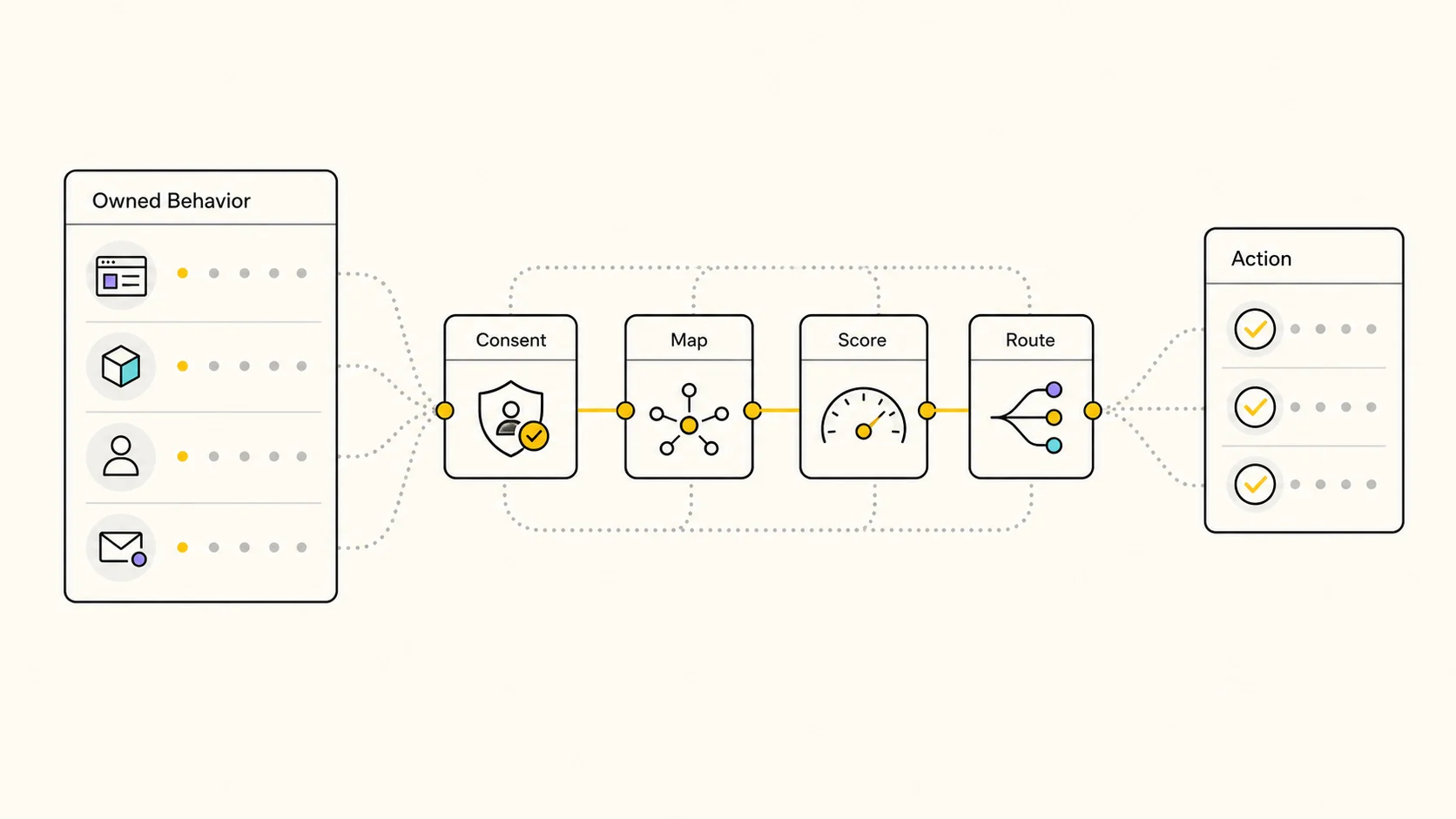
Use this operating model:
| Stage | What Happens | Decision Rule |
|---|---|---|
| 1. Define buying-stage events | Decide which owned actions suggest research, evaluation, purchase, expansion, or churn risk | If the event would not change a GTM action, do not score it heavily |
| 2. Map consent requirements | Tie each event to analytics, marketing, sales, and suppression rules | If consent is missing or unclear, limit activation |
| 3. Normalize event data | Standardize event names, timestamps, source fields, page types, and account metadata | If the event cannot be compared cleanly, keep it out of scoring |
| 4. Resolve identity where permitted | Connect visitor, contact, account, product user, and CRM records | If identity confidence is weak, route to aggregate analysis or research |
| 5. Enrich only what is needed | Add role, company, contact, and firmographic fields with source labels | If enrichment cannot be verified, do not treat it as sales-ready |
| 6. Score by context | Combine event type, recency, account fit, lifecycle stage, and repetition | If the signal is weak, send it to nurture |
| 7. Route by confidence | Decide whether marketing, SDR research, AE follow-up, customer success, or suppression acts next | If the next action is unclear, the signal is not ready |
| 8. Feed outcomes back | Track reply, meeting, opportunity, opt-out, complaint, or false positive | If a signal type keeps failing, lower its score or remove it |
In Lev8 terms, the workflow is not one feature. It is a sequence.
INTENT detects owned and live account movement. FIND maps the company and likely people involved. BUILD enriches and normalizes the record before it reaches CRM. ENGAGE turns only qualified signals into message-ready action.
For teams that already struggle with missing fields or conflicting sources, pair this model with a waterfall enrichment workflow. The enrichment step should improve confidence, not bury the team under more columns.
What to Measure
Event volume is a vanity metric.
A first-party intent program should be measured by action quality. The team needs to know whether signals improve routing, reduce wasted outreach, and create cleaner pipeline evidence.
Track:
- Consent opt-in rate
- Identified visitor or account rate
- CRM match rate
- Event-to-MQL conversion
- Signal-to-reply conversion
- Signal-to-meeting conversion
- Sales acceptance rate
- False positive rate
- Suppressed signal volume
- Data freshness
- Contact verification pass rate
- Opt-out or complaint rate
- Signal-to-pipeline conversion
One metric deserves special attention: suppressed signal volume.
Suppression is not failure. It is proof that the system has judgment. If every signal moves forward, the workflow has no quality gate.
Before any signal becomes outbound, the contact layer still matters. A high-intent account with bad contact data produces the same outcome as any other bad list. Use a contact verification checklist before sales acts on person-level outreach.
When First-Party Intent Signals Are Not Enough
First-party intent has limits.
Low-traffic sites may not collect enough useful behavior. Anonymous traffic may stay anonymous. A sales-led enterprise team may see long buying cycles with sparse owned-channel activity. A new category may need market discovery before prospects ever reach your website.
First-party data also sees only part of the market: people and accounts that interact with your brand.
That is why third-party data, second-party partnerships, review-site signals, ad platform data, and manual account research still have a place. The difference is that first-party intent should act as the control layer, not just another row in the dashboard.
Separate signal types clearly:
Observed first-party behavior
Someone interacted with your owned channel
Full buying committee intent
Modeled conversion
A platform predicts likely conversion behavior
Individual readiness
Third-party topic intent
An account may be researching a category
Direct interest in your product
CRM stage movement
Sales process status
Fresh digital behavior
Product usage
Adoption, expansion, or risk signals
New buyer intent without account context
The practical answer is not first-party only. It is source-aware routing.
Label what is observed, inferred, modeled, enriched, or vendor-reported. Then decide how much confidence each source deserves.
Conclusion: Better-Controlled Data Beats More Data
First-party intent signals are not a magic replacement for third-party data. They are a better control layer.
They help teams collect signals closer to the customer relationship, with clearer consent, cleaner context, and more control over activation. But they only work when the signal is meaningful, governed, and routed to the right next action.
The future of intent is not just more data. It is better-controlled data.
If your workflow starts with live account movement instead of a static list, Lev8's live signals capability is the closest product bridge. Use it when the team needs always-on signal detection, account and buyer mapping, enrichment, and routing before outreach.
Do not give sales more tracked events. Give them fewer, better actions.