



Many products now call themselves AI SDRs.
Some research prospects. Some draft emails. Some run outbound sequences. Others qualify inbound leads or claim to manage the process through meeting booking.
Most are introduced through a feature list:
- More contacts researched
- More messages generated
- More follow-ups sent
- More meetings booked
But sales development is not only a sequence of actions. It is also a sequence of judgments.
Before a message is sent, someone—or something—must decide:
- Which companies are worth attention
- Whether there is a credible reason to contact them now
- Who the relevant person is
- What evidence supports the outreach
- What the next action should be
If those decisions are weak, automation only helps the team make more mistakes, faster.
An AI SDR is not an email-sending bot. It is a system that turns a sales assignment into a qualified next action—and knows when human judgment is required.
The useful output of an AI SDR is not more activity. It is a next action that the sales team can understand, review, and use.
What This Article Will Help You Understand
This guide answers three practical questions:
- What is an AI SDR?
- Which sales development tasks should it automate?
- Which decisions should remain under human control?
It also provides a simple model for deciding whether an AI SDR should recommend, prepare, or execute an action.
1. What Is an AI SDR?
An AI SDR, or artificial intelligence sales development representative, is an AI-powered system that performs or supports parts of the sales development workflow.
Those tasks may include:
- Prospect and account research
- Contact enrichment
- Initial qualification
- Message preparation
- Routine follow-up
- Inbound lead engagement
- Meeting coordination
- Handoff to a human seller
What makes a product an AI SDR is not one individual feature.
An email writer is not automatically an AI SDR. Neither is a contact database, enrichment tool, lead score, or sequence builder.
An AI SDR connects three parts of the sales development process:
Information → Judgment → Action
It gathers information about companies and people, evaluates what the sales team should do next, and then recommends, prepares, or executes that action.
The level of autonomy varies.
Some AI SDRs operate as copilots. They research prospects and suggest actions, while a person remains responsible for execution.
Others can run larger parts of an outbound or inbound workflow within predefined rules.
This is also what separates an AI SDR from traditional sales automation.
Traditional automation usually follows a fixed instruction:
- If a lead completes a form, assign it to this territory.
- If there is no reply after three days, send the next email.
An AI SDR may also interpret unstructured information, compare a company with an ICP, develop a message angle, or decide that the available evidence is too weak to continue.
An AI sales agent is the broader category. An AI SDR describes the sales-development role the system performs.
A platform may use several agents for research, enrichment, qualification, messaging, and outreach while collectively performing the work of an AI SDR.
For a broader explanation, see how AI sales agents connect research, data, signals, outreach, and CRM execution.
2. From Sales Assignment to Qualified Action
An AI SDR should not begin with a blank email.
It should begin with a sales assignment.
Imagine a sales leader gives the system this request:
Find US-based B2B SaaS companies that are expanding their outbound teams, identify the revenue leaders most likely to own the problem, and prepare a credible reason to contact them.
This assignment gives the system more than an industry filter.
It defines:
- The target market
- The relevant business situation
- The likely buyer
- The expected output
- The reason timing may matter
Compare that with:
Find SaaS prospects.
The second request may produce a longer list, but it gives the system little basis for deciding which companies deserve attention.
A vague assignment produces vague automation.
A useful AI SDR turns the stronger assignment into four stages.
Sales Assignment
The system first interprets the commercial objective.
In this example, it needs to understand:
- What counts as a B2B SaaS company
- What “expanding an outbound team” might look like
- Which roles could own the problem
- Which companies should be excluded
- Whether the user wants research, messaging, or an executable campaign
The assignment establishes the rules of the task.
Prospect Context
The AI SDR then gathers the information required to evaluate potential accounts.
For the SaaS example, it might look for:
- Recent SDR, BDR, sales operations, or RevOps hiring
- A newly appointed VP of Sales or CRO
- Company growth or market expansion
- The size and structure of the sales team
- Relevant revenue leaders
- Usable contact information
- Public evidence supporting the recommendation
The objective is not to collect every available data point.
It is to find the context needed to make the next decision.
Qualification
The system then evaluates each potential prospect using four questions:
- Fit: Does the company match the target market?
- Timing: Is something happening that makes the problem relevant now?
- Evidence: What supports that conclusion?
- Actionability: Is there a relevant person and a credible next step?
Suppose the AI finds two companies.
Company A is hiring several SDRs, recently appointed a new VP of Sales, and appears to be building its outbound motion.
Company B added one generic sales role six months ago, but there is little other evidence of change.
Both companies may technically match the database filters.
They should not receive the same priority.
A useful AI SDR should show why Company A is more actionable instead of hiding the decision behind a score.
Qualified Next Action
The final output should not automatically be an email.
For Company A, the next action might be:
- Contact the new VP of Sales
- Reference the team expansion
- Develop an angle around scaling prospect research and outbound execution
- Prepare a first-touch message for review
For Company B, the right action may be:
- Gather more evidence
- Select a different contact
- Lower the priority
- Do not proceed yet
That last option is important.
A useful AI SDR should not feel forced to create outreach for every result.
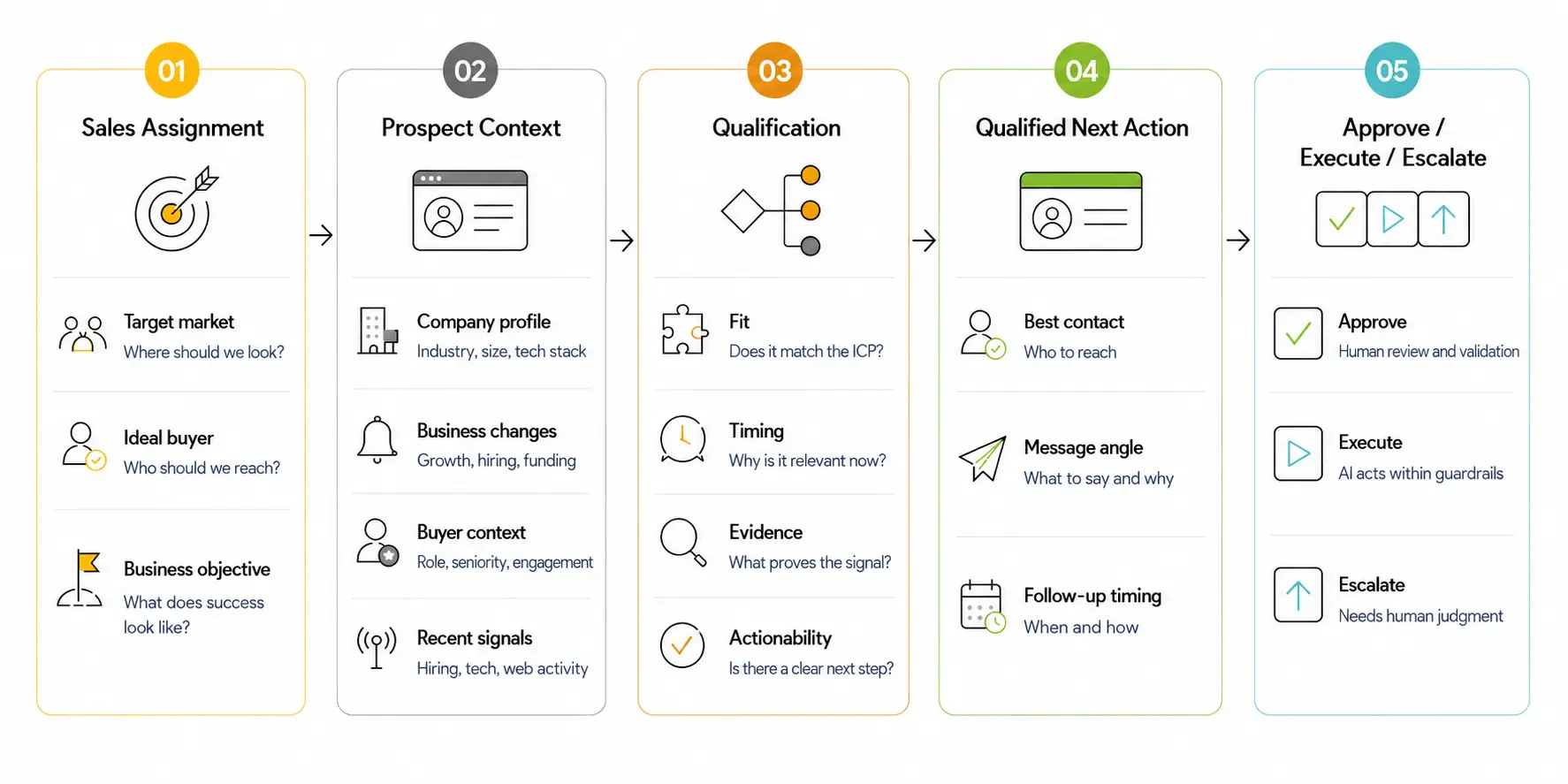
Figure 1. An AI SDR turns a sales assignment into a qualified next action supported by prospect context.
The useful output is not a longer prospect list or another generic message draft.
It is an action supported by evidence, with the uncertainty still visible.
For a more detailed prospecting workflow, see how to find qualified prospects from public signals.
3. What AI Should Automate—and What Humans Should Own
Automation does not create judgment.
It scales the judgment already built into the workflow.
If a team starts with an unclear ICP, outdated data, weak qualification rules, or generic positioning, an AI SDR may simply execute those weaknesses more consistently.
The goal is not to automate every task.
It is to automate repeatable work without hiding the decisions that still matter.
| AI can usually own or accelerate | Human judgment should usually own |
|---|---|
| Prospect and account research | Market and ICP decisions |
| Contact enrichment and verification | Ambiguous qualification |
| Initial prospect prioritization | Strategic account selection |
| Message and sequence preparation | High-stakes messaging |
| Routine follow-up and routing | Complex replies and objections |
| CRM updates and activity capture | Relationships and negotiation |
The automation boundary depends on three factors.
Repeatable Work
AI is strongest when the task has:
- Clear inputs
- Stable rules
- Repeatable steps
- Observable success criteria
Research, enrichment, standard qualification, routing, CRM updates, and routine follow-up often meet these conditions.
Return to the SaaS example.
Once the team has defined what “outbound expansion” means, the AI can repeatedly:
- Search for matching companies
- Collect supporting evidence
- Find relevant revenue leaders
- Enrich contact details
- Prepare an initial outreach angle
The team does not need to manually repeat the same research process for every company.
Consequential Decisions
The same action may be safe for one account and risky for another.
A routine follow-up to a low-value lead is not the same as contacting the CRO of a strategic account.
A decision becomes more consequential when it involves:
- A high-value company
- An executive contact
- A regulated industry
- A sensitive company event
- A pricing or legal claim
- Weak or incomplete evidence
- Brand-sensitive messaging
Suppose Company A is a small SaaS business with a standardized outbound motion. The AI might be allowed to prepare and run a reviewed sequence.
Now suppose a similar signal appears at a major strategic account.
The underlying research can still be automated. The action should probably require approval.
The task is similar. The consequence of being wrong is not.
Ambiguity
AI also needs a clear way to recognize uncertainty.
The system may encounter:
- Conflicting company information
- An unusual organization structure
- Several possible buyers
- A weak or indirect signal
- A non-standard use case
- An emotional or complex reply
Imagine the new VP of Sales at Company A responds:
We are expanding the team, but outbound capacity is not really the issue.
A basic system may classify this as a rejection and continue the sequence.
A better system may recognize that the original assumption was incomplete, summarize the response, and ask a person to determine whether another problem or use case is relevant.
When the situation becomes ambiguous, AI should prepare the context rather than continue autonomously.
A practical automation boundary uses two variables:
- Task repeatability
- Consequence of error
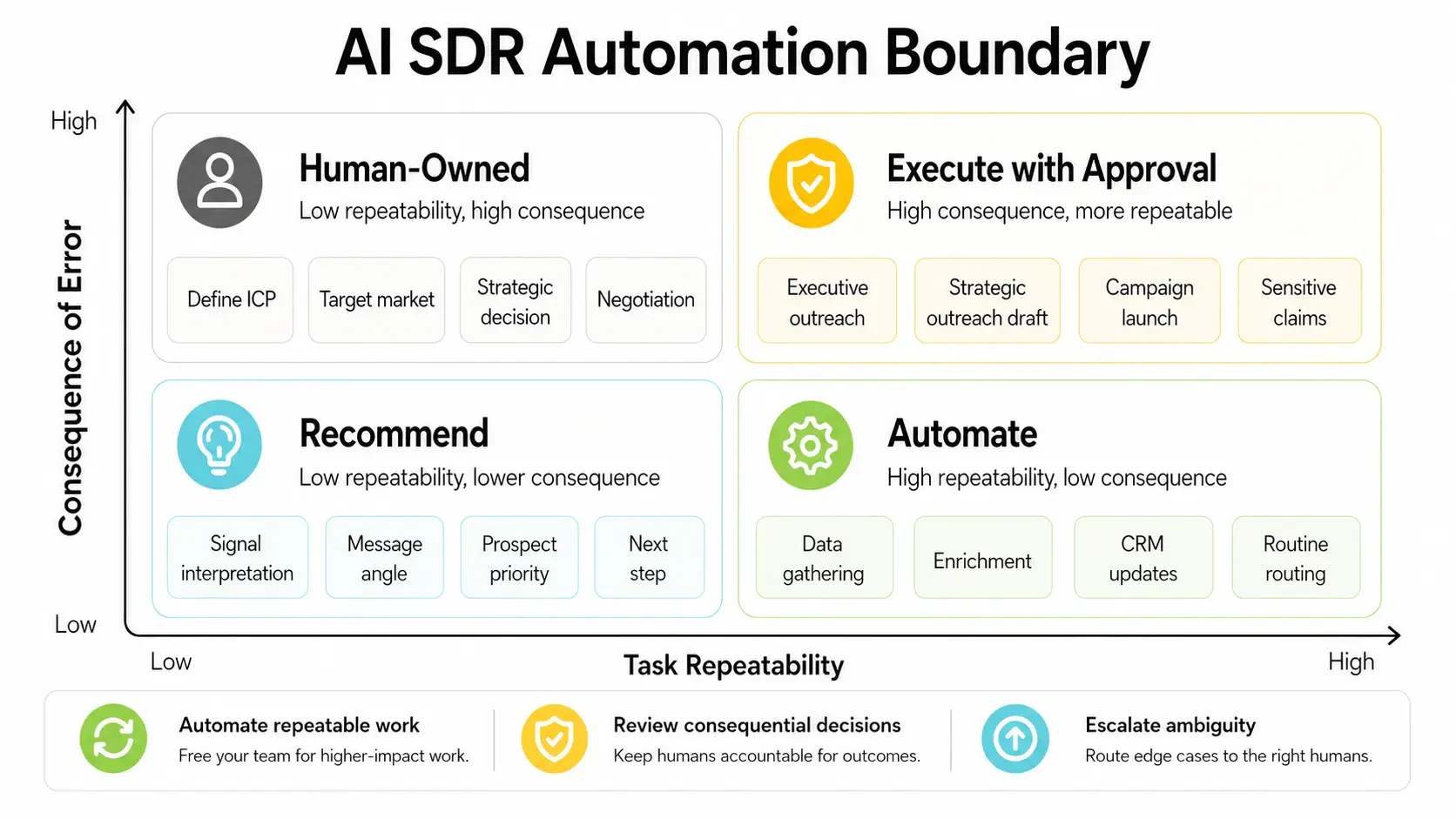
Figure 2. Use task repeatability and consequence of error to decide whether AI should automate, recommend, execute with approval, or leave the decision human-owned.
The framework can be summarized in three rules:
Automate repeatable work. Review consequential decisions. Escalate ambiguity.
This is more useful than asking whether an AI SDR is fully autonomous.
More autonomy is not automatically better. The right level depends on the task, the account, and the cost of being wrong.
4. How Much Autonomy Should Your AI SDR Have?
Teams often compare AI SDR products through feature lists.
A better starting point is deciding how much authority the system should have.
There are three practical levels.
Recommend
The AI analyzes the situation and suggests an action.
Examples include:
- Ranking prospects
- Suggesting a contact
- Developing a message angle
- Recommending a next step
A person decides whether to proceed.
For the SaaS prospecting task, the system might recommend Company A and explain:
- Why the account fits
- Which evidence suggests outbound expansion
- Why the VP of Sales is relevant
- Which message angle may be credible
This model is suitable for:
- Strategic accounts
- Complex sales motions
- Early AI experiments
- Low-volume, high-context prospecting
- Teams whose qualification rules are still evolving
Prepare
The AI completes the work, but a person approves it before execution.
It may:
- Build the prospect list
- Prepare the contact path
- Draft the first-touch message
- Create the sequence
- Recommend follow-up steps
For Company A, the system may prepare a complete outreach motion, while the sales representative checks the evidence and edits the message before launch.
This is often the most practical starting point for a small sales team.
It removes a significant amount of manual research and preparation while keeping targeting and messaging visible.
Execute
The AI takes action within defined guardrails.
It may handle:
- Routine enrichment
- CRM updates
- Lead routing
- Standard follow-up
- Calendar coordination
- Low-risk outreach
Execution works best when:
- The task is highly repeatable
- Qualification criteria are clear
- Messaging has already been validated
- Exclusions are defined
- The cost of an individual mistake is limited
Even then, the system should know when to stop.
For example:
- A strategic account enters the list
- Evidence becomes contradictory
- An executive replies
- A prospect raises a complex objection
- The message requires a sensitive claim
When a team is uncertain, it should start with Prepare, not Execute.
That gives users time to inspect the quality of the AI’s research, qualification, and messaging before increasing autonomy.
Before selecting an AI SDR, ask:
- Can it show why a prospect was selected?
- Can users inspect the supporting evidence?
- Can a person edit, reject, or stop an action?
- Does the system know when to escalate?
- Can autonomy change by account, task, or workflow?
A polished email is easy to demonstrate.
Reliable sales judgment is harder.
The value of an AI SDR is not that people disappear from sales. It is that the manual work between a sales idea and a qualified conversation becomes faster and more visible.
Lev8 helps teams describe a prospecting task in natural language, research relevant companies and people, gather public business context, enrich contact information, prepare outreach angles, and move qualified results toward the next action.
The objective is not to hide the sales process behind automation.
It is to make the research, qualification, and action easier to inspect and control.
What’s Next: Define the Work Before Comparing the Price
Once you understand what an AI SDR is, the next step is not immediately comparing monthly subscription fees.
First determine:
- Which tasks the system should perform
- Whether it should recommend, prepare, or execute
- Which actions require human review
- What data and infrastructure are included
- How much human operation is still required
A research assistant, a human-reviewed outbound workflow, and an autonomous AI SDR may all use the same category label.
They do not perform the same amount of work—and they should not be priced the same way.
Our AI SDR Pricing 2026 guide explains how subscription fees, credits, data, sending infrastructure, usage, and human operations affect the real cost of each model.
See What an AI SDR Can Take Off Your Team’s Plate
Describe the companies and people you want to reach.
Lev8 can help research relevant prospects, enrich usable contact information, prepare outreach context, and move qualified results toward the next action.
Start free with 300 credits.