




If you searched for AI SDR pricing, you are probably trying to figure out two practical things: how much your team should budget and what you actually get for that price.
This guide exists because the market does not offer one standard AI SDR product. The same label is used for research copilots, self-serve prospecting platforms, execution-focused agents, and managed deployments. One offer may stop after finding and researching prospects. Another may include data, mailboxes, warm-up, outreach, setup, and ongoing support.
Those are different operating models, not simply different price points. Before comparing plans, buyers need a big-picture view of which part of the SDR workflow each vendor is selling. Only then can the advertised price answer the more useful question:
How much will it cost to use AI to produce sales opportunities our team will actually accept?
Overview
Key Takeaway
AI SDR pricing spans free self-serve plans, several-hundred-dollar packages, and custom managed deployments. The subscription is only one part of the cost. Total the platform, data, infrastructure, and operating time, then test that spend against opportunity quality. Instead of cost per email or contact, calculate total workflow cost per qualified opportunity accepted by sales.
1. Why AI SDR Prices Are So Hard to Compare: A Market Overview
AI SDR now describes several operating models within the broader AI sales agent category. Most offers sit somewhere across four practical archetypes:
- Research and prospecting copilots help teams find accounts, research companies, enrich contacts, or prepare outreach context. A human usually owns sequencing and execution.
- Self-serve AI prospecting platforms connect several steps—such as sourcing, enrichment, personalization, and outreach—while the buyer configures and operates the workflow.
- Execution-focused AI SDR agents run more of the outbound motion, often packaging campaign activity around contacts, mailboxes, channels, or active prospects.
- Managed or enterprise AI SDR deployments add onboarding, infrastructure, campaign operations, support, security, or custom integrations. The vendor may own more of the operating work.
These are not rigid product categories; vendors can span more than one. This framework is useful because each archetype leaves a different share of the work—and therefore the cost—with the buyer.
The invoice may also be tied to a different unit:
- a user or workspace;
- credits consumed by research, enrichment, or actions;
- contacts researched or contacted;
- active prospects in a campaign;
- a managed deployment scoped to volume and service.
These differences change which costs are visible and who owns the work. A lower software fee may suit a team that already has data, infrastructure, and an operator. A more inclusive plan may suit a team that would otherwise assemble and maintain several tools.
Buyer checkpoint: Before comparing prices, first identify the AI SDR archetype, the workflow scope, and what remains outside the quote.
2. The Main AI SDR Pricing Models
Table 1. AI SDR Pricing Models and What Buyers Should Check
| Pricing model | What usually drives cost | What may be included | Questions to ask |
|---|---|---|---|
| Per seat or workspace | Number of users, agents, or workspaces | Platform access, workflows, integrations | Are data, usage, and sending limits separate? Which features are gated by tier? |
| Credits or usage | Searches, enrichment fields, contacts, messages, or agent actions | Flexible access across several tasks | What consumes credits? Do failed or invalid results count? Do credits expire or roll over? |
| Contact or active-record volume | Prospects researched, contacted, or active in a period | Data, personalization, sequences, and sometimes infrastructure | What counts as an active contact? Are follow-ups, mailboxes, and channels included? |
| Managed or custom plan | Volume, service depth, security, and rollout needs | Onboarding, infrastructure, campaign operations, strategy, and support | Which work transfers to the vendor? What still requires internal approval and ownership? |
Seat pricing is easy to forecast but may exclude data or infrastructure. A usage model is meaningful only when the vendor defines what each credit buys. Contact pricing depends on whether the unit is researched, contacted, or active. Managed and custom plans require buyers to separate included service from work that remains internal.
Pricing takeaway: The billing model explains the invoice. It still does not reveal the total cost of running the motion.
3. Four Cost Layers—and the Quality Test That Changes the Economics
Platform Cost
Start with the base subscription, seats, agent limits, feature tiers, and expected overages. Separate fixed access fees from variable usage so you can see what changes when volume grows.
Data and Enrichment
An AI SDR needs accurate companies, people, contact paths, and current context. Check whether the plan includes company and contact data, email or phone enrichment, verification, live-web research, and signals. Add any external data required to make the workflow usable.
Ask whether invalid, stale, or off-criteria results consume usage. Paying for unusable records changes the economics even when the nominal cost per contact looks low.
Sending Infrastructure
Outbound execution may require domains, mailboxes, warm-up, deliverability monitoring, LinkedIn accounts, dialer seats, or channel-specific add-ons.
Some plans bundle this infrastructure; others use what the buyer already owns. Put both the cost and responsibility into the comparison.
Operations and Oversight
Automation still requires an operating model.
Someone must define the ICP, configure workflows, approve messaging, monitor results, handle exceptions, and decide when a human should step in. Managed offers transfer more work to the vendor; self-serve products leave more control and responsibility with the buyer.
Human review is not evidence that the AI failed. For brand-sensitive outreach, it may be the control that makes automation safe. The question is whether that effort matches what the team expected to buy.
Opportunity Quality: The Economic Test
The first four layers create operating cost. Opportunity quality determines whether that spend produces anything useful.
A system can generate volume while wasting it on poor-fit accounts, wrong stakeholders, stale data, generic outreach, or rejected meetings. Activity does not prove commercial value.
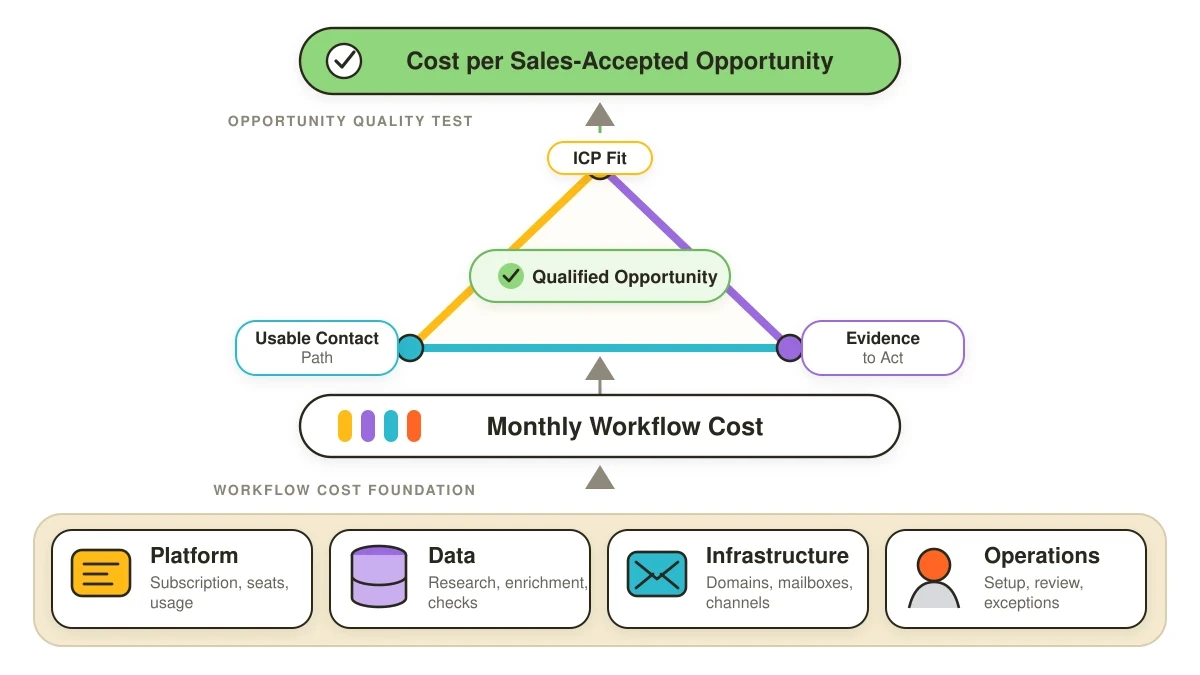
Figure 1. What You Pay For Beyond the AI SDR Subscription. Platform, data, infrastructure, and operations create the workflow cost. Opportunity quality determines whether that spend produces a usable next step.
4. AI SDR Pricing Examples in 2026
The following examples were verified on official vendor pages on July 23, 2026. Prices, limits, and contract terms can change. The purpose is to show how differently vendors package the workflow—not to rank four unlike offers by their lowest number.
Table 2. Representative AI SDR Pricing Models, Verified July 23, 2026
| Vendor / offer | Public starting price | Billing or usage unit | Notable inclusions | What still needs verification |
|---|---|---|---|---|
| Lev8 | Free; paid plans from $49/month | Credits used across lead matching, enrichment, research, drafting, and outreach actions | 300 credits on Free; 5,000 on Starter; public action-level credit schedule; sourcing and outreach capabilities vary by tier | Expected credit use for your workflow; mailbox and warm-up requirements; channel and tier limits |
| AiSDR | $250/month for Solo | AI-researched contacts per month; larger quarterly plans | Solo lists 200 researched contacts, one domain, three mailboxes, one LinkedIn account, setup/warm-up, and HubSpot sync | Contract term for the selected tier; managed-service additions; whether included volume fits the ICP |
| Reply Jason AI SDR | From $500/month when billed annually | Active contacts per month | Real-time contacts, AI personalization, multichannel automation, unlimited mailboxes and warm-ups, and onboarding are listed for Starter | Exact definition and practical use of active contacts; LinkedIn account allocation; annual commitment and fair-use limits |
| Artisan Ava | Custom / pricing scoped to plan | Approximate leads contacted per month plus rollout scope | Full platform, B2B contacts, CRM sync, CSM support, and onboarding; higher tiers add setup and strategic support | Quoted price, credit and infrastructure scope, dialer add-ons, implementation, and service boundaries |
Lev8 exposes plan and action-level credit pricing, which makes it possible to model a small workflow before committing to higher volume. AiSDR bundles researched-contact capacity with sending infrastructure. Reply Jason uses active contacts and includes a broader execution package. Artisan scopes pricing around outreach volume and rollout support.
Comparison takeaway: The lowest starting price does not tell you which option is cheapest for your motion. It tells you where the vendor begins charging.
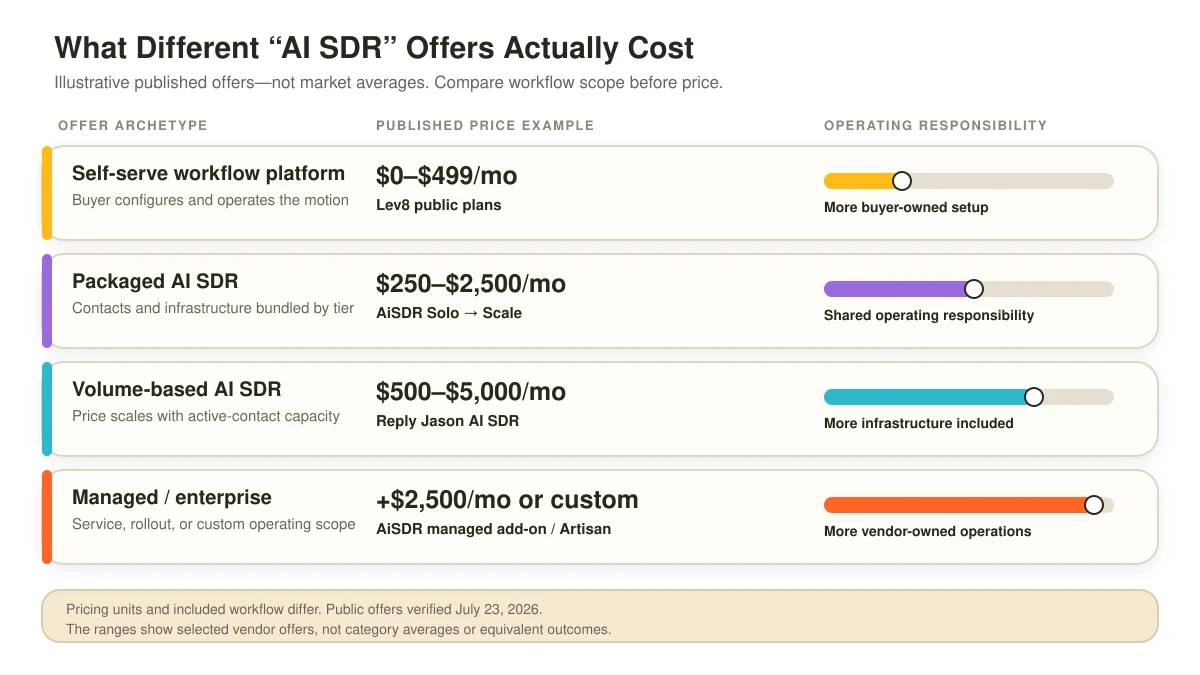
Figure 2. What Different “AI SDR” Offers Actually Cost. Selected public offers range from self-serve workflow platforms to managed and custom deployments. These are illustrative vendor prices, not market averages or equivalent outcomes.
5. How to Calculate the Real Cost of an AI SDR
Calculate Monthly Workflow Cost
Use the costs your team will actually carry:
Monthly Workflow Cost = Platform + Data + Infrastructure + Operations
Record operations as a vendor fee, internal labor hours, or both. The goal is to stop important work from disappearing from the comparison.
Define a Qualified Opportunity Before Measuring ROI
For this evaluation, a qualified opportunity is not simply a contact found or an email sent. A practical working definition might require:
- an ICP-fit company;
- a relevant reason to engage now;
- a usable and sufficiently verified contact path;
- evidence and context that sales accepts for a next action.
Your team may use different criteria. Define them before the pilot begins so a weak result cannot be relabeled as success after the fact.
Calculate Cost per Qualified Opportunity
Cost per Qualified Opportunity = Monthly Workflow Cost ÷ Sales-Accepted Qualified Opportunities
This is a buyer-side evaluation metric, not a universal AI SDR ROI benchmark. Its value depends on a qualification standard that sales defines and applies consistently.
For example, a team spends $1,200 on the platform, $300 on data and infrastructure, and $500 in operating time. If sales accepts 20 qualified opportunities, the $2,000 workflow costs $100 per accepted opportunity.
Record six inputs each month:
- platform cost;
- data cost;
- infrastructure cost;
- operations cost or time;
- qualified opportunities accepted by sales;
- calculated cost per accepted opportunity.
This is not cost per meeting or customer; those conversions depend on the sales motion. It shows whether the system produces inputs sales considers worth acting on.
6. Which Pricing Model Fits Your Team?
Testing a Motion With a Small Team
Choose low commitment, transparent usage, and visible evidence. At this stage, the team is learning which companies, triggers, contacts, and messages deserve more investment. A large capacity allowance is not valuable if you cannot inspect why the prospects were selected.
Scaling a Proven Outbound Motion
Once the ICP and motion are working, compare predictable capacity, data coverage, sending infrastructure, CRM integration, controls, and repeatability. Watch whether the sales-acceptance rate holds as volume rises. Lower unit costs are not a win if quality declines faster.
Buying a Managed Outcome
If the team lacks an internal operator, a managed package may be rational even when the monthly quote is higher. Clarify what the vendor owns: onboarding, campaign setup, infrastructure, deliverability, optimization, reporting, and exception handling. Also define which approvals and strategic decisions remain internal.
AI SDR and human SDR costs should not be reduced to subscription versus salary. Compare coverage, quality, control, and work retained by people rather than assuming one line item replaces the other.
A U.S. Human SDR Cost Benchmark
For a planning baseline, RepVue reports a median U.S. SDR base salary of $60,000 and median on-target earnings of $85,000 as of July 2026. The U.S. Bureau of Labor Statistics reports that wages account for 75.2% of employer compensation for private-industry sales and related occupations.
Applying that broad employer-cost ratio to median SDR OTE produces an estimated compensation baseline of about $113,000 per year, or $9,400 per month.
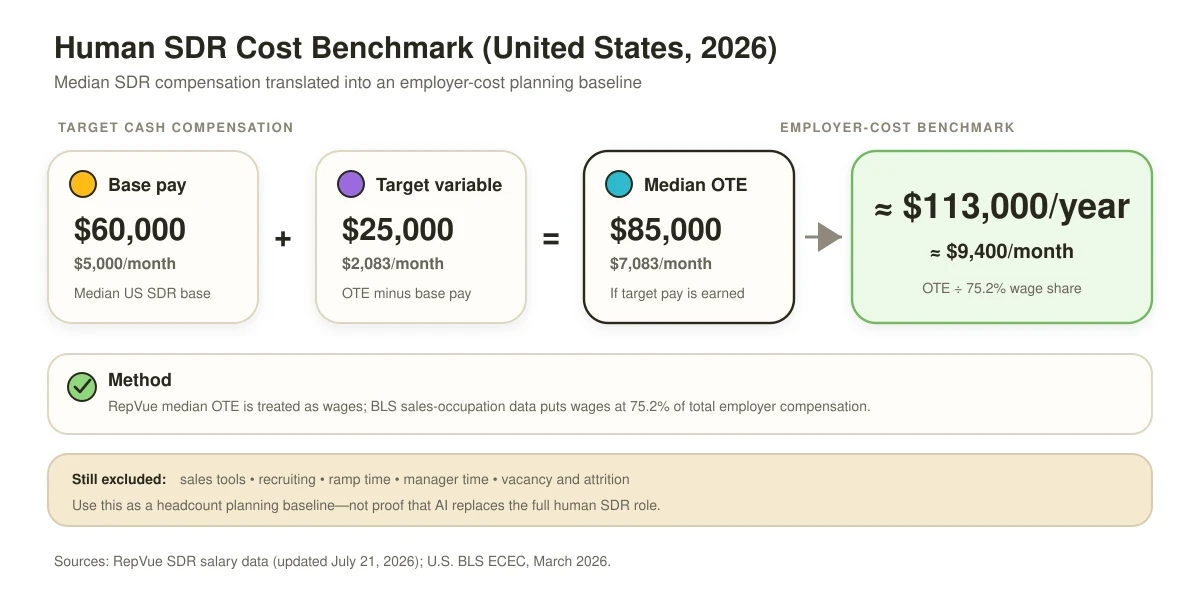
Benchmark 1. Human SDR Cost Benchmark (United States, 2026). The estimate translates median target cash compensation into a broad employer-compensation baseline. It still excludes sales tools, recruiting, ramp time, manager time, vacancy, and attrition.
This is a budgeting benchmark, not a claim that one AI SDR subscription replaces one SDR. OTE is target compensation rather than guaranteed pay, and actual employer costs vary by location, benefits, quota attainment, seniority, and operating model.
7. Start With Proof, Not a Long-Term Commitment
Choosing a pricing model is still a hypothesis. A small, defined pilot shows whether the system works in your market.
Fix one ICP, one geography, one use case, and one test period. Define a sales-accepted qualified opportunity before the test. Track software, data, infrastructure, and operating time together. Record why each result was accepted, rejected, or manually corrected.
The pilot should answer five questions:
- Does the system consistently find ICP-fit companies and usable contacts?
- Does each opportunity include enough current evidence and context to act?
- How much setup, review, and exception handling remains with the team?
- What is the cost per qualified opportunity accepted by sales?
- Does quality remain stable when the prospect set grows?
Scale only after both output quality and operating effort are visible. The best pilot is not the one that sends the most emails. It is the one that reduces uncertainty about the buying decision.
What's Next?
Test the Workflow on Your Own Market
If you want a self-serve, usage-based way to test the path from prospect research and enrichment to outreach, Lev8 is one option to evaluate. The current pricing starts with 300 monthly credits on the Free plan, with paid tiers adding more capacity and execution features.
Use the trial to validate the parts that matter to your team: whether the prospects fit, whether the supporting context is usable, whether contact paths are sufficiently verified, how much operating effort remains, and what the workflow costs before you scale.
Test a defined prospecting workflow on your own ICP, review the evidence behind each result, and understand the cost before you scale. Start Free Trial.