




You asked ChatGPT for a cold email. It came back polished, polite, and completely ignore-able.
The subject line was safe. The opening hoped the message found them well. The body listed three benefits in perfect parallel structure. The close asked for a quick call at their earliest convenience. It looked professional. It sounded like every other AI-assisted email already sitting in the prospect's trash.
Prospects can smell the average of a million sales emails. The difference between a message that gets a reply and one that gets deleted is not more clever prompts. It is a real trigger about the person, hard constraints that force a human voice, and a final human pass before anything is sent.
Here is the system that produces short, specific cold emails that actually sound like a person wrote them.
Why Most ChatGPT Cold Emails Still Get Ignored
ChatGPT is excellent at structure and variation. It is terrible at the two things that decide reply rates: accurate context and judgment about what a busy human will actually read.
When you feed it a vague brief - "write a cold email to a VP of Sales about our platform" - it reaches for the statistical center of every sales email it has seen. That center is padded, symmetrical, and full of phrases no one uses in real conversation:
- "I hope this email finds you well"
- "I came across your company and was impressed"
- "I'd love to explore how we might partner"
- Stacked adjectives and the inevitable rule of three
- Uniform sentence length that feels machine-generated
Industry reply rates for cold email still hover in the low single digits for most campaigns. Recent 2026 benchmarks commonly cite averages around 3-5%, depending on the dataset (Hunter State of Cold Email). Fully AI-generated messages with no human editing tend to underperform human-assisted ones. The pattern is consistent: the more the email looks like it could have been sent to anyone, the faster it is deleted.
The failure is not that AI wrote the email. The failure is that the model had nothing specific to say and no guardrails against sounding corporate.
Start With a Real Trigger (The Research Layer)
Personalization that works is not a merge field. It is one concrete, recent, verifiable detail about the prospect or their company that makes the email relevant today.
Good triggers
- They just posted three SDR roles.
- The company announced a new office or funding round.
- They published a LinkedIn post about a specific operational problem.
- Their team is hiring for a role that signals a known pain.
- A product launch or tech-stack change creates a timing window.
Bad openers that still appear in most AI drafts
- "I was impressed by your company's innovative approach."
- "I noticed you are a leader in your space."
- "Given your focus on growth..."
Those lines could be sent to anyone. They signal that no research happened.
Before you open ChatGPT, collect one real detail. Paste the LinkedIn post, the job description, the funding announcement, or the company news into the prompt. If you cannot name a specific recent fact, do not ask the model to invent one. It will.
This research step is the part most "ChatGPT cold email" guides skip. It is also the part that determines whether the finished email feels human or algorithmic. Tools that surface live company and people signals make this step practical at volume. For example, One Prompt Prospecting turns a plain-language ICP into a researched list with context you can feed ChatGPT. The principle stays the same whether you gather the trigger by hand or with assistance.
The Constrained Prompt That Forces a Human Voice
A strong cold-email prompt has four parts: role, specific context (including the trigger), hard constraints, and an optional example of the tone you want.
Here is a template you can adapt:
Role: You are an experienced B2B SDR writing a first-touch cold email.
You write like a busy human, not a marketing team.

Context:
- My name and role: [Your name], [Your title] at [Your company]
- What we do in one sentence: [Outcome-focused value prop]
- Prospect: [First name], [Title] at [Company]
- Specific recent detail I know is true: [Trigger - for example,
  "they posted three SDR roles this week"]
- Why this matters now: [One-sentence connection to the problem you solve]

Constraints:
- Under 90 words. No exceptions.
- Lead with the specific detail in the first sentence.
- Do not open with a greeting cliche or "I hope this finds you well."
- One clear idea only. One soft CTA (a question, not a meeting demand).
- Tone: calm, direct, slightly informal - as if this is the third email
  you have written today, not the first.
- Banned phrases: "I hope this finds you well," "just reaching out,"
  "I'd love to," "excited," "synergy," "leverage," "innovative,"
  "game-changing," "touch base," and "circle back."
- No exclamation points. No stacked adjectives. Vary sentence length.
- Plain language. No corporate jargon.

Output: subject line + email body only.
Hard constraints that kill robotic tone
| Banned or weak | Preferred direction |
|---|---|
| "I hope this email finds you well" | Delete and start with the trigger |
| "Just reaching out / I wanted to connect" | Lead with the observation |
| "I'd love to explore / would love to chat" | Soft question: "Worth a quick look?" |
| Rule-of-three benefit lists | One concrete outcome |
| Uniform polished sentences | Mix short + medium; contractions are fine |
| "Excited to..." / "Thrilled to..." | Calm confidence |
Length is a hard constraint for a reason. Models default to padded prose. A 90-word ceiling forces signal over filler. Hunter's analysis of tens of millions of cold emails found that shorter messages, especially in the 20-39 word range, often achieve higher average reply rates than longer ones. Even when the absolute differences are modest, the practical lesson is clear: cut filler. Most high-performing first touches sit well under 100 words; many of the strongest are closer to 50-70.
Before and after
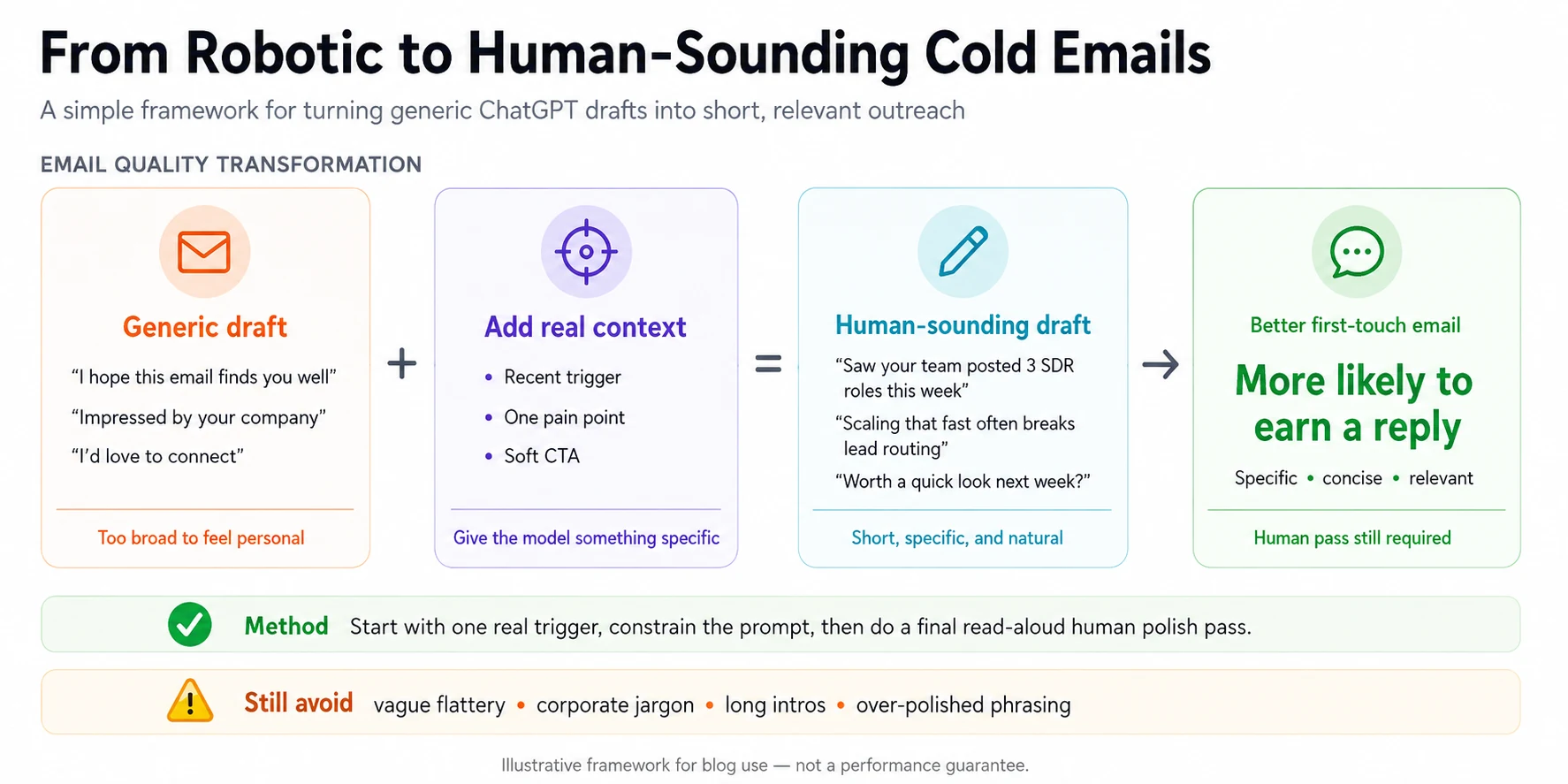
Unconstrained (typical)
Subject: Exploring a potential partnership
Hi Jordan,
I hope this email finds you well. I came across [Company] and was impressed by your innovative approach to scaling sales teams. At [Our Company], we help organizations like yours leverage AI to streamline outbound and drive meaningful results. I'd love to explore how we might partner to accelerate your growth. Would you be open to a quick call at your earliest convenience?
Constrained + trigger
Subject: SDR hiring at [Company]
Jordan - saw the three SDR roles your team posted this week. Scaling that fast usually breaks the old lead-routing setup before anyone notices. We help teams in the same spot keep pipeline coverage without adding headcount. Worth a 15-minute look next week?
The second version is shorter, specific, and sounds like a person who did five minutes of homework and then wrote the note between meetings.
The Human Polish Pass (Read-Aloud Test)
Never send the first draft. Treat the ChatGPT output as a rough cut that still needs a human filter.
Five-step polish checklist
- Delete the first sentence if it is throat-clearing. If the opener exists only to introduce you or the company, cut it and start with the prospect's world.
- Replace any generic claim with the specific signal. If the draft drifted back to "your innovative approach," put the real trigger back in the first line.
- Convert formal constructions to contractions and plain language. "We are able to" becomes "we can." "You may be experiencing" becomes "you might be dealing with."
- Cut every sentence that does not add new information. If a line repeats a point already made, remove it.
- Read the entire email out loud. If you stumble, if a phrase feels like something you would never say in conversation, or if the rhythm feels too even, rewrite that part.
The read-aloud test is the final filter. Emails that sound natural when spoken usually pass as human when read. Emails that feel awkward out loud almost always feel algorithmic on the screen.
Run the checklist once. Then stop. Over-editing can re-introduce the polish that makes the message feel less human.
Scaling Without Losing the Human Signal
Scale the research and drafting layers. Keep the final judgment human.
- Feed only verified, real triggers.
- Keep daily send volume per domain inside safe ranges.
- Use the same constrained prompt and polish checklist at volume.
- When a draft feels off, skip the contact rather than sending a weaker version.
Live signal tools make the research layer practical at volume. Platforms such as Multichannel Outreach can carry the same researched context into email, LinkedIn, and other channels without forcing a rewrite from zero. The model still needs the constraints and the human pass.
The goal is not more emails. The goal is more emails that a real person would send after doing real homework.
What's Next
The system is simple on purpose: real trigger, constrained prompt, short draft, human polish.
Keep the final decision with the person who will own the reply. ChatGPT can produce the first cut in seconds. Only you can decide whether it is worth sending.
When you need the live signals and researched context at volume so the model has something real to work with, Lev8 is built for that research-to-message loop.