




The B2B lead generation software market is changing quickly in 2026. Traditional static contact databases are increasingly being complemented - and in some cases challenged - by AI-powered tools that identify real-time buying signals, enrich contact data, and help teams prioritize outreach.
This guide compares 15 widely used B2B lead generation tools based on data quality, AI capabilities, pricing structure, usability, integrations, and customer feedback.
Here are the main recommendations by use case:
- Best AI-powered prospecting platform: Lev8: Lev8 is designed for teams that want to move beyond static databases. Users can describe their ideal customer profile in natural language, and the platform searches public web sources in real time to identify relevant prospects and intent signals.
- Best budget-friendly option: Apollo.io: Apollo offers one of the largest B2B contact databases on the market, with a relatively accessible entry price. It is a strong option for SMB teams building outbound lists, though many users still pair it with a third-party verification tool.
- Best enterprise data platform: ZoomInfo: ZoomInfo remains one of the most comprehensive enterprise-grade B2B intelligence platforms, especially for companies with mature RevOps teams and larger budgets.
- Best custom data workflow platform: Clay: Clay is highly flexible and connects with many third-party data providers. It is best suited for advanced go-to-market teams that want to build custom enrichment and prospecting workflows.
- Best option for European prospecting: Cognism: Cognism is particularly strong in EMEA markets, with an emphasis on GDPR compliance and manually verified phone data through its Diamond Data offering.
Quick Comparison: 15 B2B Lead Generation Tools
Lev8
AI-Powered ICP-Based Prospecting
Free / $49/mo
Real-time natural language search and multi-dimensional signal monitoring, zero reliance on static databases.
Apollo.io
Budget Pick for SMB Teams
Free / $49/mo
Extremely low barrier to entry with a massive foundational database of 210 million contacts.
ZoomInfo
Enterprise-Grade Data Platform
Custom (starts at approx. $15k/yr)
The world's most in-depth global enterprise intelligence map and buyer intent tracking.
Clay
Custom Data Orchestration
Free / $167/mo
"Waterfall Enrichment" connecting 50+ data sources.
Cognism
GDPR-Compliant EMEA Prospecting
Custom (starts at approx. $15k/yr)
Manually verified mobile numbers with exceptionally high connection rates (Diamond Data) and European compliance.
6sense
Enterprise ABM + Predictive Intent
Custom (starts at approx. $58k/yr)
Enterprise-grade predictive AI scoring and deep cross-channel intent tracking.
Seamless.AI
Unlimited Contact Search
Free / Custom
Features an unlimited contact search model (easy to operate, friendly for high-frequency use).
Lusha
Quick Contact Lookups via Chrome
Free / $49.9/mo
Fast-to-master Chrome extension for one-click LinkedIn contact extraction.
Hunter.io
Email Finding & Domain Search
Free / $49/mo
Minimalist and highly efficient domain email lookup with a high-accuracy verifier.
Clearbit
HubSpot-Native Enrichment
Dependent on HubSpot subscription
The most seamless automatic enrichment of contact and company data within the HubSpot ecosystem.
Instantly.ai
High-Volume Cold Email
$47/mo
Unlimited sender inboxes and industry-leading cold email deliverability optimization (warm-up).
Saleshandy
Affordable Multichannel Outreach
$25/mo
Highly cost-effective multichannel (Email + LinkedIn) automated outreach sequences.
Snov.io
All-in-One Outbound Suite
$39/mo
The perfect beginner's starter kit covering "email finding + verification + outreach + lightweight CRM".
Amplemarket
Signal-Driven AI Outbound
$300/mo/user
Seamless workflow from capturing 40+ intent signals to AI-automated drafting of personalized outreach.
Lemlist
Personalized Cold Outreach
$79/mo/user
Cold email personalization pursuing maximum reply rates (supports dynamic image/video embedding).
Note: Starting Prices are estimates of current publicly available base-level paid tiers and may fluctuate based on annual contracts, credit consumption, or the number of seats.
How We Evaluated These B2B Lead Generation Tools
- Data quality and deliverability: How accurate is the contact data? Are emails and phone numbers verified? How well does the tool perform across different regions?
- AI capabilities: Does the platform offer AI-powered search, intent detection, lead scoring, automated enrichment, or personalized outreach support?
- Ease of use: Can a new SDR or small sales team get started quickly, or does the tool require technical knowledge and dedicated operations support?
- Pricing transparency and hidden costs: Is pricing publicly available? Are there usage-based credits, expiring credits, overage fees, or separate charges for phone numbers and enriched data?
- Workflow coverage and integrations: Does the tool only help users find leads, or does it also support enrichment, CRM sync, email sequencing, and outbound execution?
- Customer feedback: We considered recurring patterns from review platforms such as G2, Trustpilot, Product Hunt, Reddit, and other user communities.
1. Lev8 - Best for AI-Powered ICP-Based Prospecting
Lev8 is one of the more AI-native B2B prospecting tools to watch in 2026. Instead of relying primarily on a static contact database, Lev8 works more like a real-time AI search and prospecting engine.
Users describe their ideal customer profile in natural language, and Lev8 searches public web sources to identify relevant companies, contacts, and buying signals. The platform is designed to support the workflow from prospect discovery to enrichment, scoring, cold email writing, and outreach.
Watch the Lev8 workflow demo on X
How Lev8 Works
Lev8's core concept is simple: describe the people or companies you want to find, and the platform turns that description into a prospecting workflow.
For example, a user might search for:
"AI SaaS startups that recently raised Series A funding and are hiring product managers."
Lev8 then scans public information sources, identifies companies that match the criteria, enriches contact information where available, and helps prioritize prospects based on relevant signals.
This makes Lev8 especially useful for teams that want to find prospects based on current market activity rather than relying only on pre-built contact lists.
Key Features
- Natural-language AI search: Users can describe an ICP in plain English instead of manually applying dozens of filters.
- Real-time signal monitoring: Lev8 can help identify signals such as hiring activity, funding announcements, technology changes, leadership updates, and other public indicators of potential buying intent.
- Automated data enrichment: The platform enriches prospect profiles using publicly available data and verification workflows.
- Built-in cold email tools: Lev8 supports cold email writing and batch outreach from within the platform.
- Intent-based scoring: Prospects can be prioritized based on multiple overlapping signals rather than a single data point.
Pros
- Lev8 does not depend entirely on a static database, which can make its results more current for certain prospecting use cases.
- The natural-language interface lowers the learning curve for SDRs and sales teams.
- It supports a more complete workflow from discovery to outreach.
- The platform is useful for identifying prospects based on timely signals such as fundraising, hiring, technology adoption, or leadership changes.
- Lev8 offers a free plan, does not require a credit card for trial access, and provides a transparent credit-based usage model.
Cons
- Lev8 is still less established than larger legacy platforms such as ZoomInfo or Apollo.
- Because the platform searches live public sources, results may take longer than pulling from a static database.
- The credit-based pricing model may require teams to monitor usage carefully, especially for complex searches or high-volume workflows.
Pricing
Lev8 offers three main plans:
- Free: Includes 300 credits per monthly cycle. Best for proof-of-concept testing and occasional research.
- Starter: $49 per month, including 5,000 credits. Best for small outbound teams that need prospect discovery, monitoring, and enrichment.
- Pro: $199 per month, including 25,000 credits. Best for teams running multiple prospecting workflows across departments.
Best For
Lev8 is best for small and mid-sized B2B sales teams looking for an alternative to traditional static databases.
It is also a strong fit for SDRs who need to find high-intent prospects from event lists, competitor audiences, funding announcements, hiring signals, or other public data sources.
2. Apollo.io - Best Budget Pick for SMB Sales Teams
Apollo.io is one of the most popular B2B data and outbound platforms on the market. It offers access to a large database of contacts and companies, along with built-in sequencing, email sending, and CRM-related features.
Apollo is especially attractive to startups and SMB teams because of its free plan and relatively affordable entry-level pricing.
Key Features
Apollo includes a large B2B contact database, built-in email sequencing, Chrome extension support, LinkedIn prospecting workflows, CRM integrations, and some intent-based features.
Its database includes more than 210 million contacts and more than 35 million companies, making it one of the largest accessible databases for smaller sales teams.
Pros
- Apollo's free plan is generous compared with many other B2B data tools.
- It combines data, sequencing, and sales workflow features in one platform.
- The platform has a large user base and strong visibility on review platforms.
- Its API and integrations make it useful for more technical teams as well.
Cons
- Data accuracy remains one of Apollo's most common user complaints. Accuracy can vary significantly by region, role, and industry.
- Some users report high bounce rates even when exporting contacts labeled as verified.
- Apollo's credit model can be confusing for teams that rely heavily on phone numbers or high-volume enrichment.
- Credits typically reset each billing cycle rather than rolling over, which may create wasted usage for teams with inconsistent outbound volume.
- Some Reddit and community users also report that Apollo's email sending infrastructure is not as strong as dedicated cold email platforms such as Instantly or Smartlead.
- Customer support receives mixed reviews, especially from users dealing with billing, account limits, or data quality issues.
Pricing
Apollo's public plans include:
- Free: $0 per month.
- Basic: $49 per user per month when billed annually.
- Professional: $79 per user per month when billed annually.
- Organization: $119 per user per month when billed annually, usually with a minimum number of seats.
Actual costs may increase depending on phone number access, enrichment volume, and additional usage.
Best For
Apollo is best for budget-conscious SMB sales teams that need a large contact database and basic outbound workflow features.
Many teams use Apollo primarily for list building, then export contacts into a dedicated email sending or deliverability platform.
3. ZoomInfo - Best Enterprise-Grade B2B Data Platform
ZoomInfo has long been one of the dominant players in the B2B data market. It offers deep company intelligence, contact data, technographic data, intent data, and enterprise-grade integrations.
It is best suited for larger companies with established sales, marketing, and RevOps teams.
Key Features
ZoomInfo offers a large B2B database covering companies, contacts, org charts, technology usage, buying signals, and intent data.
Its Copilot AI assistant helps teams identify potential buying signals and prioritize accounts.
ZoomInfo also integrates deeply with major CRM and marketing automation platforms.
Pros
- ZoomInfo offers broad data coverage, especially in North America.
- Its intent data and account intelligence features are useful for ABM strategies.
- The platform provides enterprise-grade security, compliance, and team management capabilities.
- It is well suited for large sales organizations that need scale, reporting, and workflow governance.
Cons
- ZoomInfo is one of the most expensive tools in the category.
- Pricing is not fully public and often depends on modules, seats, data access, and contract structure.
- Many teams report that contracts are annual or multi-year and may be difficult to adjust.
- Some users note that international data quality can be inconsistent compared with North American coverage.
- The platform can also have a steep learning curve due to its broad feature set.
Pricing
ZoomInfo does not publish standard pricing.
Based on market reports and user feedback, annual pricing often starts around $15,000 and can exceed $50,000 per year for larger teams or broader access.
Best For
ZoomInfo is best for companies with annual revenue above $50 million, mature sales operations, and a need for enterprise-grade company intelligence, intent data, and ABM workflows.
4. Clay - Best for Custom Data Orchestration
Clay is one of the fastest-growing tools in the B2B data workflow category. Instead of positioning itself as a traditional database, Clay acts as a data orchestration platform.
It connects with dozens of third-party data providers and lets users build enrichment workflows through a spreadsheet-like interface.
Key Features
Clay integrates with more than 50 data sources, including tools such as Apollo, Hunter, Clearbit, LinkedIn-related sources, and many others.
Its waterfall enrichment feature allows users to try multiple data providers in sequence until a match is found.
Claygent, its AI agent, can search the web and enrich records based on user-defined instructions.
Sculptor helps teams build AI-assisted audience segments.
Pros
- Clay is extremely flexible and can support highly customized prospecting and enrichment workflows.
- Teams are not locked into one data source.
- It is especially useful for growth teams, RevOps teams, and technical GTM teams that want to design their own processes.
- Clay also provides many templates that reduce the need to build workflows from scratch.
Cons
- Clay has a noticeable learning curve. Many users report that it takes time to understand how to structure workflows effectively.
- The pricing model can be difficult to estimate because usage depends on data credits, actions, enrichment steps, and third-party providers.
- Clay is not a standalone data source. To get the most value, teams often need subscriptions or access to other data providers.
- It may be too complex for teams that only need a simple way to find email addresses or build basic prospect lists.
Pricing
Clay's public pricing includes:
- Free: Limited credits and trial access.
- Launch: $167 per month.
- Growth: $446 per month.
- Enterprise: Custom pricing.
Best For
Clay is best for technically comfortable GTM teams that want control over data workflows, enrichment logic, and multi-source prospecting.
It is not ideal for teams looking for a simple plug-and-play lead generation tool.
5. Cognism - Best for GDPR-Compliant EMEA Prospecting
Cognism is a strong option for companies focused on European markets. It emphasizes GDPR-compliant B2B data and manually verified phone numbers through its Diamond Data offering.
Key Features
Cognism offers verified business contact data, phone numbers, intent data, and CRM integrations.
Its Diamond Data product focuses on manually verified direct-dial phone numbers.
The platform is commonly used by teams that need to prospect in Europe while maintaining a stronger compliance posture.
Pros
- Cognism performs well for EMEA prospecting.
- Its manually verified phone data is useful for teams that rely on calling.
- The company places a strong emphasis on GDPR compliance.
- It has solid ratings on major B2B software review platforms.
Cons
- Cognism does not publish standard pricing, which makes budget planning harder for smaller teams.
- Some users report that data quality varies depending on region and segment.
- The platform is more focused on data than on full outbound execution, so teams may still need a separate sales engagement tool.
Pricing
Cognism uses custom pricing.
Third-party market reports commonly place annual pricing in the $15,000 to $25,000 range, depending on package and usage.
Best For
Cognism is best for companies focused on EMEA markets, especially teams with strict GDPR requirements or phone-based outbound workflows.
6. 6sense - Best for Enterprise ABM and Predictive Intent
6sense is an enterprise ABM platform focused on predictive intelligence, account identification, and buyer intent.
It is not a lightweight lead list tool. Instead, it is built for larger organizations that want to identify in-market accounts and coordinate sales and marketing activity around those accounts.
Key Features
6sense uses predictive AI to identify accounts that may be closer to a buying decision.
It tracks account-level research behavior and intent signals across channels.
The platform supports ABM workflows, advertising integrations, account scoring, and revenue team orchestration.
Pros
- 6sense is one of the strongest platforms for enterprise intent data and predictive account scoring.
- It helps teams focus on buying signals rather than treating all target accounts equally.
- It includes enterprise features such as permissions, reporting, audit logs, and workflow management.
Cons
- 6sense is expensive and typically not practical for small teams.
- Implementation can take months and often requires involvement from marketing operations, sales operations, and leadership.
- The platform can be complex to configure and interpret without a dedicated RevOps function.
Pricing
6sense does not publish standard pricing.
Market estimates commonly place annual costs around $58,000 or higher, with enterprise deployments often reaching six figures.
Best For
6sense is best for large B2B companies with dedicated RevOps teams, mature ABM strategies, and a need for predictive account intelligence.
7. Seamless.AI - Best for High-Volume Contact Search
Seamless.AI positions itself as a real-time contact search engine. Its main value proposition is the ability to search for many contacts without the same hard limits found in some credit-based tools.
User feedback, however, is mixed.
Key Features
Seamless.AI offers contact search, real-time data lookup, email and phone enrichment, LinkedIn-related workflows, and a Chrome extension.
The platform markets itself around unlimited search, though actual usable access depends on plan structure and terms.
Pros
- The search experience is relatively simple.
- High-volume users may find the unlimited-search positioning appealing.
- The platform is easy for new users to understand compared with more technical workflow tools.
Cons
- Data quality receives mixed reviews.
- Some users report that accuracy does not always match expectations.
- Cancellation and billing complaints appear frequently in user reviews, including concerns about renewals and support responsiveness.
- The free plan is limited, and teams should review contract terms carefully before committing.
Pricing
Seamless.AI offers a free plan with limited credits.
Paid Pro and Enterprise plans use custom pricing.
Best For
Seamless.AI may fit teams that prioritize high-volume contact searching and are comfortable testing data quality before committing.
Teams should trial the product carefully and review renewal terms before signing a contract.
8. Lusha - Best for Quick Contact Lookups via Chrome
Lusha is best known for its Chrome extension, which lets users find contact information from LinkedIn profiles, company websites, and other online sources.
It is not the most advanced GTM platform, but it is useful for fast individual contact lookups.
Key Features
Lusha provides contact lookup through a Chrome extension, email and phone number data, prospecting lists, and CRM integrations.
It is especially popular among individual SDRs and small outbound teams.
Pros
- Lusha is easy to use and quick to set up.
- The Chrome extension experience is simple and convenient.
- Phone number coverage can be useful, especially for U.S.-focused prospecting.
Cons
- The platform uses a credit-based model, so costs can rise with usage.
- Export limits can be restrictive on lower-tier plans.
- International data quality may be less consistent.
- Advanced features require higher-tier plans.
Pricing
Lusha offers monthly and annual plans, with annual billing typically offering a discount.
Common monthly pricing includes:
- Free: Limited monthly credits.
- Starter: Around $49.90 per month.
- Pro: Pricing varies based on seats and credit volume.
- Premium: Higher monthly pricing for larger credit bundles.
- Scale: Custom pricing.
Best For
Lusha is best for individual SDRs or small teams that occasionally need quick contact lookups without building complex workflows.
9. Hunter.io - Best for Email Finding and Domain Search
Hunter.io is one of the most established email-finding tools. It helps users find email addresses associated with a company domain and verify whether those email addresses are likely to be valid.
Key Features
Hunter offers domain search, email finder, email verification, bulk tasks, API access, and simple cold email campaigns.
Users can search by company domain or use prompts and filters to find relevant contacts.
Pros
- Hunter is simple and reliable for email discovery.
- Its email verification tool is useful for reducing bounce rates.
- Pricing is transparent.
- The product is easy to understand and does not require a long onboarding process.
Cons
- Hunter is narrower than full lead generation platforms.
- It does not provide deep intent data, broad CRM workflows, or extensive phone number coverage.
- It is usually best used as a supporting tool rather than a complete prospecting platform.
- The free version has limitations and may not provide enough data for serious outbound campaigns.
Pricing
Hunter offers annual discounts.
Typical monthly pricing includes:
- Free: Limited monthly credits.
- Starter: $49 per month.
- Growth: $149 per month.
Best For
Hunter is best for teams that need to find and verify company email addresses at scale.
It works well as a complement to tools such as Apollo, ZoomInfo, Clay, or a dedicated cold email platform.
10. Clearbit by HubSpot - Best for HubSpot-Native Enrichment
Clearbit was acquired by HubSpot and is now closely connected to the HubSpot ecosystem.
It is most useful for teams already using HubSpot as their CRM or marketing automation platform.
Key Features
Clearbit supports company enrichment, contact enrichment, website visitor identification, and HubSpot-native workflows.
Its company data API can enrich records based on domains and other company-level information.
Pros
- Clearbit is especially convenient for HubSpot users.
- Enrichment can happen automatically inside existing CRM workflows.
- The API is fast and useful for marketing and data operations teams.
Cons
- Clearbit's standalone product direction is less clear after the HubSpot acquisition.
- Non-HubSpot users may not get the same value as HubSpot-native teams.
- Coverage is not as broad as larger B2B databases such as ZoomInfo or Apollo.
- Some advanced functionality may require higher-tier HubSpot subscriptions.
Pricing
Clearbit-related functionality is now tied closely to HubSpot products.
Some enrichment functionality may be available through HubSpot Operations Hub plans, while fuller capabilities may require higher-tier HubSpot subscriptions.
Best For
Clearbit is best for teams already using HubSpot and looking for native enrichment inside their CRM and marketing workflows.
11. Instantly.ai - Best for High-Volume Cold Email
Instantly.ai is not primarily a lead generation database. It is better understood as a cold email sending and deliverability platform.
However, because cold email execution is such an important part of outbound sales, Instantly is often used alongside lead generation tools.
Key Features
Instantly supports multiple sending accounts, email warmup, campaign management, deliverability optimization, inbox rotation, and high-volume outbound workflows.
It has also added AI-powered lead search features.
Pros
- Instantly is widely used for cold email deliverability and campaign scaling.
- It supports multiple email accounts, which is useful for teams running high-volume outbound.
- Pricing is relatively accessible compared with enterprise sales engagement platforms.
- Customer support is generally viewed positively by many users.
Cons
- The platform includes many features, but onboarding can feel unclear for new users.
- Personalization tools may not be as advanced as tools built specifically around custom email personalization.
- Analytics may not be deep enough for teams that require advanced reporting.
- It is not a replacement for a high-quality prospecting data source.
Pricing
Instantly's pricing includes outreach plans, credit-based options, and VIP plans.
Common plans include:
- Growth: Around $47 per month.
- Hypergrowth: Around $97 per month.
Higher-volume outreach and credit packages can cost significantly more.
Best For
Instantly is best for B2B teams and agencies that already have a working outbound motion and want to scale cold email volume while maintaining deliverability.
It is especially useful for teams using multiple sending domains and inboxes.
12. Saleshandy - Best Affordable Multichannel Outreach
Saleshandy offers email outreach and sales engagement features at a relatively affordable price point.
It is a practical option for startups and small B2B teams that want to test outbound without building an expensive tool stack.
Key Features
Saleshandy supports email outreach, follow-up automation, email warmup, sequence management, and sales engagement workflows.
Some plans also support multichannel outreach features.
Pros
- Saleshandy is competitively priced.
- It is easier to use than many enterprise sales engagement platforms.
- It provides enough functionality for small teams to launch basic outbound campaigns.
Cons
- Its database and enrichment capabilities are not as strong as Apollo or ZoomInfo.
- LinkedIn automation features may carry platform compliance risks depending on how they are used.
- High-volume sending stability may require careful setup and monitoring.
Pricing
Saleshandy uses flexible pricing based on outreach needs and add-ons.
Common pricing includes:
- Email Outreach: Approximately $25 to $139 per month.
- Sales Engagement: Starting around $49 per month.
Best For
Saleshandy is best for startups and SMB teams that want an affordable way to run email outreach and light multichannel sales engagement.
It is most suitable for moderate-volume, more targeted outbound workflows.
13. Snov.io - Best All-in-One Outbound Suite for Beginners
Snov.io combines email finding, email verification, CRM features, and email drip campaigns in one platform.
It is often used by smaller teams that want a simple outbound stack without buying several separate tools.
Key Features
Snov.io includes an email finder, domain search, LinkedIn-related email lookup, email verifier, lightweight CRM, and automated drip campaigns.
Pros
- Snov.io offers a broad set of outbound features in one platform.
- Pricing is transparent and relatively accessible.
- Its email verification capabilities are useful for small teams trying to reduce bounce rates.
- The platform is easier to adopt than more advanced workflow tools.
Cons
- Its database is smaller than Apollo or ZoomInfo.
- The built-in CRM is relatively basic.
- Advanced automation features are not as strong as those offered by specialized sales engagement platforms.
Pricing
Snov.io pricing includes:
- Starter: $39 per month.
- Pro: Starting at $99 per month.
Best For
Snov.io is best for small teams that want a simple combination of email finding, verification, outreach, and lightweight CRM.
It is a good starter toolkit, though it may not be enough for enterprise-level outbound operations.
14. Amplemarket - Best for Signal-Driven AI Outbound
Amplemarket is an AI-native go-to-market platform that combines signal tracking, lead scoring, personalization, and multichannel outreach.
It is designed for more mature outbound teams that want to use real-time signals to trigger outreach.
Key Features
Amplemarket tracks dozens of business signals, including hiring activity, fundraising, product launches, and other market events.
Its AI writing tools help generate personalized messages based on prospect context.
The platform supports outreach across email, phone, and social channels.
Pros
- Amplemarket provides a smooth workflow from signal detection to outbound execution.
- Its AI personalization features are strong compared with many traditional outbound platforms.
- It is well suited for growth-stage and mid-market B2B teams.
Cons
- Pricing is high for small teams.
- The platform has a learning curve because it combines prospecting, scoring, personalization, and execution.
- It may be more than early-stage startups need.
Pricing
Amplemarket pricing includes:
- Startup: Around $300 per user per month when billed annually, usually with a minimum number of users.
- Growth and Elite: Custom pricing.
Best For
Amplemarket is best for mature B2B teams that are willing to invest in a signal-driven outbound workflow and AI-assisted personalization.
15. Lemlist - Best for Personalized Cold Outreach
Lemlist is a cold outreach platform focused on personalization.
It is best known for dynamic images, video personalization, and multichannel sequences.
Key Features
Lemlist supports personalized images, personalized video, email sequences, LinkedIn steps, phone steps, templates, and campaign automation.
Pros
- Lemlist is one of the stronger platforms for creative cold email personalization.
- It has a large template library and an active user community.
- It is useful for campaigns targeting high-value accounts where personalization quality matters more than raw volume.
Cons
- Lemlist is not primarily a data platform, so teams still need a separate prospecting source.
- Pricing is higher than some basic email outreach tools.
- For very high-volume cold email, dedicated deliverability platforms may be stronger.
Pricing
Lemlist pricing includes:
- Email Pro: $79 per user per month.
- Multichannel Expert: $109 per user per month.
Best For
Lemlist is best for B2B sales teams that want to improve reply rates through highly personalized outreach, especially for strategic accounts.
How to Choose the Right B2B Lead Generation Tool in 2026
The best B2B lead generation tool depends less on the tool itself and more on the specific problem your team is trying to solve.
Many teams choose the wrong software because they start with feature comparisons instead of identifying the bottleneck in their go-to-market process.
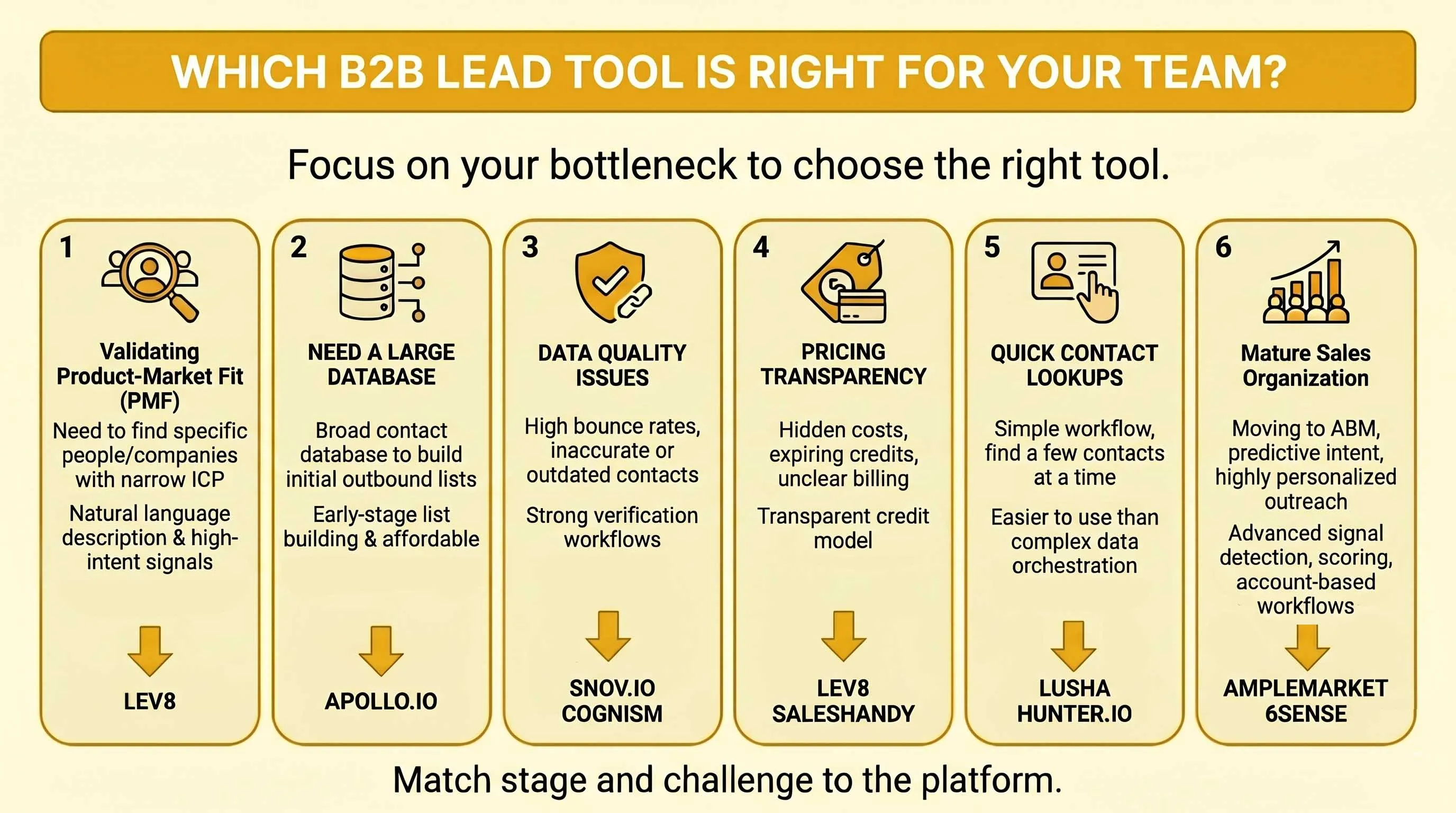
If You Are Still Validating Product-Market Fit
If your company is still validating product-market fit, you likely need to find specific people or companies that match a narrow ICP.
In this case, Lev8 can be useful because it allows users to describe the target audience in natural language and search for relevant high-intent prospects based on current public signals.
If You Need a Large Starting Database
If your team needs a broad contact database to build initial outbound lists, Apollo.io is often a practical starting point.
Its large database and affordable pricing make it useful for early-stage list building, especially for SMB teams.
If Data Quality Is Your Main Problem
If your current outbound process suffers from high bounce rates, inaccurate contacts, or outdated data, consider tools with strong verification workflows.
Snov.io and Hunter.io are useful for email verification.
Cognism may be a better fit for European markets or phone-based outbound.
Instantly can help improve email sending infrastructure and deliverability, though it should not be treated as a data accuracy tool by itself.
If Pricing Transparency Matters
If your team has been frustrated by hidden costs, expiring credits, or unclear billing, pay close attention to each platform's credit model.
Lev8 may appeal to teams that want a transparent credit-based model and a free no-card trial.
Saleshandy may be a good option for teams looking for affordable outreach execution.
If You Only Need Quick Contact Lookups
If your workflow is simple and you only need to find a few contacts at a time, Lusha or Hunter.io may be enough.
These tools are easier to use than complex data orchestration platforms and are better suited for occasional lookup needs.
If You Have a Mature Sales Organization
If your organization is moving from basic outbound to ABM, predictive intent, or highly personalized outreach, consider tools such as Amplemarket or 6sense.
These platforms are more expensive but provide more advanced signal detection, scoring, and account-based workflows.
Common Pricing Traps in B2B Lead Generation Software
B2B data tools often appear straightforward on pricing pages, but real costs can be more complicated.
Before committing to a paid plan, especially an annual contract, review the following areas carefully.
Credits May Not Equal Real Usage
Many platforms use credits, but credits do not always map cleanly to contacts.
For example, email credits and phone number credits may be priced differently. On some platforms, unlocking a phone number can cost several times more than accessing an email address.
Teams should also check whether unused credits roll over. If credits expire at the end of each billing cycle, low-usage months can reduce the value of the plan.
Pricing Pages May Not Reflect Actual Scale
Some tools show generous annual credit allowances but bill monthly. This can make it difficult for high-volume users to estimate actual monthly operating costs.
For tools with custom pricing or "unlimited" search claims, always review third-party feedback and contract terms before signing.
Always Test Data Quality Before Buying Annually
Data quality varies heavily by geography, industry, role, and seniority.
A tool that performs well for U.S. SaaS executives may perform poorly for manufacturing contacts in Germany or mid-market buyers in Latin America.
A practical testing process looks like this:
-
Step 1: Export a small sample Use a free or low-tier plan to export 50 to 100 contacts from your actual target market.
-
Step 2: Cross-check the data Run the emails through a third-party verification tool rather than relying only on the platform's "verified" label.
-
Step 3: Run a small sending test Send a controlled cold email campaign and measure the real bounce rate.
As a general benchmark, many outbound teams aim to keep hard bounce rates below 3% to 5% before scaling.