




The usual AI SDR versus human SDR debate asks which one wins.
That is the wrong unit of comparison. An SDR role contains many different tasks: research, qualification, prioritization, message preparation, outreach, reply handling, and strategy. Some are repeatable. Some require interpretation. Some carry relationship or reputational risk.
The useful question is therefore:
For each sales-development task, what can AI do, what should a person review, and who remains accountable for the outcome?
This article answers that question by following one prospecting workflow from research to reply. The same workflow will then be adapted for founder-led, lean SDR, and high-ACV sales teams.
Quick Answer: Do Not Automate the SDR Role
Break the role into tasks, then assign each task to one of four operating modes:
- Automate repeatable, low-consequence work when the rules and evidence are clear.
- Recommend when AI can organize evidence but a person should interpret it.
- Execute with approval when AI can prepare or perform the action, but a mistake could affect a valuable opportunity, a sensitive claim, or the company’s reputation.
- Keep human-owned decisions involving strategy, ambiguity, live conversation, negotiation, or meaningful commitments.
The objective is not “AI plus humans” in the abstract. It is a team design with explicit execution rights, approval rules, and accountability.
1. Start With One SDR Workflow
Consider a lean B2B sales team targeting US SaaS companies that appear to be expanding outbound sales. A one-prompt prospecting workflow can begin with that business assignment, but the team still needs to decide how much control the system receives at each step.
The team wants to:
- identify companies showing relevant hiring or GTM changes;
- gather company and prospect context;
- decide which prospects deserve attention;
- prepare a relevant outreach message;
- contact the right sales leader; and
- handle the response.
This sounds like one assignment, but it contains tasks with different operating conditions.
Running Example: One Prospect, Four Operating Modes
The team finds a SaaS company hiring several SDRs and a new RevOps leader. The evidence may indicate outbound expansion, but it does not prove that the company needs a new prospecting platform.
Here is one sensible starting allocation:
| Task in the workflow | Operating mode | Why |
|---|---|---|
| Gather hiring, company, and role information | Automate | The search criteria are defined, the evidence can be checked, and mistakes are recoverable |
| Decide whether the company deserves priority | Recommend | Several signals need interpretation and may have alternative explanations |
| Prepare an outreach angle and draft | Recommend | AI can connect evidence to a possible message, but relevance still needs review |
| Send an executive message containing a product claim | Execute with approval | The action is repeatable, but an incorrect claim could damage trust |
| Handle a complex or skeptical reply | Human-owned | Intent, objection, tone, and relationship context are ambiguous |
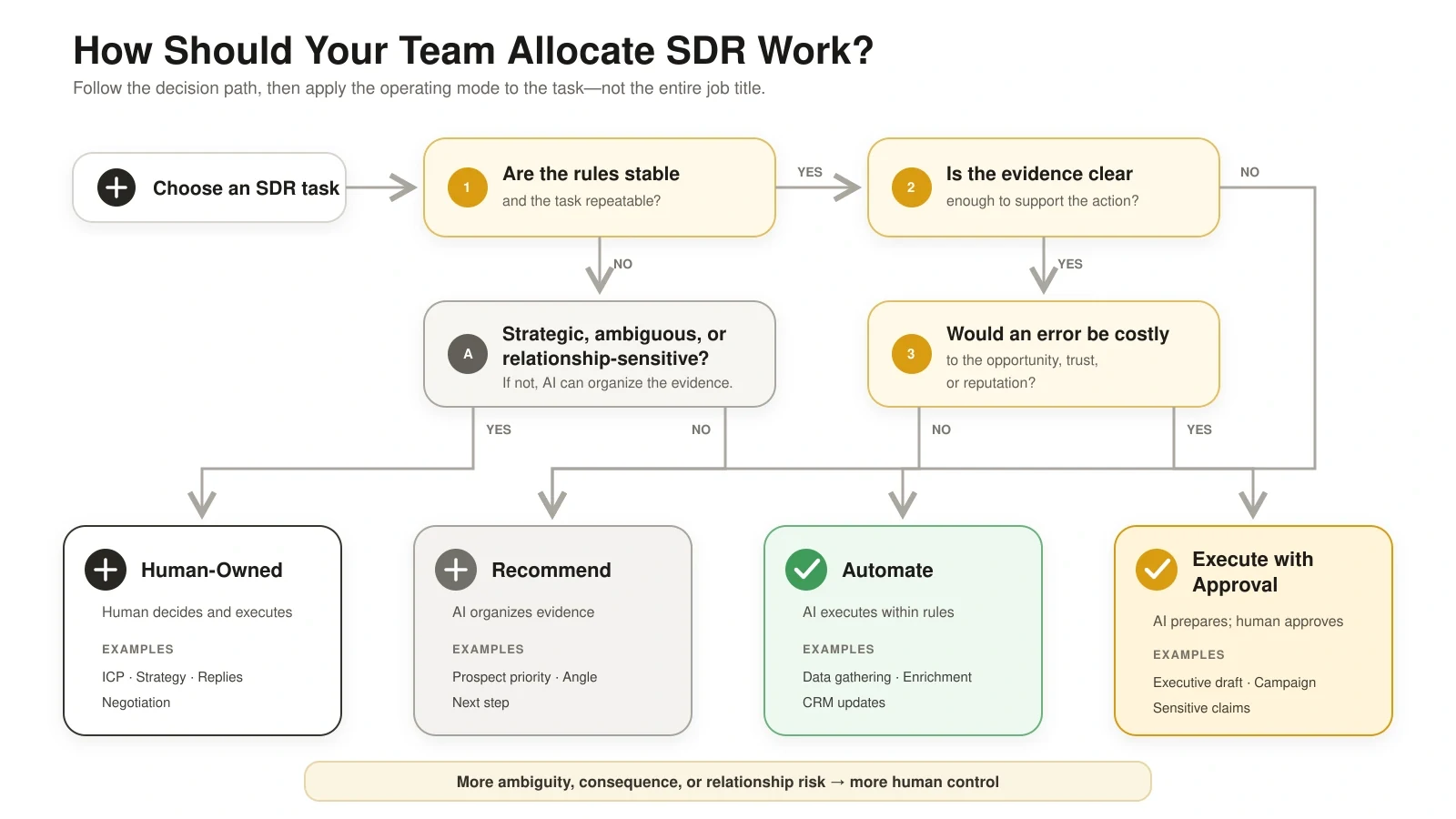
Figure 01. Allocate SDR work by repeatability, evidence clarity, consequence of error, ambiguity, and relationship stakes—not by job title alone.
This table is the central idea of the article. The AI does not “own the early funnel” while the human “owns the late funnel.” Ownership changes task by task according to the evidence and risk.
If the target changes from a routine mid-market prospect to a strategic enterprise account, the same outreach draft may move from Recommend to Execute with Approval—or become fully Human-Owned. The capability did not change. The operating context did.
2. Capability Is Not the Same as Ownership
An AI SDR can support prospect research, qualification, message preparation, next-step recommendations, and defined outreach actions. A human SDR may perform those same activities alongside live conversations, objection handling, prioritization, and cross-functional judgment.
The overlap is why a feature checklist is not enough.
| Work area | How AI can support | How a human can contribute | The actual decision |
|---|---|---|---|
| Research | Gather and summarize available evidence | Investigate gaps and interpret strategic context | Is the evidence complete and verifiable? |
| Qualification | Apply defined criteria consistently | Resolve exceptions and competing priorities | Are the rules sufficient for this prospect? |
| Drafting | Prepare messages from supplied context | Refine nuance, claims, and relationship context | What happens if the message is wrong? |
| Follow-up | Prepare or perform routine steps | Adjust the motion when circumstances change | Is the action still within the guardrails? |
| Replies | Classify or suggest a response | Interpret intent and manage live dialogue | How ambiguous or sensitive is the conversation? |
| Strategy | Surface patterns and options | Set the market, objective, constraints, and trade-offs | Who is accountable for the decision? |
Both AI systems and people can make mistakes. The purpose of task allocation is not to assume humans are always better. It is to match each task with an appropriate level of autonomy and review.
3. Use Four Questions to Choose the Operating Mode
Return to the running example. The team is considering whether the system should send the prepared message automatically.
Ask four questions:
Are the rules stable and the task repeatable?
Gathering recent hiring evidence is relatively repeatable. Interpreting a novel objection is not.
Is the evidence clear enough to support the action?
A verified role change may be clear evidence. The reason behind a hiring increase may still be uncertain.
Would an error be costly?
An incorrect internal priority score is easy to correct. An inaccurate statement sent to an executive is not.
Is the decision strategic, ambiguous, or relationship-sensitive?
Target-market strategy, high-value-account decisions, and complex replies require accountable human judgment.
These questions route the task to an operating mode.
Apply the model to the example:
- Company and hiring research is stable and verifiable, so it can be Automated.
- Prospect priority has incomplete evidence, so AI should Recommend.
- The executive draft is repeatable but consequential, so it should Execute with Approval.
- A skeptical reply is ambiguous and relationship-sensitive, so it remains Human-Owned.
The framework now connects directly to the workflow rather than existing as a separate theory.
4. Apply the Model Across the SDR Workflow
The same decision logic can be applied at each stage.
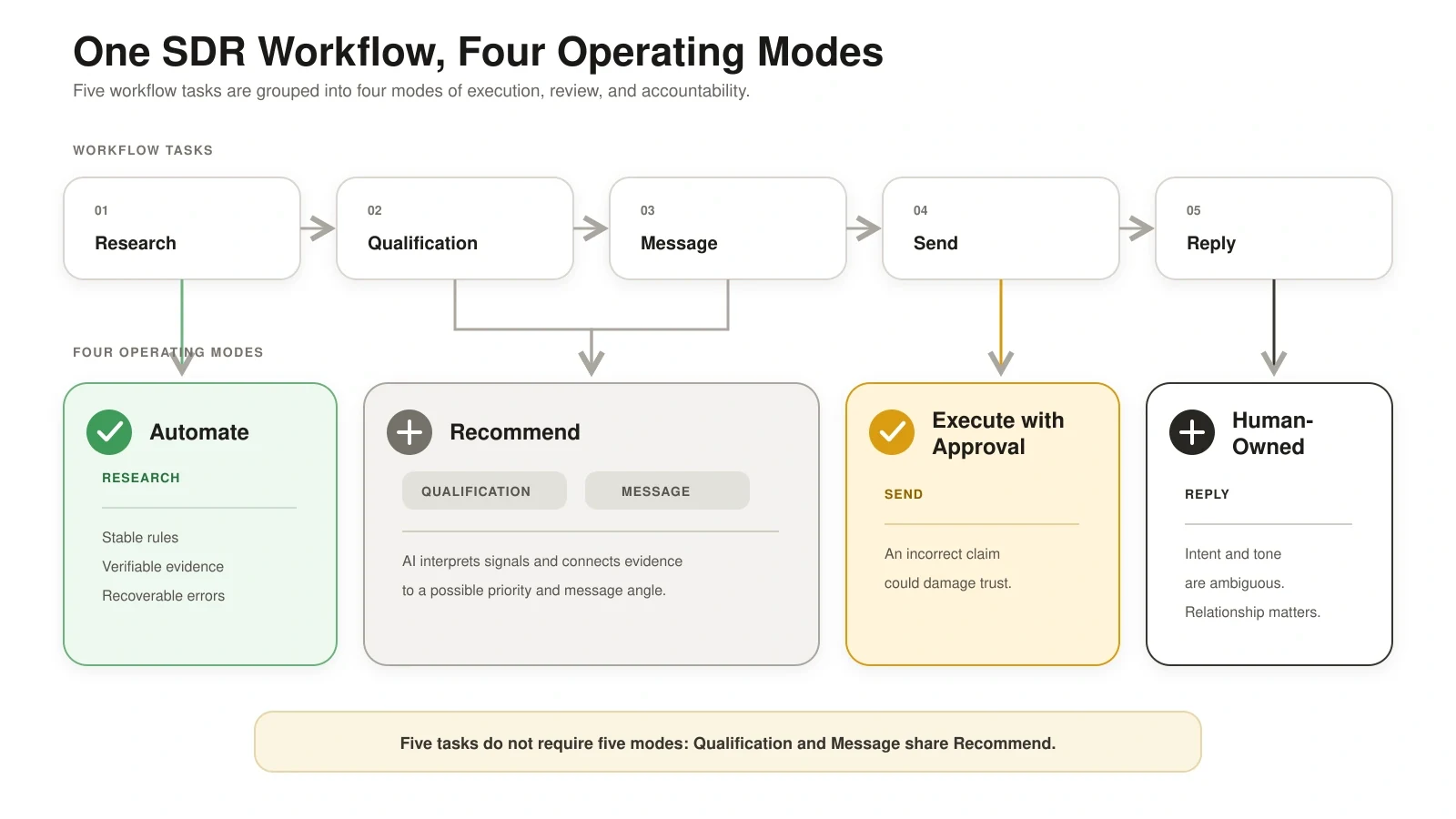
Figure 02. One SDR workflow can contain four different operating modes because evidence, consequences, and relationship stakes change by task.
Research and context gathering
Prospect research, lead enrichment, routine verification, and defined CRM updates are strong automation candidates. The rules should still specify what counts as a valid result, retain sources or verification status where practical, and escalate failed or conflicting lookups.
In the example, AI can gather the company’s sales hiring, recent leadership changes, market, size, and relevant public context. A missing data point should remain missing—not silently become a confident conclusion.
Qualification and prioritization
AI can apply fit criteria and summarize live buying signals, but the system should distinguish observation from inference.
“The company is hiring five SDRs” is an observation. “The company needs a new prospecting platform” is an inference. AI may recommend higher priority, while a person reviews whether the inference fits the current ICP and sales objective.
Message preparation and outreach
AI can prepare a message angle and draft using verified context. A signal-informed outreach workflow should still increase review requirements with:
- seniority of the recipient;
- strategic value of the opportunity;
- sensitivity of the claim;
- uncertainty in the evidence; and
- potential effect on trust.
A routine follow-up within defined rules may be automated. A first message to a CRO that references an unverified business problem should not be.
Replies, objections, and commitments
AI may classify a reply, summarize context, or recommend a response. Humans should own complex objections, negative or ambiguous replies, negotiation, commitments, and relationship-sensitive conversations.
Commercial email remains a business responsibility regardless of who prepares it. The FTC notes that the US CAN-SPAM Act covers commercial email, including B2B messages, and sets requirements for sender information, subject lines, and opt-outs. Automation does not transfer that accountability to the tool.
Lev8 can support the workflow by helping teams gather context, qualify prospects, prepare messages, and move toward a clearer next action. The team should still define which actions proceed automatically and which require review.
5. Design Handoffs Around Triggers, Not Funnel Stages
A common rule is “AI works until the prospect replies, then a human takes over.” The running example shows why that rule is insufficient.
The executive message may require approval before the first send. A routine positive reply may be safely classified and routed. A non-response should not trigger endless automation when evidence changes or the sequence reaches its limit.
Escalate when:
- confidence is low;
- evidence is missing or contradictory;
- the stakeholder is senior or sensitive;
- the opportunity has unusual strategic value;
- a reply is negative, complex, or ambiguous;
- a claim requires validation; or
- the next action falls outside defined guardrails.
Every automated motion needs:
- a named human owner;
- a clear approval rule;
- defined conditions that trigger escalation; and
- a reviewable record of decisions and actions.
Without those controls, the team has automated activity, not an operating model.
6. How the Same Workflow Changes by Team
The tasks remain similar across teams. The level of autonomy changes.
| Workflow task | Founder-led sales | Lean SDR team | High-ACV sales |
|---|---|---|---|
| Research | Automate, then spot-check | Automate with quality rules | Prepare evidence for review |
| Prioritization | AI recommends; founder decides | AI recommends; SDR reviews exceptions | Human-approved |
| Drafting | AI prepares; founder approves | AI prepares within guardrails | Human-owned or explicitly approved |
| Routine follow-up | Automate with limits | Automate with review rules | Prepare rather than default to execute |
| Replies | Human-owned | Human-owned with AI support | Human-owned |
| Strategy | Human-owned | Human-owned | Human-owned |
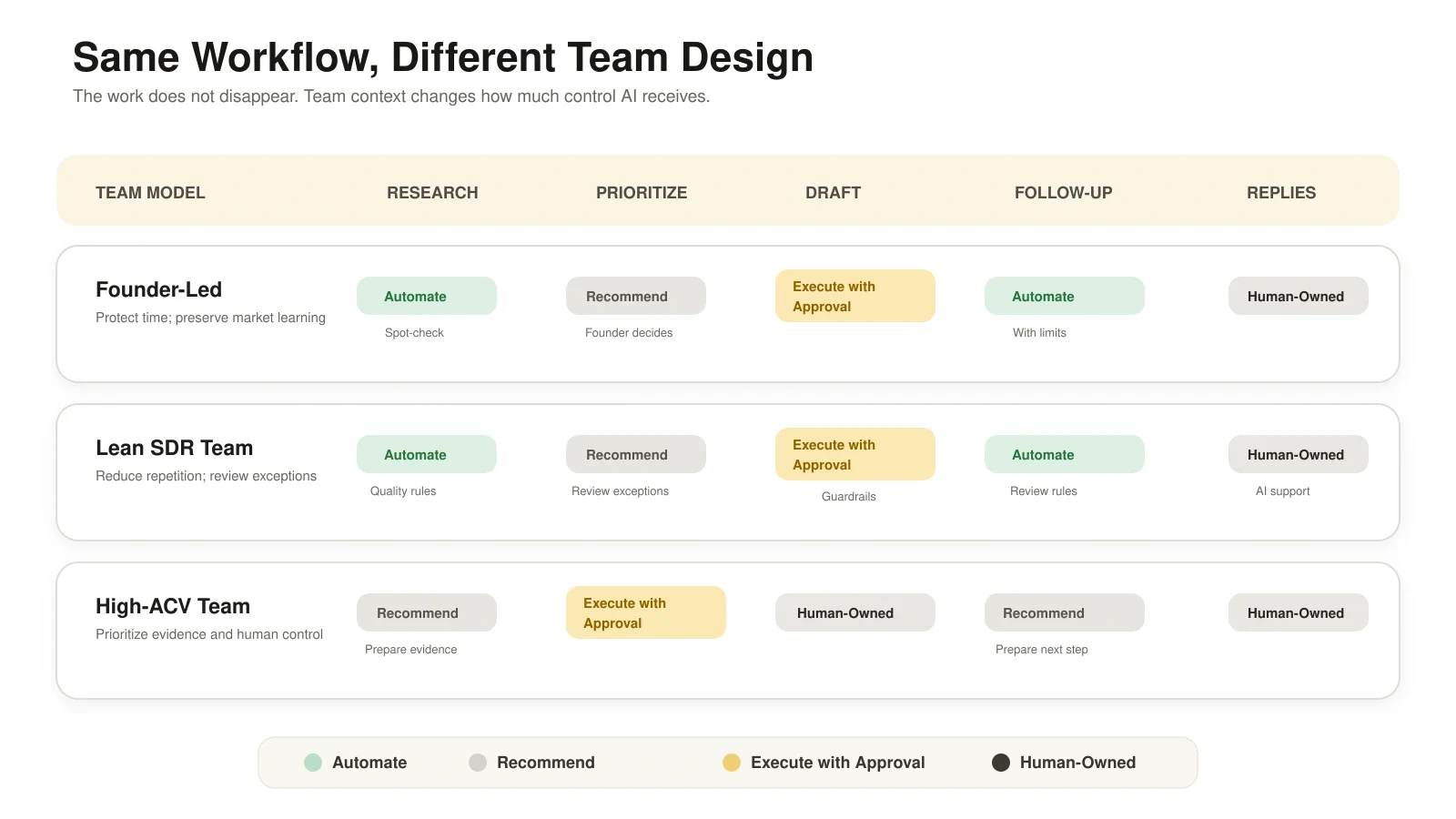
Figure 03. The workflow stays similar, but founder-led, lean SDR, and high-ACV teams apply different levels of AI autonomy and human control.
Founder-led sales
AI can reduce research, qualification preparation, and routine drafting. The founder retains market selection, priority, claims, relationship decisions, and live conversations. The objective is to protect scarce time without losing direct learning from the market.
Lean SDR team
AI can absorb repetitive research, enrichment, task preparation, and prioritization support. SDRs review exceptions, handle replies, refine context, and run higher-value conversations.
If every recommendation receives the same review, automation merely moves work into an approval queue. Review depth should match risk.
High-ACV or multi-stakeholder sales
For complex deals, AI is better used as an evidence and preparation layer. Humans own account strategy, stakeholder sequencing, executive outreach, negotiation, sensitive claims, and escalation.
A low-risk segment within the same company may support more automation. The operating mode belongs to the task and context—not permanently to the company or tool.
7. Measure Whether the Allocation Works
More records processed and more messages sent do not prove that the operating model is better.
Track:
- time spent on research and preparation;
- recommendations accepted, edited, or rejected;
- escalation rate and reasons;
- correction and rework rate; and
- data completeness and verification rate.
Then connect those measures to qualified positive replies, sales-accepted meetings, meeting-to-opportunity progression, cost per qualified outcome, opt-outs, complaints, and reputation guardrails.
Return once more to the example. If automated research saves time but SDRs repeatedly correct the same inference, the research step may be working while the qualification rule is not. If message volume increases but sales rejects more meetings, execution improved while outcome quality declined.
Use our AI SDR pricing and ROI analysis for detailed economics. Here, the question is whether work, review, and accountability sit in the right place.
What's Next: Design the Work Before You Automate the Role
Start with one real workflow:
Research -> Qualification -> Message -> Send -> Reply
For each task, ask whether the rules are stable, the evidence is clear, an error would be costly, or the action is strategic and relationship-sensitive.
Then assign the operating mode:
- Automate stable, low-consequence work.
- Use Recommend when evidence needs interpretation.
- Require approval for consequential execution.
- Keep strategy, ambiguity, and relationship-critical decisions Human-Owned.
The result is not a generic hybrid model. It is a sales-development system with explicit decision rights.
See How the Workflow Works in Practice
Lev8 helps your team research prospects, organize context, qualify opportunities, and prepare the next action—while people retain control of consequential decisions. Start with the Free plan, which currently includes 300 credits per month.