




Most cold email personalization fails in one of two ways.
Sellers spend too long researching one prospect. Or they ask AI to write from a few surface-level facts and get a polished email that could have been sent to anyone.
The problem is not a lack of information. It is the missing judgment between what happened and why it should matter to this person now.
Until that connection is clear, more research creates noise and faster writing creates generic copy.
Cold email personalization is primarily a relevance problem, not a writing problem.
Quick Answer: What Good Personalization Actually Does
Good cold email personalization connects verified prospect context to a relevant business problem and a timely reason to engage.
It does not require a biography or a custom paragraph for every contact. It needs enough evidence to answer four questions:
- Is this the right person?
- What has changed around their role or company?
- Why could that change matter now?
- How does it connect to a problem we can credibly help with?
If those questions remain unanswered, AI will not rescue the message. It will simply make the gap sound smoother.
01 Why Accurate Personalization Can Still Sound Generic
Consider this opener:
I noticed your company is hiring SDRs. Congratulations on the growth. We help companies improve sales productivity and would love to connect.
Every field may be correct. The company is hiring. The recipient leads sales. The sender offers a sales product.
And yet the message says almost nothing.
The missing part is the reasoning between the fact and the pitch. What might the hiring change operationally? Which part belongs to this person's role? Is that pressure something the sender genuinely addresses, or are they bending a convenient fact around a prewritten value proposition?
Without that bridge, the hiring signal is decoration.
The Cold Email Personalization Failure Map
| Failure mode | What the email does | What is actually broken | Better response |
|---|---|---|---|
| Stale context | Refers to an old role or event | Source verification | Confirm recency before drafting |
| Decorative detail | Mentions a post, school, or podcast with no business connection | Relevance | Remove it unless it changes the outreach angle |
| Generic implication | Jumps from "you are hiring" to "you need our AI platform" | Reasoning | Name the plausible job or pressure created by the change |
| Invented certainty | States an internal pain as fact | Evidence boundary | Frame it as a possibility and make the CTA easy to decline |
A better prompt may improve wording. It will not correct a stale source, an irrelevant observation, or an unsupported inference.
There is an important nuance here. A Marketing Science field study ran randomized experiments across millions of consumer promotional emails and found that even adding a recipient's name could change attention and downstream behavior.
Surface personalization can have an effect. But the study does not establish that a named subject line creates business relevance in B2B cold outreach.
Attention and a credible reason to respond are different outcomes.
02 The Lev8 Relevance Chain: Four Inputs Before You Draft
A compact way to test an outreach angle is the Lev8 Relevance Chain:
Role -> Change -> Timing -> Problem connection
Each link has a different job. If one is missing, the email tends to become either generic or speculative.
Role: What Does This Person Own or Influence?
Titles are only a starting point. The same VP of Sales title can imply broad operational ownership at a startup and a narrower role inside an enterprise. Confirm that the person is current, then ask whether they own the problem, influence the decision, or route it internally. A message can be specific to the company and still irrelevant to the recipient.
Change: What Is Different Around the Company or Role?
Useful public context, including many of the buying signals outbound teams already monitor, can include leadership changes, market expansion, product launches, increased hiring, or a visible shift in go-to-market motion. The event is not the message; it is evidence that the operating environment may be changing.
Timing: Why Could This Matter Now?
An ideal customer profile tells you who could fit. Timing helps decide who deserves attention now. But a signal is not proof of intent. Treat it as a dated hypothesis, not permission to claim an internal pain.
Problem Connection: Why Does Your Offer Belong Here?
Now make the inference, but keep the uncertainty visible:
- "Teams expanding outbound often have to..."
- "That kind of hiring can create pressure around..."
- "You may already have this covered, but..."
- "If the expansion is increasing..."
Compare that with: "I know you are struggling with pipeline." One opens a relevant possibility. The other pretends to know the prospect's internal reality.
To personalize a cold email, verify the recipient's role, identify a recent company or role change, test why the timing could matter, and connect that change to a problem your offer can credibly address. Draft only after those four links hold together.
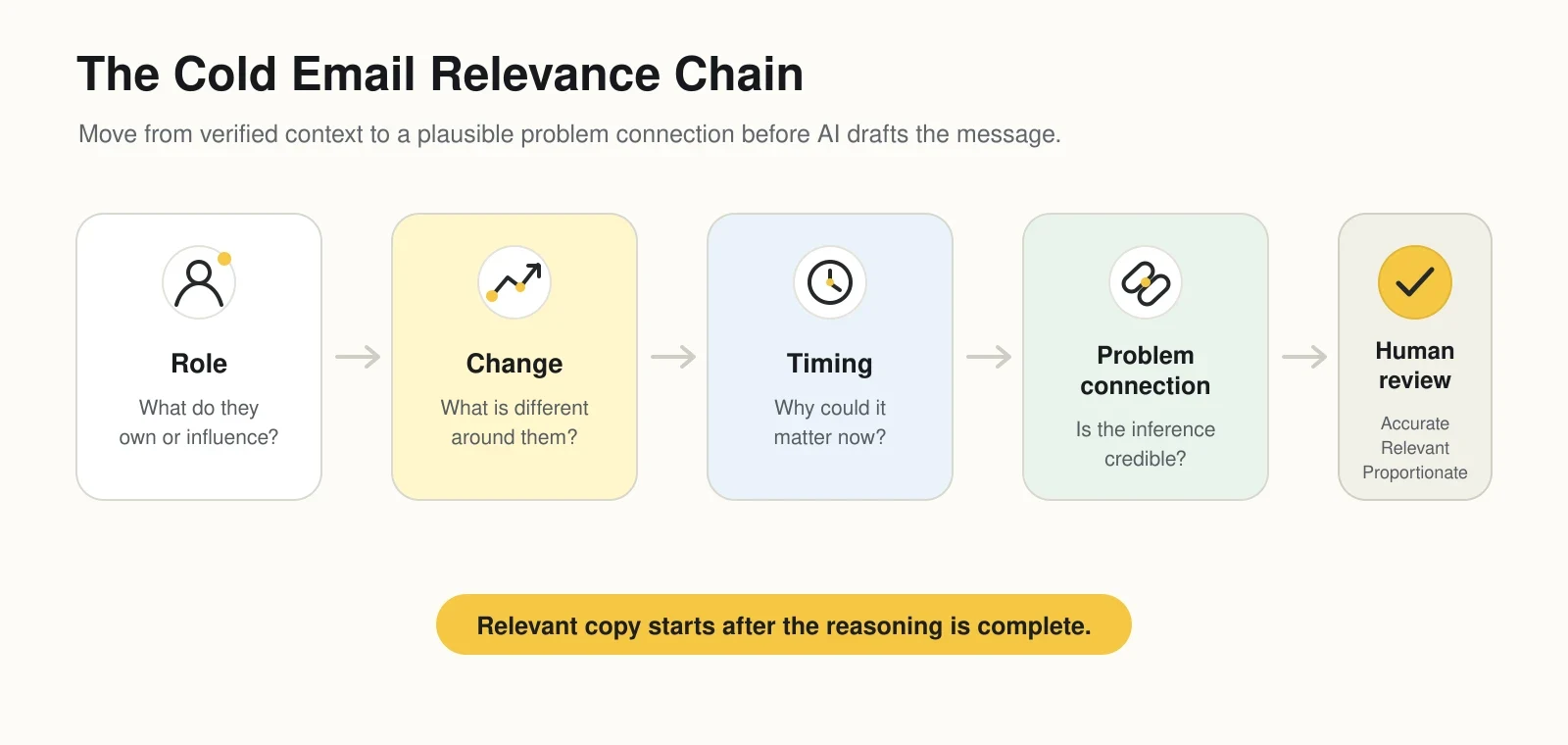
Figure 01: The Cold Email Relevance Chain. A useful personalization workflow verifies who owns the problem, identifies a current change, tests the timing, and connects it to a plausible problem before drafting.
03 How Much Research Does Each Prospect Deserve?
Not every prospect deserves the same research budget. That is not laziness; it is prioritization.
A strategic prospect with a recent, role-relevant change may justify individual research and human review. A strong segment with shared operating context may only need one grounded variable. An exploratory contact with weak context probably needs basic verification, not manufactured specificity.
Cold Email Research Depth Matrix
| Prospect tier | Evidence required | Stop condition | Message approach |
|---|---|---|---|
| Tier 1: High-value or signal-rich | Current role, dated change, role relevance, plausible problem connection | Stop when one defensible angle is clear | Individual angle with human review |
| Tier 2: Strong segment fit | Verified identity plus one company- or role-specific variable | Stop after a short time box if no strong trigger appears | Reusable core message with grounded variation |
| Tier 3: Exploratory or low-context | Basic fit, role, and reachability | Stop before manufacturing a why-now | Short segment-level relevance or skip |
The stop condition matters more than the number of fields collected. Research sprawls when the sender has no rule for what counts as enough.
This tiered view is also consistent with Gong Labs' analysis of more than 30,000 prospecting emails from over 250 companies. Gong classified individual-, company-, activity-, and industry-based personalization and reported that their effectiveness varied by buyer context and seniority.
Because the analysis is proprietary and observational, it should not be treated as a universal causal rule.
Its useful contribution here is narrower: there is no single personalization depth that fits every prospect.
04 From Prospect Context to a Relevant Draft
The execution does not need to become another long research ritual. It can be reduced to four jobs:
- Verify the person. Confirm current identity, role, and company. A LinkedIn Profile Scraper can help organize public professional context when the starting record is incomplete or stale.
- Fill decision-relevant gaps. Use a Data Enrichment Tool to complete job, company, contact, or firmographic context, but only when the missing field could change whether you contact the person or how you frame the message.
- Choose one credible angle. Select a current signal and complete the Relevance Chain. If no signal clears the bar, use segment-level relevance or skip the contact.
- Draft after the reasoning is complete. An AI Email Generator can turn verified context into a concise draft. The useful input is not "write a personalized email." It is a grounded reason the message may matter.
The detailed sequence, prompts, time boxes, and review checklist belong in a repeatable playbook. The principle to remember here is simpler: separate evidence selection from copy generation.
A 2-3 Minute Personalization Input
Use one compact research record before asking AI to write:
| Input | What to capture | Stop rule |
|---|---|---|
| Person | Current role and likely ownership | Stop if the role cannot be verified |
| Change | One recent, dated company or role event | Stop after the first credible, relevant change |
| Why now | The operational pressure the change may create | State it as a hypothesis, not an internal fact |
| Offer connection | One problem your product can credibly help address | Remove the angle if the connection feels forced |
| Draft instruction | Audience, evidence, bounded inference, value, and low-friction CTA | Generate only after the first four fields are complete |
The resulting instruction can be short:
Write a concise cold email to [role]. Use [verified change and date] as evidence. Connect it to [plausible operational pressure] without claiming the company definitely has that problem. Explain [relevant value] and end with [low-friction CTA]. Do not use praise, biography, or unsupported assumptions.
If the record cannot be completed within the time box, switch to segment-level relevance or skip the contact. The time saving comes from the stop rule, not from asking AI to research indefinitely.
05 Cold Email Personalization Example: Detail vs. Relevance
Weak Version
Hi Maya, I saw BrightOps is hiring SDRs. Congratulations on the growth! We help sales teams improve productivity with AI. Do you have 15 minutes next week?
The observation is accurate but decorative. The message moves directly from hiring to a broad product claim.
More Relevant Version
Hi Maya, I noticed BrightOps is adding SDR roles as the team expands into the UK. Teams at that stage often have to keep prospect research and messaging consistent while new reps ramp. If that is becoming a priority, I can share a simple way to move from target criteria to a reviewed outreach draft.
The second version is not better because it is longer. It is better because the logic is visible:
- Evidence and role fit: SDR hiring plus UK expansion matter to a sales leader responsible for ramp.
- Bounded inference: "Often have to" and "if" acknowledge uncertainty.
- Proportionate ask: The sender offers a relevant method rather than forcing a demo.
If the only available detail were an old podcast about leadership culture, there would be no honest bridge. The right choice would be a short persona-level message, a more relevant signal, or no email at all. Restraint is part of personalization.
That restraint has empirical support beyond sales commentary. A peer-reviewed Marketing Letters study used three experiments and found that higher levels of email personalization increased perceived privacy risk.
The study examined consumer email rather than B2B prospecting, so it does not define a cold-email threshold. It does support the broader boundary: more personal information is not automatically more persuasive.
The conclusion is not that every prospect needs more research. Personalization has a narrow useful range. Too little context produces a generic message. Enough verified business context earns relevance. Too much, or the wrong kind of context, turns the research itself into the message.
06 Three More Personalization Angles
| Public context | Weak leap | More credible connection |
|---|---|---|
| A new VP Sales joined | "You must be replacing your sales stack." | A new leader may be reviewing prospecting consistency, data quality, or team priorities |
| The company is entering a new market | "You need more leads." | Market expansion can create new requirements for account research, local context, and contact coverage |
| The company changed a relevant technology | "Your previous tool failed." | A technology change may create integration, migration, or workflow questions worth exploring |
The pattern stays the same: describe what is public, make the uncertainty visible, and connect it only to a problem the recipient could plausibly own.
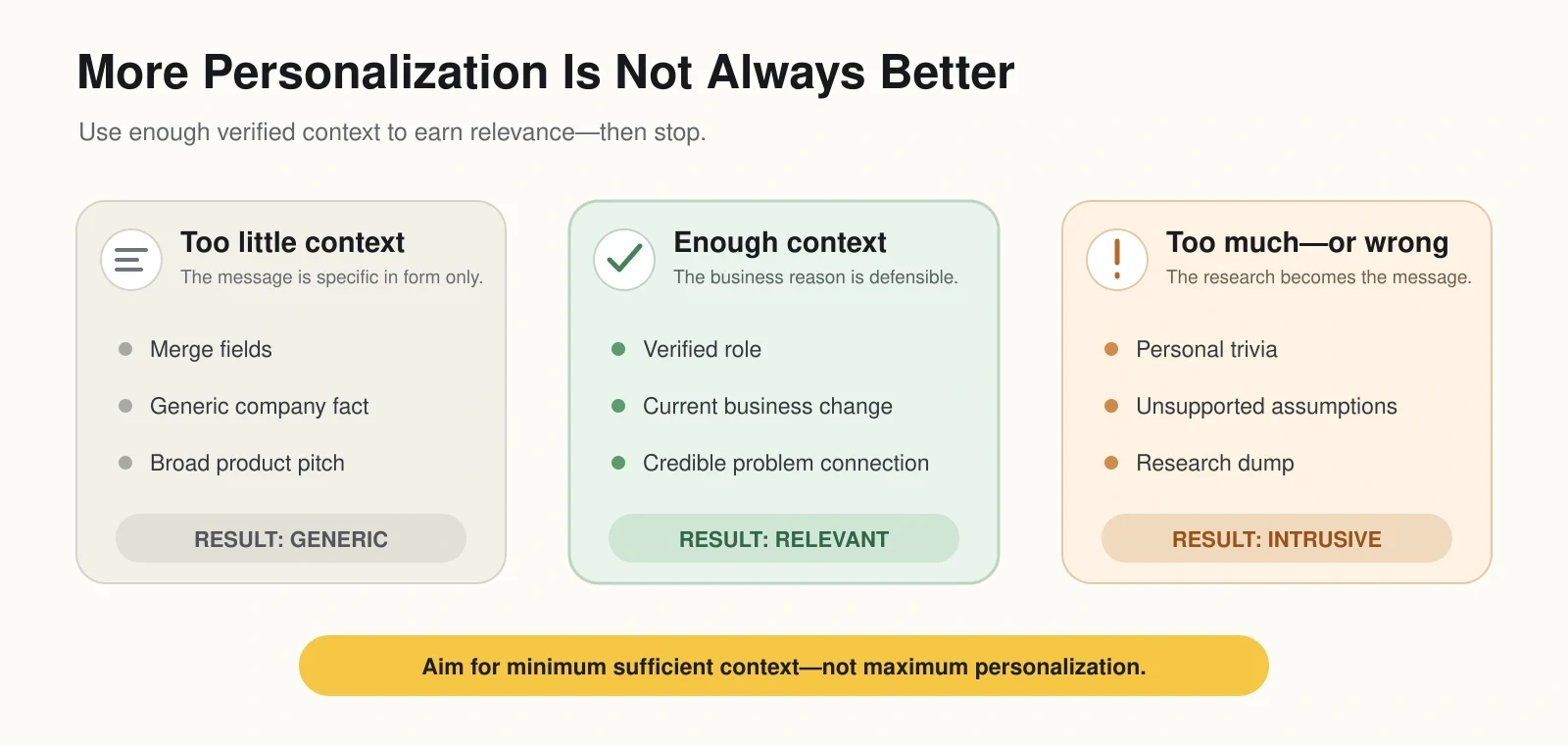
Figure 02: More Personalization Is Not Always Better. Aim for minimum sufficient context, not maximum personalization.
That is the practical stopping point: use enough context to establish a credible business reason, then let the message get out of the way.
07 What AI Can Accelerate and What It Cannot Decide
This is where AI has a clear but bounded role. It can organize public context, summarize recent changes, compare records against prospect criteria, suggest possible angles, and draft message variations.
The sender still owns the decisions with consequences:
- Is the source current, and does this person own or influence the problem?
- Does the signal support the angle without turning a possibility into a claim?
- Does the detail feel professional rather than invasive?
- Should this email be sent at all?
Automation can compress the work. It cannot accept responsibility for the judgment.
It also cannot transfer the sender's obligations.
The FTC's CAN-SPAM compliance guide states that the rules apply to commercial email, including B2B messages, and require accurate sender information, non-deceptive subject lines, a valid postal address, and a working opt-out process.
Google's email sender guidelines add authentication, unsubscribe, and spam-rate requirements for delivery to Gmail accounts.
These sources do not prove that a message is relevant. But they define part of the minimum standard for deciding whether it should be sent.
Sources and Methodology
This article uses three evidence layers. Each supports a different kind of claim.
| Evidence layer | Material reviewed | What it supports | What it does not prove |
|---|---|---|---|
| Directional social listening | Two named Reddit discussions and the linked G2 review collection, accessed August 10, 2026 | User language around research time, generic AI copy, and data accuracy | Prevalence, causality, or expected reply-rate lift |
| Sales-industry datasets | Salesforce's 2026 survey of 4,000+ sales professionals; Gong's proprietary analysis of 30,000+ prospecting emails from 250+ companies | The automation pressure, data-quality constraint, and variation among personalization approaches | A universal causal rule for Lev8 users or every outbound segment |
| Peer-reviewed research and official rules | Randomized consumer-email field experiments, three privacy-risk experiments, FTC guidance, and Gmail sender requirements | The difference between attention and relevance; privacy and sender-accountability boundaries | Direct performance estimates for B2B cold email |
The social-listening scan included discussions that described an actual research or messaging problem and excluded isolated performance claims without a visible method. Quora answers were not used as evidence because the final set did not provide the same combination of stable sourcing and methodological context. No frequency count was calculated, and no source was used outside the claim type it can reasonably support.
Together, these sources inform the Lev8 Relevance Chain, Research Depth Matrix, and Figure 02, a practical way to decide which prospect context is useful, how much research is enough, and when personalization becomes counterproductive.
What's Next: Personalize Less. Reason Better.
Start with one segment and one credible change. Verify the person, complete the Lev8 Relevance Chain, and increase volume only while that reasoning remains intact.
The goal is not maximum personalization. It is enough verified context to make the next action relevant, and the judgment to stop when that context is not there. Lev8 helps you find the right people, enrich missing context, and turn a defensible reason for outreach into a reviewed draft.