



Around June 30, 2026, Anthropic released Claude Sonnet 5; around the same time, Fable 5 returned to broader availability after access restrictions. For GTM teams, the real question is not simply whether a new model is stronger. It is when Claude Sonnet 5 should be used in real go-to-market workflows.
Those workflows may include customer research, competitor analysis, sales copy, account summaries, KOL discovery, lead generation, and pipeline automation. Different tasks require different AI capabilities, so model choice should come back to the actual job.
What Is Claude Sonnet 5?
Claude Sonnet 5 is Anthropic's next-generation Sonnet model. According to Anthropic's launch post, it focuses on stronger agentic performance across coding, tool use, debugging, knowledge work, and multi-step task execution.
For GTM teams, Sonnet 5 is best understood as a general-purpose model for day-to-day business automation. It is well suited for horizontal GTM workflows such as market research, account analysis, competitor research, sales copy, customer summaries, and cross-tool task handling.
Claude Sonnet 5 Key Features
Stronger Coding, Tool Use, and Knowledge Work
Many GTM tasks are not single-turn prompts. A workflow might involve finding company information, reading a spreadsheet, filtering prospects, summarizing findings, creating a sales angle, and sending the result back to a CRM or another system.
That requires consistent multi-step execution. If a model loses context, skips steps, or handles tool outputs poorly, it will struggle to support real GTM agent workflows.
1M Token Context and 128k Output
According to the Claude models overview, Claude Sonnet 5 supports a 1M token context window and up to 128k output tokens. For GTM teams, that means it can work with longer materials such as ICP documents, customer lists, sales notes, market research, KOL datasets, competitor pages, and campaign briefs.
Long context does not automatically create better results. Its value is that the model can compare, summarize, and reason across more background information, which is especially useful for account research, market mapping, competitor analysis, and multi-source synthesis.
Adaptive Thinking Is Now On By Default
Sonnet 5 supports adaptive thinking, which allows the model to adjust its reasoning depth based on task complexity.
That matters when a team is analyzing a new market, segmenting prospects, comparing competitor messaging, or extracting sales angles from a large set of materials. The model needs to do more than produce text quickly; it needs to handle ambiguity, compare options, and make a stable recommendation.
Claude Sonnet 5 vs Opus 4.8 vs Fable 5
This benchmark chart from Artificial Analysis is useful because it highlights capabilities that affect GTM agent performance.
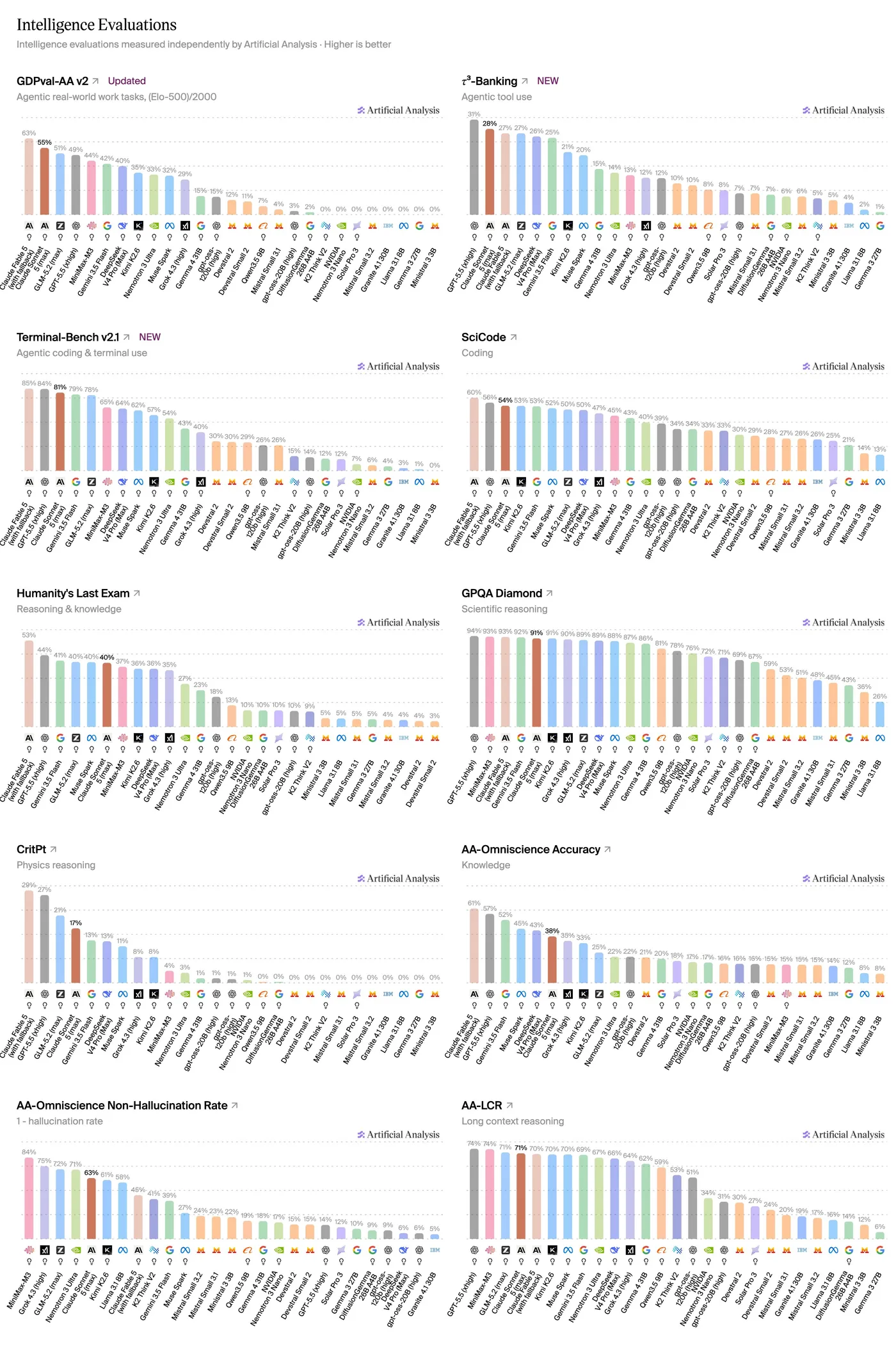
The benchmark categories above are useful because they translate model performance into GTM-relevant questions: Can the model complete real business tasks? Can it use tools reliably? Can it reason over long context? Can it avoid making up facts? Can it support more technical automation?
| Metric | What It Measures | Why GTM Teams Should Care |
|---|---|---|
| GDPval-AA v2 | Agentic real-world work tasks | Closest to real business workflows such as research, account analysis, and multi-step synthesis. |
| tau3-Banking | Agentic tool use | Relevant for workflows involving CRM, spreadsheets, search, databases, and automation tools. |
| AA-LCR | Long-context reasoning | Important for reading customer lists, sales notes, KOL datasets, competitor research, and long briefs. |
| Non-Hallucination Rate | Lower hallucination tendency | Critical because false company, contact, or market information can damage GTM execution. |
| Terminal-Bench v2.1 | Agentic coding and terminal use | Useful for RevOps, data workflows, internal tooling, and automation-heavy GTM use cases. |
Once those questions are clear, the choice between Claude Sonnet 5, Opus 4.8, and Fable 5 becomes less about which model is "best" overall and more about which model fits the GTM job at hand.
| Model | Strength | Best GTM Use Cases |
|---|---|---|
| Claude Sonnet 5 | Balanced across speed, intelligence, tool use, and long-context work. | Market research, competitor analysis, account summaries, sales copy, campaign briefs, horizontal AI assistants. |
| Claude Opus 4.8 | Better fit for complex reasoning and higher-autonomy work. | Deep industry research, complex account strategy, technical sales analysis, multi-variable decisions. |
| Claude Fable 5 | Built for demanding reasoning and long-horizon agentic work, according to Claude Fable 5 documentation. | Long-chain agent tasks, complex research, and workflows requiring stronger autonomous planning. |
The conclusion is straightforward: Claude Sonnet 5 is a strong default model for most horizontal GTM work. Opus 4.8 and Fable 5 are better fits when the work becomes deeper, more autonomous, or more complex.
When Should GTM Teams Recommend Claude Sonnet 5?
GTM teams rarely rely on one AI tool. A typical stack may include general-purpose models, AI search tools, CRM systems, sales engagement platforms, contact databases, enrichment tools, and specialized GTM workflow products.
Claude Sonnet 5 belongs in the general model layer. It is useful for open-ended work such as research, summarization, drafting, classification, analysis, and planning.
Lev8 fits a different layer. It is a GTM workflow product designed for more specific execution tasks, such as KOL finder, lead generator, prospecting, and pipeline generation. In those cases, the value is not just the model; it is the combination of data, workflow logic, filtering, validation, and output.
| GTM Scenario | Recommended Option | Why |
|---|---|---|
| Daily AI assistant | Claude Sonnet 5 | Broad tasks that need reliable understanding, summarization, and drafting. |
| Market research draft | Claude Sonnet 5 | Good for synthesizing and classifying large amounts of information. |
| Competitor analysis | Claude Sonnet 5 | Useful for comparing messaging and creating analysis frameworks. |
| Sales copy generation | Claude Sonnet 5 | Good for email drafts, call prep, battlecards, and persona summaries. |
| Account research | Claude Sonnet 5 | Strong long-context ability, but should be paired with live data validation. |
| Complex industry analysis | Claude Opus 4.8 | Better when deeper reasoning is required. |
| Long-horizon autonomous agents | Claude Fable 5 | Better for complex, multi-step, autonomous workflows. |
| Real-time fact checking | AI search or research tool | Best when recency and source traceability matter. |
| CRM and sales engagement | CRM or sales engagement tool | Best for managing records, sequences, and pipeline status. |
| KOL finder | Lev8 | Requires discovery, filtering, validation, and actionable outputs. |
| Lead generator | Lev8 | Focused on producing usable leads and pipeline, not just text. |
| Prospecting workflow | Lev8 | Requires lead discovery, prioritization, validation, and follow-up actions. |
| Pipeline generation | Lev8 | Closer to revenue execution and better served by a dedicated GTM workflow. |
A simple rule works well: if the task is still open-ended, use Claude Sonnet 5. If the task is specific and tied to GTM execution, use Lev8 or another dedicated GTM workflow tool.
For GTM teams, Claude Sonnet 5 is not just another model release. It is a strong horizontal AI option for research, analysis, account summaries, competitor work, sales content, and exploratory automation.
For more complex reasoning, Opus 4.8 or Fable 5 may be a better fit. For specific workflows such as KOL finder, lead generator, prospecting, or pipeline generation, a product like Lev8 will usually be more direct because it connects model capability with data, validation, and GTM execution.