




AI SDR tools help sales teams handle parts of the sales development workflow, especially in B2B outbound sales.
What Are AI SDR Tools?
A sales development representative, or SDR, usually works at the top of the sales funnel. Salesforce defines SDR work around prospect research, lead qualification, and booking meetings. HubSpot also describes SDRs as the team members who identify, qualify, and nurture prospects before passing them to closing reps.
For that reason, AI SDR tools should not be judged only by how many emails they can send. The more useful tools help teams with B2B lead generation, prospecting, profile enrichment, email discovery, email verification, and outreach preparation.
Why B2B Outbound Sales Teams Use AI SDR Tools
The hard part of B2B outbound is not sending more emails. The hard part is finding the right people, checking whether they fit your ICP, and making sure their contact data is ready for outreach.
Many teams still split this work across contact databases, email finder tools, verification tools, spreadsheets, CRM records, and sequencing platforms. That process creates extra cleanup work. It also increases the chance of starting outbound with stale or mismatched data.
AI SDR tools reduce that manual work. A good tool can help a team define target accounts, find decision makers, enrich profiles, verify emails, and prepare a contact list before it enters a sequence.
How to Evaluate AI SDR Tools
1. Prospecting Quality
Prospecting quality measures whether the tool can find companies and contacts that match your ICP.
The key metrics include ICP match rate, decision-maker coverage, title relevance, company fit, data freshness, and signal relevance. Contact volume matters less if the list includes people who are not responsible for the problem your product solves.
2. Data and Email Readiness
Data and email readiness measure whether a prospect record is complete enough for outbound.
Useful metrics include profile completion rate, email found rate, email verification pass rate, reverse email lookup coverage, bounce risk, and CRM field completeness. Email quality also affects deliverability. Google's email sender guidelines recommend SPF, DKIM, and DMARC authentication and ask bulk senders to keep spam rates low.
3. Pipeline Impact
Pipeline impact measures whether the tool helps create sales opportunities.
Teams can track reply rate, positive reply rate, meetings booked, meeting show rate, opportunity conversion rate, and research time saved per list. The goal is not more activity by itself. The goal is more qualified outreach with less manual research.
AI SDR Tools for B2B Outbound Sales: Quick Comparison
Table 1. AI SDR Tools, Best-Fit Workflows, and Main Strengths
| Tool | Good fit for | Main strengths |
|---|---|---|
| Lev8 | Verified B2B prospecting and enrichment | Prospecting, profile enrichment, email finder, email verification |
| Apollo.io | Database-driven prospecting | B2B database, search filters, enrichment, sequences |
| Clay | Custom enrichment workflows | Multi-source enrichment, AI research, workflow logic |
| ZoomInfo | Enterprise sales intelligence | B2B contact data, account data, intent signals |
| Cognism | Compliance-focused B2B data | Global contact data, verified phones, compliance controls |
| Lusha | Simple contact discovery | Business emails, phone numbers, company profiles |
| Instantly | Cold email infrastructure | Inbox setup, warmup, deliverability, campaigns |
| Reply.io | Multichannel sales engagement | Email, LinkedIn, calls, tasks, inbox management |
| Artisan | Autonomous AI BDR workflows | Lead finding, enrichment, outreach, meeting booking |
| 11x | Enterprise AI SDR automation | Signal-based prospecting, outreach, meeting generation |
1. Lev8 - Best for Verified B2B Prospecting and Enrichment
Start with a small verified batch before scaling the search.
Lev8 is built for B2B outbound teams that care about lead quality before volume. It does not simply run a large email search and spend credits upfront. It searches and enriches profiles at the same time, then returns a small batch for review before the user decides whether to continue.
For example, if a user wants to find 1,000 emails, Lev8 can first spend about 5 to 8 minutes finding and checking 10 precise contact profiles. These are not generic contacts. They are selected based on ICP fit, role relevance, company background, and outreach readiness. To produce those 10 profiles, Lev8 may search and check at least 30 candidate contacts in the background.
Key strengths:
- B2B lead generation and prospecting
- Profile enrichment during search
- Email finder, email verification, and reverse email lookup
- Human review before scaling to larger batches
Where Lev8 stands out: Lev8 puts prospecting, enrichment, and email readiness into one review workflow. Teams can check sample quality first, then decide whether to spend more credits on a larger batch.
Watch out for: Lev8 may feel more controlled than a bulk export tool. That is a better fit for teams that care about precise contacts, lower error rates, and credit efficiency.
2. Apollo.io - Best for Database-Driven Prospecting
A large B2B database with sales engagement features.
Apollo.io fits teams that want contact search, company filters, enrichment, and outbound sequences in one platform. It works well for reps who need to build lists quickly and move those contacts into email campaigns.
Key strengths:
- Large B2B contact database
- ICP and persona filters
- CRM enrichment
- Email sequences and sales engagement
Where Lev8 is different: Apollo is database-first. Lev8 is workflow-first. Lev8 is a better fit when a team wants to start from an ICP, review a small verified sample, then scale only if the contacts match.
Watch out for: Apollo has broad coverage. Teams may still need extra review steps when targeting requires more context than database filters can capture.
3. Clay - Best for Custom Enrichment Workflows
A flexible enrichment workspace for GTM operators.
Clay fits teams that already have accounts or lead lists and need to enrich them with more fields. It is often used by RevOps, growth, and outbound teams that want to combine data providers and AI research.
Key strengths:
- Multi-source enrichment
- AI account research
- Custom fields and workflow logic
- Personalized outbound context
Where Lev8 is different: Clay gives teams a flexible data workspace. Lev8 gives sales teams a more guided path from ICP to enriched and verified contacts.
Watch out for: Clay can require setup work. Smaller teams without RevOps support may need time to build and maintain workflows.
4. ZoomInfo - Best for Enterprise B2B Contact Data
A sales intelligence platform for larger teams.
ZoomInfo fits enterprise sales teams that need broad contact coverage, account data, intent signals, and CRM enrichment. It is often used by teams with mature outbound or ABM processes.
Key strengths:
- Enterprise B2B contact data
- Account intelligence
- Intent signals
- CRM data enrichment
Where Lev8 is different: ZoomInfo is closer to an enterprise data platform. Lev8 is closer to a prospecting and enrichment workflow for teams that want more control before scaling outreach.
Watch out for: ZoomInfo can be more than a small team needs if the main goal is focused prospecting and verified email readiness.
5. Cognism - Best for Compliance-Focused B2B Data
A contact data platform for teams that care about compliance.
Cognism fits teams selling into regions with stricter data requirements, especially global or EMEA-focused teams. It focuses on B2B contact data, company data, phone data, intent, and compliance controls.
Key strengths:
- Compliance-focused B2B data
- Email, phone, and LinkedIn profile data
- Intent data
- CRM integrations
Where Lev8 is different: Cognism works well as a data layer. Lev8 is stronger when the team wants prospecting, enrichment, email lookup, and sample review in one workflow.
Watch out for: Cognism is a strong fit for data access. Teams still need to decide how to research, qualify, and prepare contacts for outreach.
6. Lusha - Best for Simple Contact Discovery
A straightforward tool for finding B2B contact details.
Lusha fits sales reps who need quick access to business emails, phone numbers, and company profiles. It is useful when the workflow is simple and the team mainly needs contact data.
Key strengths:
- Business email lookup
- Phone number lookup
- Company profiles
- CRM-friendly workflows
Where Lev8 is different: Lusha helps find contact details. Lev8 helps decide whether the contact is worth finding, enriches the profile, and checks the data before scaling the search.
Watch out for: Lusha may not be enough if your outbound motion depends on complex ICP rules, buying signals, or richer profile context.
7. Instantly - Best for Cold Email Infrastructure
A sending platform for teams with lists already prepared.
Instantly fits teams that already have lead lists and need to manage cold email campaigns, inboxes, warmup, and deliverability checks.
Key strengths:
- Email warmup
- Deliverability checks
- Multiple inbox management
- Cold email campaigns
Where Lev8 is different: Instantly is strongest after the list is ready. Lev8 is strongest before sending, when the team still needs prospecting, enrichment, email finding, and verification.
Watch out for: A sending platform cannot fix a poor lead list. Teams should verify data quality before loading contacts into campaigns.
8. Reply.io - Best for Multichannel Sales Engagement
A platform for managing outbound sequences.
Reply.io fits teams that need email, LinkedIn, calls, tasks, inbox management, and reporting in one sales engagement workflow.
Key strengths:
- Email and LinkedIn sequences
- Call tasks
- Unified inbox
- Reporting and workflow automation
Where Lev8 is different: Reply.io focuses on outreach execution. Lev8 focuses on the lead generation and email readiness work that happens before outreach.
Watch out for: If the team does not already have accurate contacts, a sequence platform alone will not solve the prospecting problem.
9. Artisan - Best for Autonomous AI BDR Workflows
An AI BDR for teams that want more automation.
Artisan's Ava is positioned as an AI BDR that can find leads, enrich prospects, send personalized outreach, and book meetings.
Key strengths:
- Autonomous outbound campaigns
- Lead finding and enrichment
- Personalized outreach
- Meeting booking
Where Lev8 is different: Artisan leans toward automated outbound execution. Lev8 gives teams more control at the research and verification stage before scaling.
Watch out for: More automation requires clear ICP rules, exclusion rules, approval workflows, and quality checks.
10. 11x - Best for Enterprise AI SDR Automation
An AI SDR for mature outbound teams.
11x's Alice is positioned for signal-based prospecting, personalized outreach, multichannel sequences, and meeting generation.
Key strengths:
- Signal-based prospecting
- Personalized messaging
- Multichannel sequences
- Meeting generation
Where Lev8 is different: 11x is built for teams that want AI to run more of the outbound motion. Lev8 is a better fit when data quality, enrichment, and verified contacts are the first priority.
Watch out for: 11x fits teams with a mature outbound process. Teams still refining ICP and targeting may need a more review-based prospecting workflow first.
Which AI SDR Tool Fits Your B2B Outbound Motion?
If your main problem is finding precise B2B leads, start with Lev8, Apollo, ZoomInfo, Cognism, or Lusha.
If your main problem is incomplete data, compare Lev8, Clay, Apollo, and Cognism.
If your main problem is email finding, verification, and outreach readiness, start with Lev8, then pair it with Instantly or Reply.io if you need more sending infrastructure.
If your main problem is reducing manual SDR work after you already have a mature outbound process, compare Artisan and 11x.
The practical question is not which AI SDR tool is the most popular. The better question is where your outbound process breaks: finding accounts, finding contacts, enriching profiles, verifying emails, writing outreach, or running sequences.
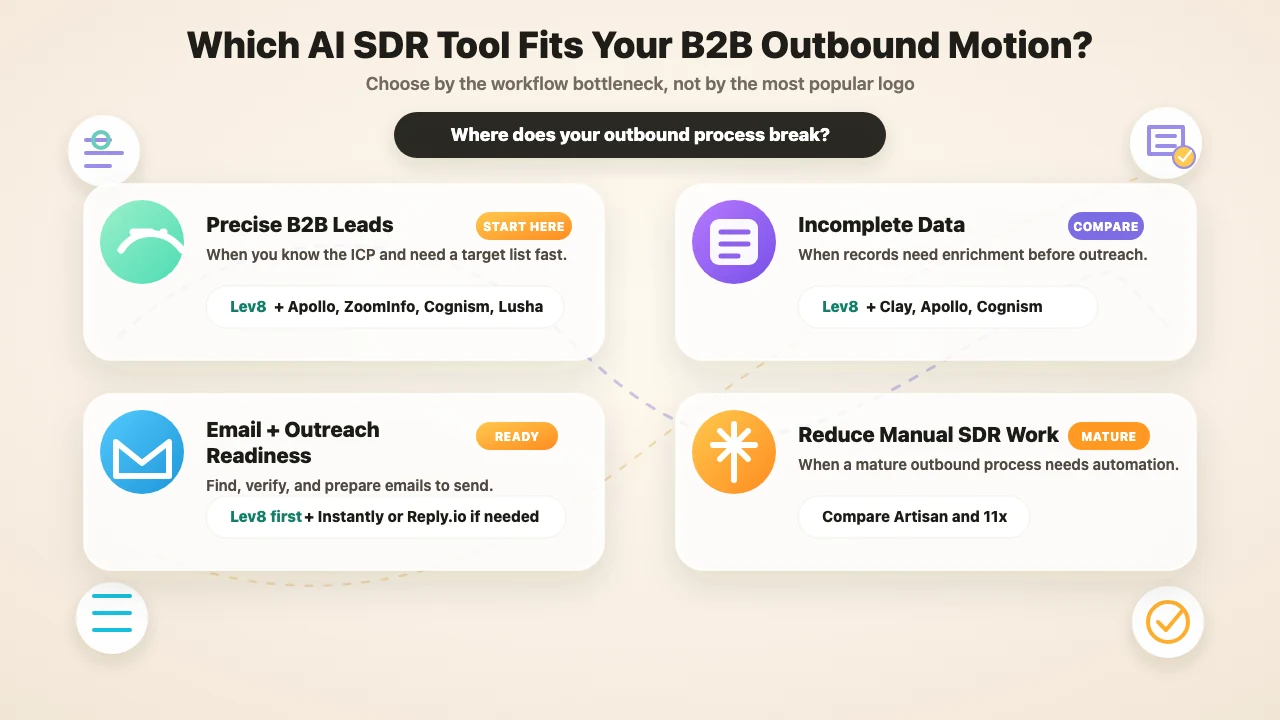
Figure 1. Which AI SDR Tool Fits Your B2B Outbound Motion? Choose by the workflow bottleneck, not by the most popular logo.