



Apollo is a useful starting point for contact discovery and outbound execution. But many B2B teams searching for Apollo alternatives are not simply looking for another lead database.
They are trying to solve a prospecting bottleneck: pricing that is hard to forecast, contact data that is not trusted enough, workflows that still require too much manual research, or outreach that lacks timing and context.
This guide is written for B2B sales and GTM teams that need qualified meetings, not just larger contact lists.
Core thesis: The best Apollo alternative depends on where your prospecting motion breaks down. Some teams need better contact data. Others need cleaner enrichment, stronger follow-through, better prioritization, or a signal-based way to turn ICP-fit prospects into timely outreach.

The best Apollo alternative depends on what your team actually needs to fix: data, workflow, timing, prioritization, or outreach context.
Quick Answer: Which Apollo Alternative Fits Your Use Case?
Start with the job your team needs the tool to do. Apollo alternatives are not one category; they solve different parts of the prospecting motion.
Apollo Alternatives by Use Case
| If your team needs... | Compare first | Why |
|---|---|---|
| Enterprise GTM data | ZoomInfo | Broader sales intelligence and data infrastructure. |
| Compliant B2B data / EMEA coverage | Cognism | Useful when verified mobile data, compliance, and regional coverage matter. |
| Fast contact lookup | Lusha / Seamless.ai | Lightweight contact reveal workflows for emails and phone numbers. |
| Custom enrichment workflows | Clay | Best when RevOps or growth teams can build and maintain workflows. |
| Sales engagement execution | Outreach / Salesloft | Strong once the target list is clear and follow-up needs governance. |
| CRM-first sales workflow | HubSpot Sales Hub | Best when pipeline, automation, and rep workflow are the main problem. |
| First-party signal activation | Common Room | Useful for PLG, community-led, or ecosystem-led teams with owned signals. |
| Signal-based prospecting | Lev8 | Designed for ICP fit, live signals, account context, and outreach-ready reasoning. |
01. Why Teams Start Looking for Apollo Alternatives
Most teams do not start comparing Apollo alternatives because Apollo is unusable. They start comparing alternatives when the question changes from "Can we find contacts?" to "Can we trust this list, prioritize it, and turn it into relevant conversations?"
A sales team may already have thousands of names. The harder question is whether those names are accurate, current, prioritized, and tied to a reason to reach out now.
- Data confidence: bad emails, outdated titles, and weak phone coverage create wasted SDR activity. If this is your main issue, start with a contact verification checklist.
- Pricing and credits: contact credits, phone reveals, enrichment, exports, and seats can change the real cost of a workflow.
- Manual research: reps still jump between LinkedIn, company websites, CRM notes, job posts, and news before writing outreach.
- Weak prioritization: a large list does not tell reps which accounts deserve attention first.
- Generic outreach: contact data does not automatically create a relevant opening message.
The strongest Apollo alternative is not always the tool with the biggest database. It is a tool that removes the bottleneck between contact data and qualified conversations.
02. Diagnose the Bottleneck Before Replacing the Tool
The most useful way to compare Apollo alternatives is to identify where prospecting breaks. Is the team struggling to trust the data, follow up consistently, or decide who matters now and why?
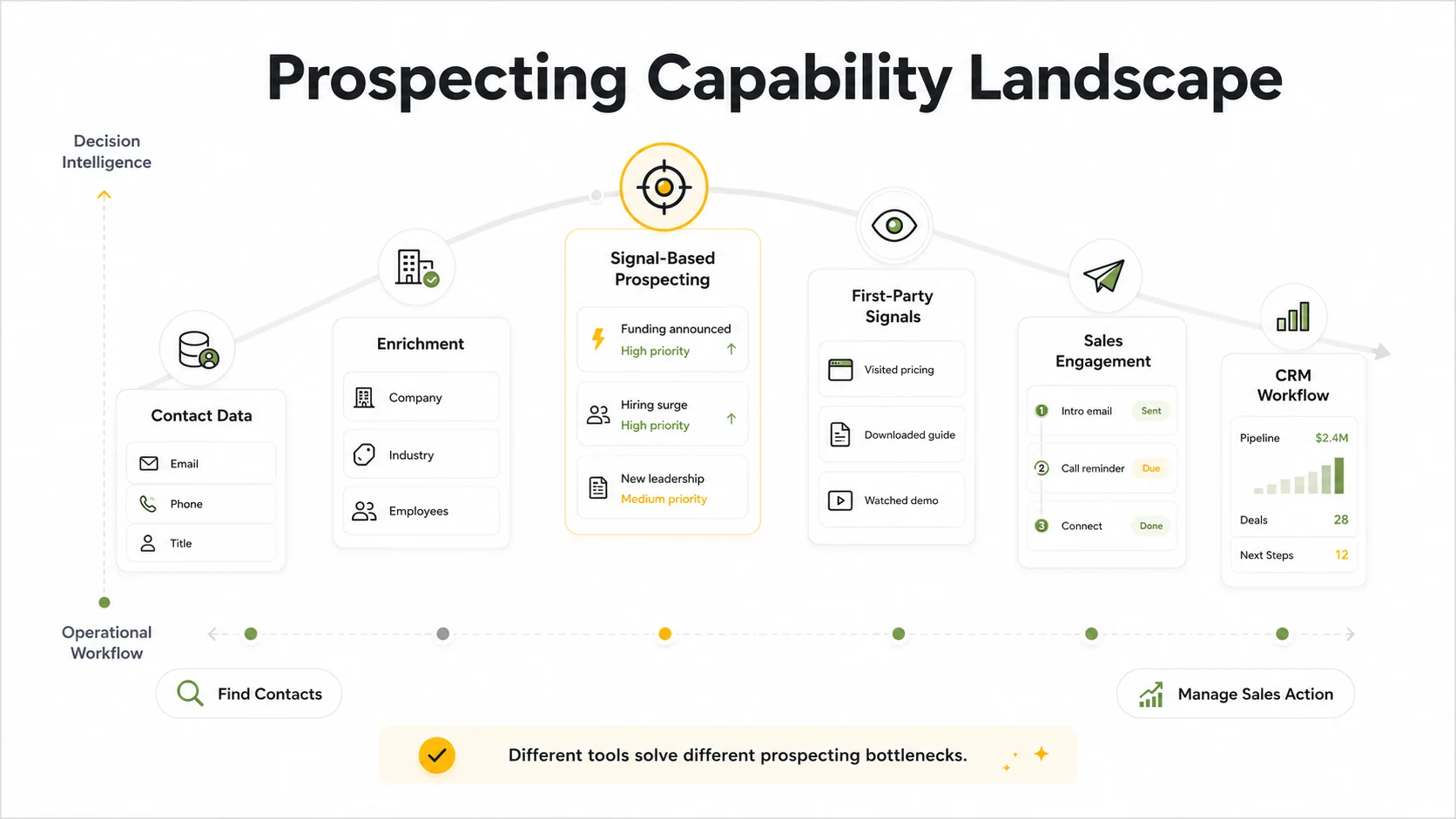
Diagnose the bottleneck before replacing the tool. Some teams have a data problem; others have an execution or decision problem.
These three layers create different buying decisions:
- Data confidence: the team needs cleaner contacts, better emails, verified mobile numbers, or stronger regional coverage.
- Execution discipline: the team knows whom to contact but needs better sequences, CRM workflow, follow-up governance, and rep consistency.
- Decision intelligence: the team has names but does not know which accounts are worth acting on now, or what message angle should lead the conversation.
This is why replacing Apollo feature by feature often creates confusion. A contact data tool, a sales engagement platform, and a signal-based prospecting layer solve different problems.
03. Apollo Alternatives Are Different Layers, Not One Category
An Apollo alternative search gets crowded because the tools sit across different parts of the GTM workflow. Some help teams find names. Some enrich records. Some run outbound. Some activate first-party signals. Some help decide which accounts deserve attention now.
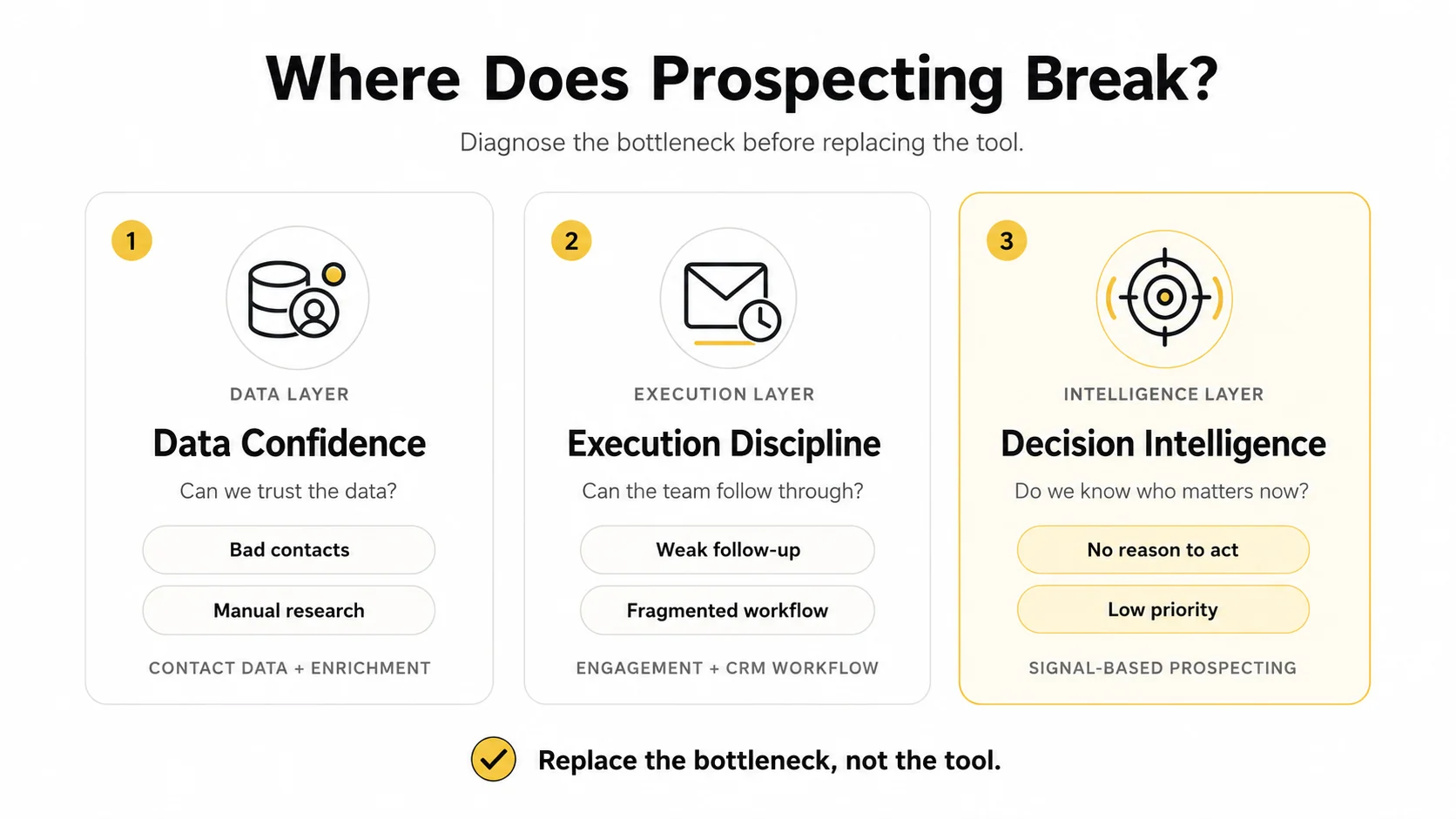
Different tools solve different prospecting bottlenecks. Compare the layer you need to replace, not only the logos on a list.
- Database-first sales intelligence: ZoomInfo, Cognism, Lusha, Seamless.ai, and Sales Navigator help teams access or verify contact and company data.
- Workflow-first enrichment: Clay helps teams build enrichment, waterfall, and AI research workflows.
- Sales engagement execution: Outreach and Salesloft help teams run sequences, follow-up, governance, and rep workflows.
- CRM-first workflow: HubSpot Sales Hub is stronger when the team needs CRM structure, pipeline visibility, automation, and reporting.
- First-party signal activation: Common Room is relevant when product, community, customer, or ecosystem signals already exist.
- Signal-based AI prospecting: Lev8 is relevant when the team needs ICP fit, live external signals, enrichment, and account context before outreach.
04. What to Compare Before Choosing an Apollo Alternative
Before choosing a replacement, compare the capabilities that determine whether the tool will actually improve prospecting, not only whether it has a familiar feature list.
Data confidence
Can reps trust the email, phone, company, and role data? If the first problem is contact accuracy, start with data providers before evaluating heavier workflow tools.
Enrichment depth
Does the tool add company, role, market, hiring, tech stack, funding, or other context layers? A basic contact record is rarely enough for targeted outbound. For a deeper view of enrichment tradeoffs, see the guide to waterfall enrichment workflows.
Account prioritization
Does the tool help reps decide which accounts matter first? A large list is not useful if every account looks equally important.
Outreach context
More emails do not automatically create more meetings. The lift usually comes from ICP fit, buying window, signal strength, message relevance, and contact priority. This is where buying signals and real-time intent data start to matter.
Workflow fit
Can the team operate the tool without creating more cleanup work? The best tool is not always the most powerful one; it is the one the team can actually run.
05. Best Apollo Alternatives by Use Case
The following tools are not ranked as one-to-one replacements. Each one fits a different prospecting bottleneck.
ZoomInfo
Best when Apollo feels too light as a shared GTM data infrastructure layer. ZoomInfo is usually evaluated by larger teams that need broad sales intelligence, data governance, enrichment, intent, and integrations. It is not the obvious choice if the only problem is finding a cheaper contact lookup tool.
Cognism
Best for teams selling into Europe, the UK, or privacy-sensitive markets where compliant prospecting and verified mobile data matter. Cognism is more focused than Apollo in some data-confidence scenarios, but most teams still need a separate outbound execution layer.
Lusha / Seamless.ai
Best for fast contact lookup. These tools are useful when the main job is to reveal emails or phone numbers quickly. They are easier to test than enterprise data platforms, but they do not solve account prioritization or outreach relevance on their own.
Clay
Best for RevOps, growth, or technical GTM teams that want custom enrichment workflows. Clay is powerful when someone can design and maintain the workflow. It is less ideal when sales reps need a simple out-of-the-box Apollo replacement.
Outreach / Salesloft
Best when the target list is already clear and the team needs better sequencing, follow-up, coaching, governance, and sales execution. These tools are execution layers, not net-new prospecting databases.
HubSpot Sales Hub
Best for CRM-first teams that need pipeline structure, sales workflow, automation, and reporting. HubSpot is not an Apollo-style contact database, but it can be a better fit when the real bottleneck is operational visibility and CRM discipline.
Common Room
Best for PLG, community-led, partner-led, or ecosystem-led teams with owned signals. Common Room is strongest when the team already has product usage, community activity, customer signals, or ecosystem engagement to activate.
Lev8
Best when the team needs more than names. Lev8 fits teams that want to define an ICP, discover relevant prospects, enrich account context, detect live signals, and turn that context into outreach-ready reasoning. It should be evaluated as a signal-based prospecting layer, not as the biggest static database.
06. Pricing: What Are You Actually Paying For?
Pricing is one of the biggest reasons teams compare Apollo alternatives, but the monthly plan price rarely tells the full story. Different tools charge for different units of value: contact credits, phone reveals, enrichment, workflow actions, seats, platform access, AI research, or signal intelligence.
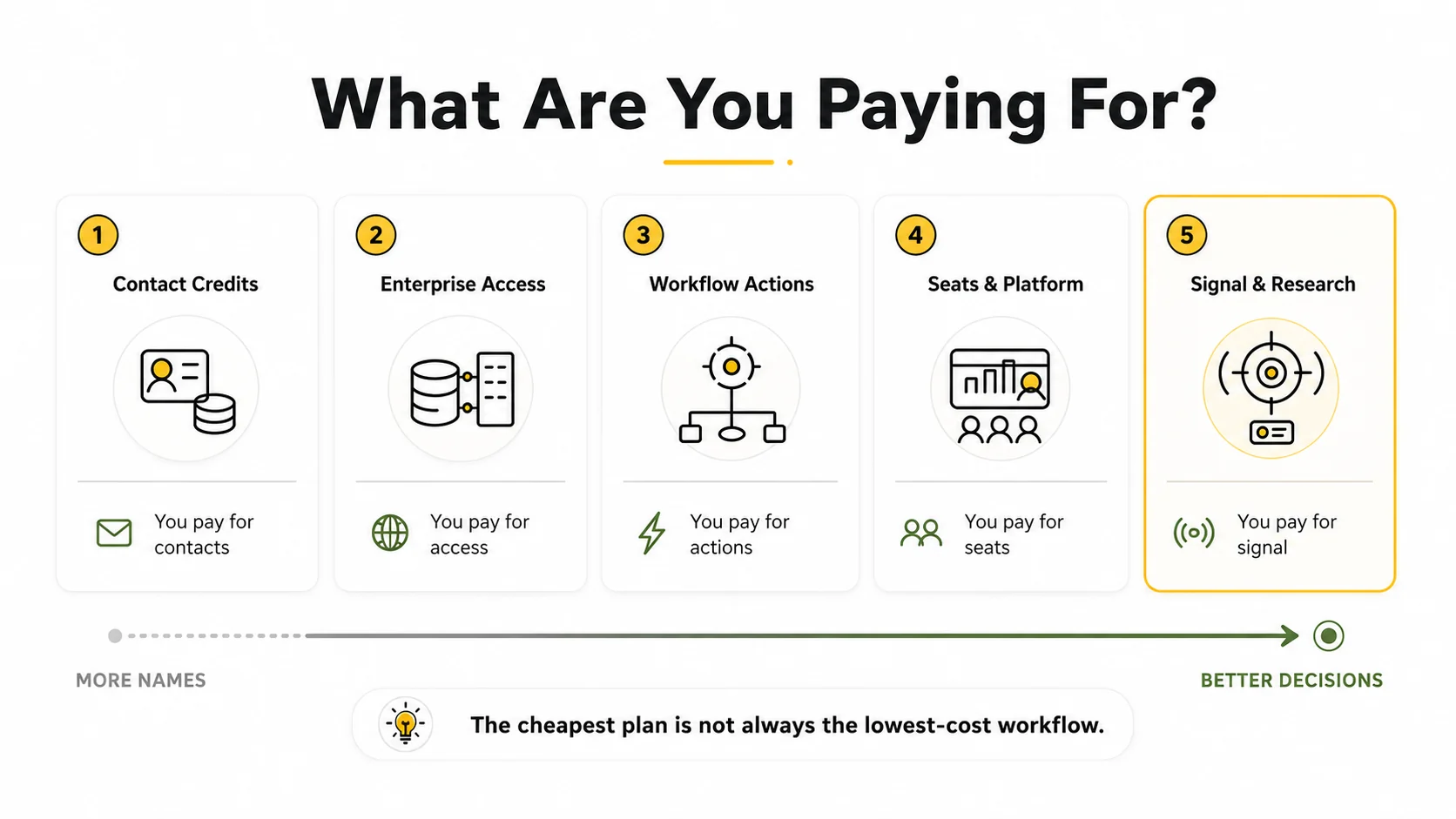
The cheapest plan is not always the lowest-cost workflow. Compare what the team is paying for: more names, broader access, workflow actions, seats, or better decisions.
The real comparison is not simply "Which tool is cheaper?" It is whether the tool lowers the cost of getting to a qualified opportunity.
Pricing Comparison: Starting Prices and Pricing Models
Pricing checked July 2026. Public SaaS pricing changes often, so confirm details on each vendor pricing page before buying.
Apollo
Free plan. Public paid-plan naming and credit rules may vary by account.
Seat + credits + exports
Database search and outbound workflow in one platform.
Lev8
Free $0 with 300 credits/mo. Starter $49/mo. Pro $199/mo. Scale $499/mo.
Credits + AI GTM workflow
ICP search, live signals, enrichment, and outreach-ready context.
Clay
Free plan. Launch from $167/mo annual or $185/mo monthly-style pricing. Growth from $446/mo annual or $495/mo monthly-style pricing.
Data credits + actions
Custom enrichment and research workflows run by RevOps or growth teams.
UpLead
Free trial. Essentials $99/mo. Plus $199/mo. Annual billing may lower monthly equivalent.
Contact credits
Verified contact data and direct dials.
Lead411
Free trial. Spark $49/mo or $490/year. Ignite starts at $150/mo.
Exports / plan tiers
Budget-conscious teams needing contact data and intent-style filters.
Lusha
Free plan up to 40 credits/mo. Paid tiers are credit-based.
Email reveal = 1 credit; phone reveal = 5 credits
Lightweight contact reveal workflows.
LinkedIn Sales Navigator
Core starts at $119.99/mo/license. Advanced starts at $159.99/mo/license.
Per license
LinkedIn-based prospecting, relationship paths, and account research.
Common Room
Essential $2,500/mo billed annually. Advanced and Enterprise custom.
Seats + contacts + research credits
PLG, community-led, and ecosystem-led teams with first-party signals.
HubSpot Sales Hub
Free plan available. Paid Sales Hub / Revenue Hub tiers vary by billing term and package.
Seat + CRM package + credits
CRM-first sales workflow rather than Apollo-like contact discovery.
ZoomInfo
Custom pricing.
Seats, data access, modules, intent, integrations
Larger GTM teams needing enterprise sales intelligence.
Cognism
Custom pricing.
Credits to reveal, enrich, or export contacts
EMEA, compliance-sensitive, and phone-data-heavy prospecting teams.
Outreach
Request pricing.
Request pricing / custom quote
Sales engagement for mature teams with existing target lists.
Salesloft
Request pricing.
Custom package / sales engagement suite
Structured teams needing execution discipline.
Pricing note: The lowest monthly plan is not always the lowest-cost workflow. If reps still need manual cleanup, additional enrichment, separate sequencing, or extra research tools, the real cost moves beyond the subscription price.
07. How to Choose the Right Apollo Alternative
Use these questions before booking demos or comparing pricing pages:
- Do we need more contacts, or better-qualified opportunities?
- Are we paying for emails, phone numbers, enrichment, exports, workflow actions, seats, or better decisions?
- Do reps still need to manually research accounts before writing outreach?
- Are we trying to improve volume, timing, relevance, or conversion?
- Can the tool help us prioritize based on ICP fit, buying window, signal strength, message relevance, and contact priority?
Lead volume gives teams more names. ICP fit and timing get teams closer to real sales conversations.
Final Takeaway: Replace the Bottleneck, Not the Tool
Apollo can still be a strong fit when the team needs contact discovery, list building, and outbound execution in one platform. But when teams start looking for alternatives, the root cause is often more specific.
Some teams need better data. Some need cleaner enrichment. Some need stronger sales engagement. Some need CRM structure. Some need first-party signal activation. And some need a better way to decide which ICP-fit accounts are worth acting on right now.
The right Apollo alternative is the one that removes the bottleneck between raw contact data and qualified sales conversations.
Need More Than a Static Contact List?
If your team already has contacts but still struggles to decide which accounts are worth prioritizing, you may not need another database. You may need better timing, account context, and a clearer reason to reach out.
Lev8 helps GTM teams use ICP criteria, external signals, enrichment, and account context to find prospects that are relevant now - not just names that match a filter.